When you hear about a Crown land sale in Ontario, it's easy to picture buying a pristine slice of the Canadian Shield. But it's not quite like buying a typical piece of real estate. This is the formal process of the provincial government transferring public land into private hands—a permanent change that is rare, tightly controlled, and usually reserved for properties no longer serving a public purpose.
What a Crown Land Sale in Ontario Really Means
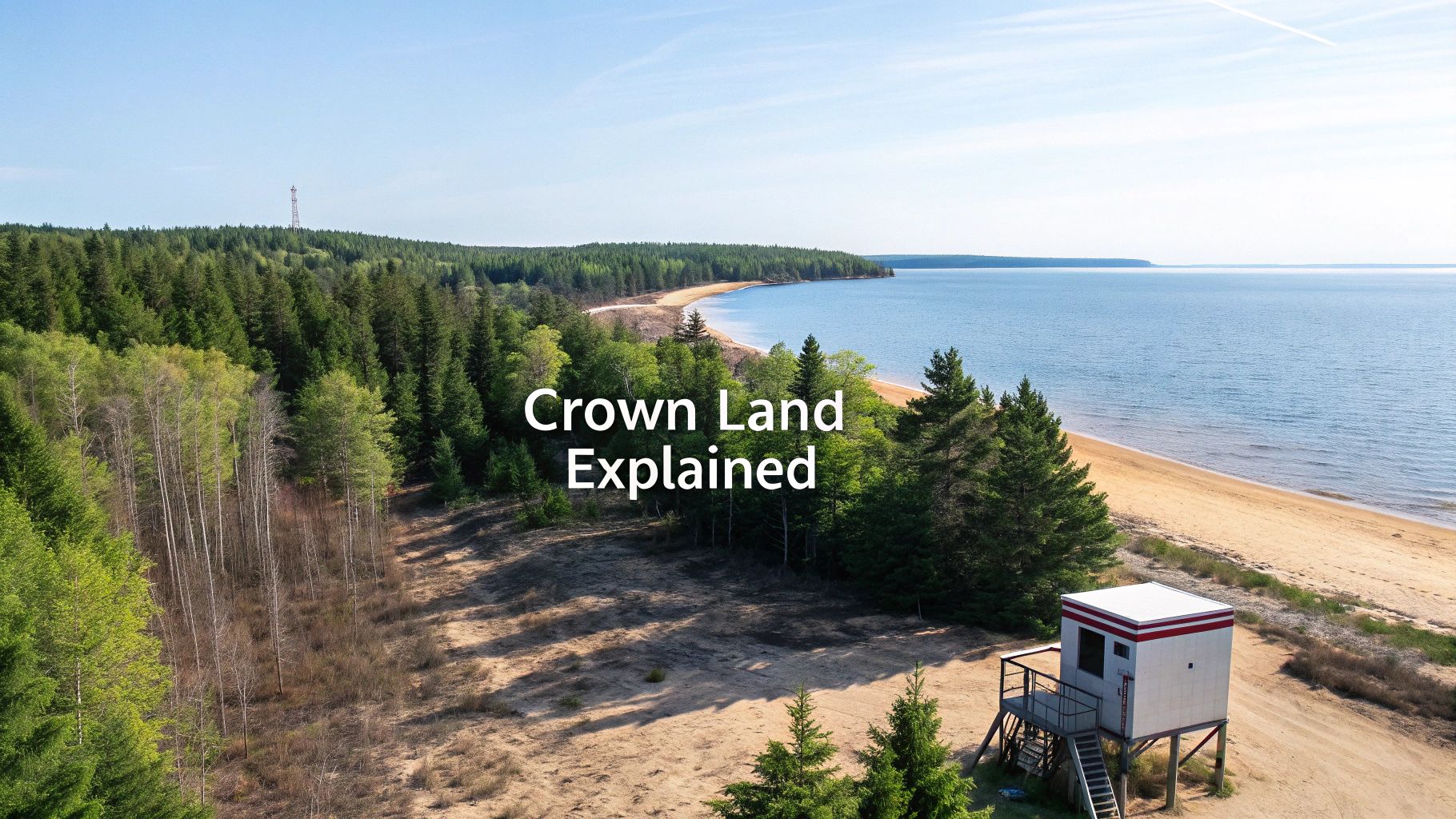
The dream of owning a piece of untouched wilderness is powerful, but the reality is much more intricate. A crown land sale in Ontario isn't just a transaction; it's a fundamental shift from public stewardship to private ownership. It forever alters how that specific piece of land can be used and who gets to access it.
Crown land makes up an incredible 87% of Ontario's total landmass. It's all managed by the Ministry of Natural Resources and Forestry (MNRF). Think of it as our collective backyard—a massive shared resource for everything from recreation and conservation to economic activity. When a parcel of it is sold, it’s removed from this public trust for good.
From Public Access to Private Property
The biggest change to wrap your head around is the transfer of rights. Most public Crown land is open for activities like hunting, fishing, and hiking, all guided by provincial rules. The moment it's sold, it becomes private property.
A Crown land sale extinguishes general public access rights. The new owner gains the authority to control entry, build structures (within zoning laws), and manage the land as they see fit, forever altering its status for hunters and outdoor enthusiasts.
This is exactly why the process is so strict. The MNRF doesn't just put pristine wilderness on the market. Sales are typically limited to surplus properties—parcels that the government has determined are no longer needed for a public function. This could be a small, isolated piece of land or a property flagged for a specific economic development initiative.
The Historical Context of Land Sales
The patchwork of private and public land we see in Ontario today was carved out by history. Way back in 1827, the British Crown sold 2.4 million acres to the Canada Company, a massive private deal that kicked off settlement across what we now call Southern Ontario. This one event helps explain why so much of what was once Crown land is now in private hands. You can explore more about these historical land grants and sales to get a sense of their impact.
Understanding this history is critical for any outdoorsperson. The line between public and private land is absolute, and getting it wrong can lead to serious trouble. That’s why modern mapping tools are so indispensable. Using a platform like HuntScout, you can overlay Crown land data and WMU boundaries on a map. It gives you the confidence to know exactly where you stand—whether you’re scouting a potential purchase or just planning your next hunt.
When you hear about Crown land becoming available in Ontario, it's rarely a simple "For Sale" sign situation. In fact, a direct purchase is often the least common way to go. The official term you'll run into is disposition, which is just the government's catch-all phrase for any process that grants someone rights to use or own a piece of Crown land.
Think of it like getting access to a car. A direct sale is like buying the car outright—you get the title, and it's all yours. A lease is more like a long-term rental; you get exclusive use for a set period, but you never actually own it. A licence? That's like borrowing the car for a specific, short-term task. Each one serves a very different purpose, and knowing the difference is key for anyone interested in a crown land sale ontario.
Direct Sales: The Path to Ownership
A direct sale, also called a grant or patent, is the only way to truly own a piece of Crown land. This is the big one. The process transfers ownership from the Crown to you (or your company), creating what’s known as a freehold title.
Once that land is sold, it's officially off the public books. The new owner controls who comes and goes and can use the property according to local bylaws, just like any other private parcel. But don't get your hopes up too high—these sales are quite rare. They're usually reserved for parcels of surplus land that the government has decided no longer serve a public purpose.
Leases: Long-Term Rights Without the Title
A Crown land lease is a much more common arrangement. It grants an individual or a business the exclusive right to use a piece of land for a specific purpose over a fixed term. Think remote cottages, fishing lodges, or other tourism operations. Lessees pay an annual rent to the Crown and have to play by the rules laid out in their lease agreement.
While a lease gives you secure, long-term tenure—often for 10 to 20 years with renewal options—it’s crucial to remember that you don't own the land. It remains public property, and your rights are strictly defined. A lease for a hunt camp, for instance, doesn't suddenly give you the right to start a logging operation.
A lease gives you exclusive use for a defined period, but the Crown always retains ultimate ownership. Selling the lease or making major changes to the land requires ministry approval, as you are stewarding public land.
This distinction is a big deal. You can't just sell the land itself. You can only transfer your lease to another eligible person, and even that process has to be approved by the Ministry of Natural Resources and Forestry (MNRF). Any improvements you make, like building a cabin, become part of the leased land and are subject to the agreement's terms.
Licences of Occupation: Temporary and Task-Specific
The most temporary arrangement is a Licence of Occupation, sometimes known as a Land Use Permit. This simply grants you permission to use Crown land for a specific, short-term purpose. We're talking about things like setting up a temporary work camp, needing access to a remote site, or holding a small-scale commercial event.
These licences aren't exclusive, meaning other people can still use the area, and they don’t grant you any real tenure. They’re basically a permission slip from the government, usually good for a year or less.
To help you see the differences at a glance, we've put together a quick comparison of the main disposition types.
Crown Land Disposition Types Compared
| Disposition Type | Ownership Rights | Typical Duration | Common Use Cases | Key Consideration |
|---|---|---|---|---|
| Direct Sale | Full Private Ownership (Freehold) | Permanent | Surplus residential lots, industrial land, additions to existing farms. | The only path to true ownership, but opportunities are very limited. |
| Lease | Exclusive Use Rights (Not Ownership) | 10-20 Years (Renewable) | Remote cottages, tourist outfitter camps, commercial operations. | Provides long-term security of use without the cost of purchase. |
| Licence of Occupation | Temporary Use Rights (Non-Exclusive) | 1 Year or Less | Temporary work camps, site access, small-scale commercial events. | A permit for a specific activity, not a right to the land itself. |
Understanding which path you're on is the first real step. If you're dreaming of permanent ownership and the freedom to build and manage your own private slice of Ontario, only a direct crown land sale ontario will get you there. For most other uses, a lease or licence will be the route to follow.
How to Find Crown Land for Sale or Lease
Finding a parcel of Crown land for sale in Ontario isn't like scrolling through listings on your local real estate site. These opportunities are few and far between, and you have to know exactly where to look. The only real starting point is the official channels managed by the Ministry of Natural Resources and Forestry (MNRF).
The most direct place to check is the Government of Ontario's official web page for Crown land dispositions. Think of it as the main bulletin board for any surplus properties the province decides to offer to the public. These listings can be sporadic, so checking in regularly is key.
This diagram gives you a quick visual breakdown of the different ways the government grants tenure on Crown land.
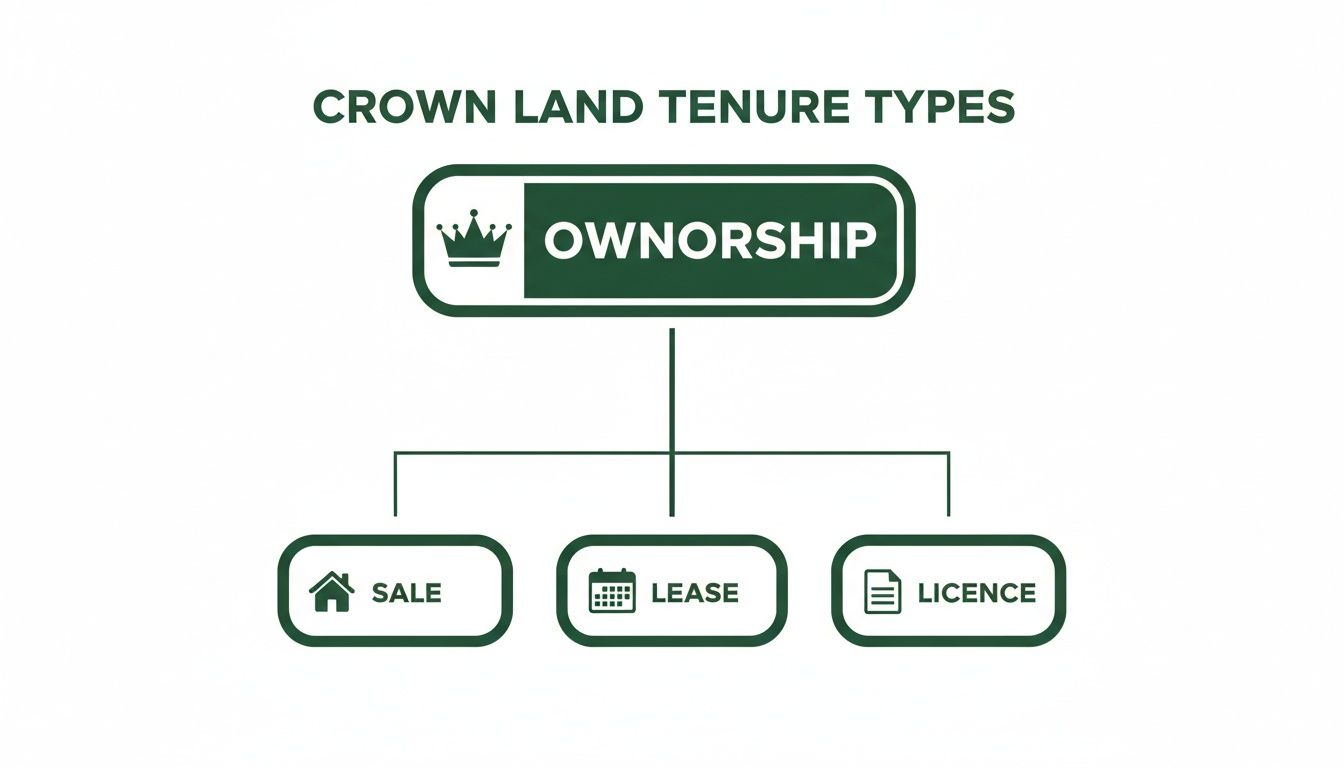
As you can see, a direct sale is just one of the three main paths. Each comes with a very different level of commitment and rights.
Using Official Government Portals
Your search really boils down to two key government tools. Getting comfortable with them is the first step to finding a legitimate listing and avoiding any dead ends.
- MNRF Crown Land Dispositions Site: This is the official marketplace. It lists the details on available parcels, including location, size, and how it's being sold (e.g., public tender, direct sale). The listings usually come with property info sheets that have the legal descriptions and basic maps.
- Ontario Public Lands Registry: This is a more advanced tool, best used for doing your homework. Once you’ve zeroed in on a property, you can search this registry to dig into existing patents, leases, and licences on that specific piece of Crown land.
Patience is your best friend when using these sites. New properties can pop up without much fanfare, so you need to be diligent. When one does get listed, pay very close attention to the deadlines and application rules—they are always rigid.
Beyond the Provincial Listings
While the MNRF site is the main hub, it isn't the only place an opportunity might appear. Sometimes, other levels of government get involved.
- Municipal Surplus Land Sales: From time to time, municipalities sell off surplus land they own. While it’s not technically Crown land at that point, some of these parcels might have started as Crown grants and can be unique finds.
- Realty Services: For certain high-value or complicated properties, the province might hire third-party realty services to manage the sale. These are almost always announced on the main dispositions page, so you won't miss them if you're watching that source.
The single most important step after you find a potential parcel is what we call ground-truthing. A property description tells you what you're buying on paper; a satellite map and an in-person visit tell you what you're actually getting.
Cross-Referencing with Modern Mapping Tools
Finding a listing is really just step one. A legal description on a government website doesn't tell you anything about the land’s character, how to get to it, or what’s around it. This is where a modern tool like HuntScout becomes absolutely essential.
Once you have a potential parcel's location, you can drop a pin on HuntScout's interactive map and do some critical virtual scouting.
- Assess Accessibility: Is there a road in, or is it landlocked? Use the satellite and topographic layers to see if any roads or trails actually lead to the property. A parcel with no legal access is a classic and very expensive mistake.
- Analyze the Terrain: What are you really looking at? Is it a swamp, a sheer rock face, or the perfect patch of woods? High-resolution imagery gives you a clear picture of the landscape before you waste a trip.
- Check Hunting Regulations: By overlaying the Wildlife Management Unit (WMU) boundaries, you can instantly see the specific hunting regulations for that exact spot. If you're buying land for hunting, knowing the local seasons, tags, and rules isn't just a good idea—it's non-negotiable. You can learn more about how to navigate Ontario's WMU maps to stay compliant.
This two-pronged approach—using official government portals to find the opportunities and a powerful mapping app to verify their real-world value—is the smartest way to tackle a crown land sale in Ontario. It helps you get past the paperwork and understand the true potential of what you might be buying.
Navigating the Crown Land Purchase Process
So, you've got your eye on a piece of Crown land. Buying it isn't like picking up a cottage lot from a realtor. It’s a formal, multi-stage journey that’s heavy on process and light on speed. Think of it less like a transaction and more like an expedition. Understanding the map before you start can save you a world of frustration.
This isn’t a quick sale. The entire system is built to protect the public’s interest before any land moves into private hands for good. Every step, from your first inquiry to the final signature, is deliberate. Patience isn't just a virtue here; it's a requirement.
The Initial Inquiry and Application
It all starts when you formally express interest in a property that's been declared surplus. This is more than a casual email—you'll need to submit a detailed application to the Ministry of Natural Resources and Forestry (MNRF). They'll want to know who you are and, just as importantly, what your plans are for the land.
Consider this step one: the gatekeeper. The MNRF uses your application to screen for basic eligibility and ensure your proposal doesn't clash with provincial policies. They’re making sure your request is solid before they dedicate significant government time and resources to a full-blown review.
The MNRF Review and Due Diligence
Once your application is in the system, the real heavy lifting begins on the ministry's side. This is easily the longest part of the whole affair. The government dives deep, conducting comprehensive due diligence that goes way beyond just the land's monetary value. They’re looking at its environmental, social, and historical significance.
Here’s a glimpse of what’s happening behind the scenes:
- Environmental Assessments: Experts comb over the details, checking for sensitive wetlands, habitats for endangered species, or other significant natural features. The goal is to make sure the sale won’t trigger any unintended ecological damage.
- Aboriginal Consultation: This is a big one. The Crown has a constitutional duty to consult with Indigenous communities whose Aboriginal or treaty rights could be impacted by the sale. It’s a mandatory, and often lengthy, part of the process.
- Circulation to Other Agencies: Your application gets passed around to other government ministries and public bodies. They’re checking to see if the land is needed for another public purpose, like a future park, conservation area, or highway.
This careful approach is rooted in history. Early 20th-century records from Statistics Canada show Ontario had already disposed of a massive 412,582 square miles of Crown land, with 68,490 square miles sold off. That represented 10.7% of Canada's entire public domain at the time. This history of large-scale land transfers is exactly why today's process is so rigorous. You can discover more about Canada's historical public lands data to really grasp the scale.
The MNRF's review process can often take a year or longer. The complexity of environmental screenings and the constitutional requirement for thorough Aboriginal consultation mean that timelines are often extended.
Negotiation and Final Agreement
If the property makes it through all the checks and balances, you finally move into the negotiation phase. The price isn't pulled out of thin air; it's determined by a formal appraisal to establish fair market value. The MNRF is legally required to get a fair price for a public asset.
At this stage, you'll hammer out the final terms of the sale with the ministry. Everything gets documented in a formal Agreement of Purchase and Sale, which covers the price, closing date, and any special conditions or reservations tied to the title—things like public shoreline access or utility easements. For more in-depth guides, you can explore other articles on our HuntScout blog.
Closing and Title Transfer
The last step feels the most familiar: the closing. It’s handled by lawyers on both sides, much like any standard real estate deal. Once all the conditions are met and the money has changed hands, the Crown issues a patent or grant. This is the official document that formally transfers ownership from the public to you.
That patent is registered, and just like that, you are the legal, titled owner. The land is now yours to manage according to local bylaws and any of those reservations noted in the sale. The long journey is over, and a piece of Ontario’s public domain has officially become private property.
Who Can Buy Crown Land? Eligibility and What You Need to Know
Thinking about buying a piece of Crown land? It's an exciting idea, but it's not as simple as just having the money ready. The government has specific rules about who can even apply, and every single parcel comes with its own unique set of strings attached. This is the reality check every potential buyer needs before they get their hopes up.
First things first, let's cover the basics. To even get your foot in the door, you have to meet a few non-negotiable requirements.
Generally, you must:
- Be at least 18 years old.
- Be a Canadian citizen or a permanent resident.
- If you're applying as a business, the corporation has to be legally allowed to own land in Ontario.
Meeting these criteria is just the first step. The real homework begins when you dig into the conditions and reservations that will define what you can—and can't—do with the land, forever.
Understanding the Fine Print: Land Use Restrictions
When you buy Crown land, you don't get a blank canvas. The property is still woven into a larger tapestry of regulations and pre-existing rights that, as the new owner, you are legally bound to respect. Overlooking these can lead to some serious headaches and unexpected bills down the line.
One of the most common surprises for buyers is the shoreline reservation. In almost all sales of waterfront property, the Crown holds back a 66-foot (20-metre) strip of land right along the water's edge. This area remains public land to ensure everyone can still travel the shoreline, for activities like portaging, for example. You might own the land behind this strip, but you won't own the actual waterfront.
And that's not all. Other rights can also impact the property:
- Existing Access: Is there a trail, portage, or old road crossing the land? It might be a protected right-of-way, meaning the public or specific neighbours have the legal right to keep using it.
- Utility Easements: Power lines, communication cables, or pipelines might run through the property. The utility companies will have a registered right to access their infrastructure for maintenance.
- Zoning Rules: Once the land becomes private, it falls under the local municipality's rules. These zoning bylaws will control everything from whether you can build a cottage to the type of septic system you'll need to install.
The Duty to Consult and a History of Complex Claims
A crucial part of any Crown land sale is the government's duty to consult with Indigenous communities. This is a constitutional requirement for any action, including a land sale, that could affect Aboriginal or treaty rights. This process is mandatory for every single sale and can add a significant amount of time to the whole transaction.
Ontario's history of land ownership is long and tangled. Between 1787 and 1996, hundreds of thousands of Crown land parcels were sold or granted. This created a complicated legacy of overlapping claims and disputes—so much so that special commissions were set up as early as 1797 just to sort it all out. This history of Ontario's complex land claims really puts into perspective why doing your homework today is so important.
A Word of Caution: One of the biggest mistakes people make is underestimating the hidden costs. The purchase price is just the starting point. You'll also be on the hook for expensive land surveys, legal fees, and potentially the cost of building an access road if one doesn't legally exist. These "extras" can easily double your initial investment.
Using HuntScout to Master Ontario's Landscape
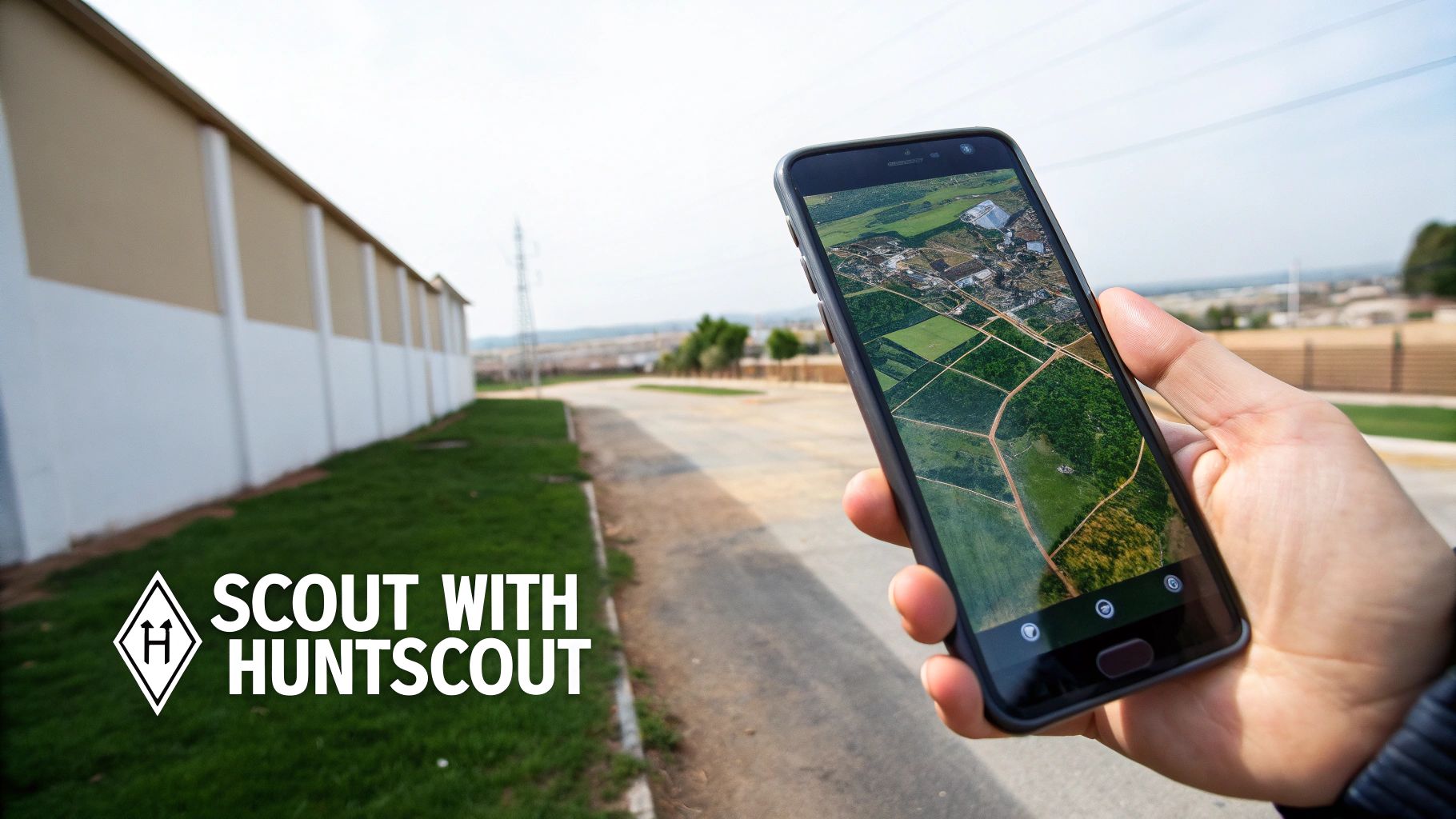
Whether you’re seriously looking into a crown land sale in Ontario or just planning your next hunt, truly understanding the landscape is everything. Paper maps and clunky government websites will only get you so far. To make smart decisions, you need on-the-ground intelligence, which is where a powerful mapping tool like HuntScout comes in.
Think of it this way: reading a property's legal description is one thing, but seeing it with your own eyes is another. HuntScout gives you that critical perspective, turning abstract data points into a clear, tangible picture of the land. It’s an essential piece of kit for both prospective buyers and serious hunters.
Distinguish Public from Private with Confidence
The first and most basic challenge is knowing exactly where you stand. HuntScout’s high-resolution Crown Land Maps are built for this very purpose, clearly showing the lines between public General Use Areas and private (patented) lands.
If you're scouting a potential purchase, this is non-negotiable. You can see the property's boundaries in relation to surrounding public lands, check for access points, or spot if a parcel is completely landlocked. For hunters, it simply means no more second-guessing. You’ll know you’re on the right side of the fence, every time.
A common and costly mistake is discovering a property has no legal access after the sale. Using modern mapping to verify roads, trails, and surrounding land status before you even think about applying is just smart due diligence.
Layer on Critical Hunting Data
Beyond just showing you who owns what, HuntScout overlays the essential information that truly brings the landscape to life. You can see instantly how a piece of land fits into the bigger picture of provincial hunting regulations.
- WMU Boundary Overlays: Just tap anywhere on the map to see which Wildlife Management Unit (WMU) you’re in. This immediately tells you the specific hunting seasons, tags, and rules for that exact spot.
- Custom Waypoints: Mark and save your own points of interest. Pin a promising treestand location, a potential building site on a property you're eyeing, or just the spot where you parked your truck. Over time, you’ll build a personal library of invaluable intel.
Go Where the Data Can't Follow
Let’s face it, many of Ontario’s best spots are in remote areas where cell service is a dream. This is where HuntScout’s offline mapping capability becomes a game-changer.
Before you head out, you can save detailed maps of your target area right to your device. This ensures you have full access to all your layers, waypoints, and property lines, no matter how far off the grid you venture. It makes you a safer, more effective, and self-reliant outdoorsman. For a complete rundown of what it can do, explore the HuntScout app and see how it can transform your planning.
Common Questions About Ontario Crown Land Sales
Getting into the details of a crown land sale in Ontario naturally brings up a lot of questions. Let's tackle some of the most common ones head-on to clear up any confusion and build on what you've learned so far.
Can I Build a Cabin on Crown Land I Buy?
The short answer is usually yes, but it's not a free-for-all. Once you own the land, you're no longer dealing with the Crown, but you are subject to the same rules as any other private landowner. This means you have to follow all provincial laws and, crucially, local municipal zoning bylaws.
These local rules are what will really dictate what, where, and how you can build. On top of that, the original purchase agreement from the Crown might include its own specific restrictions on how the land can be used. It is absolutely critical to do your homework on all building regulations before you sign on the dotted line.
Is Buying Crown Land Cheaper Than Private Land?
You might think so, but that’s not always the case. The Ministry of Natural Resources and Forestry (MNRF) is legally obligated to sell surplus Crown land at fair market value. They bring in professional appraisers to determine that value, so you're not likely to stumble upon a hidden bargain.
Remember to look beyond the sticker price. You'll need to budget for surveys, legal fees, and potentially significant costs for things we take for granted, like building an access road or bringing in utilities. When you add it all up, a Crown land parcel can easily cost just as much, if not more, than a comparable private lot.
Once Crown land is sold and becomes private property (patented), general public access rights are extinguished. It becomes private land with no public right of entry, unless specific easements are registered on the title.
Does the Public Still Have Access After a Sale?
No, once the sale is complete and the land is officially private property, the public’s right to access it is gone. The land is yours, and you control who comes and goes.
The only exception is if specific reservations or easements were included as part of the sale and registered on the title. For instance, an easement might be in place to protect a historic portage trail or to guarantee a forestry company can get to its timber. These would be clearly spelled out in the legal documents, but otherwise, access is entirely at your discretion.
How Long Does the Crown Land Sale Process Take?
Be prepared to play the long game. The entire process, from the first application to finally getting the keys, can easily take a year or even longer. This isn't your typical real estate deal.
Several things can slow the process down:
- The complexity of the property itself.
- The need for detailed environmental assessments.
- The requirement for consultations with Aboriginal communities.
- The ministry's own workload and internal priorities.
A crown land sale in Ontario is a marathon, not a sprint, and it demands a healthy dose of patience from any potential buyer.
Whether you're planning your next hunt or digging into a potential land purchase, you need the best information at your fingertips. HuntScout delivers detailed Crown land maps, WMU boundaries, and offline capabilities that give you a serious advantage in the field. Download the app and master Ontario's landscape today. Learn more at https://huntscout.app.