Alberta is prime elk country, plain and simple. It’s a place that delivers one of North America's premier hunting experiences, thanks to a massive land base and healthy, thriving elk herds. But getting into those animals means you first have to get a handle on how everything works here.
You’ve got to learn the ins and outs of the Wildlife Management Units, figure out the puzzle of Crown land access, and understand the difference between a general tag and a special draw. This guide is built to walk you through all of it.
Your Blueprint for a Successful Alberta Elk Hunt
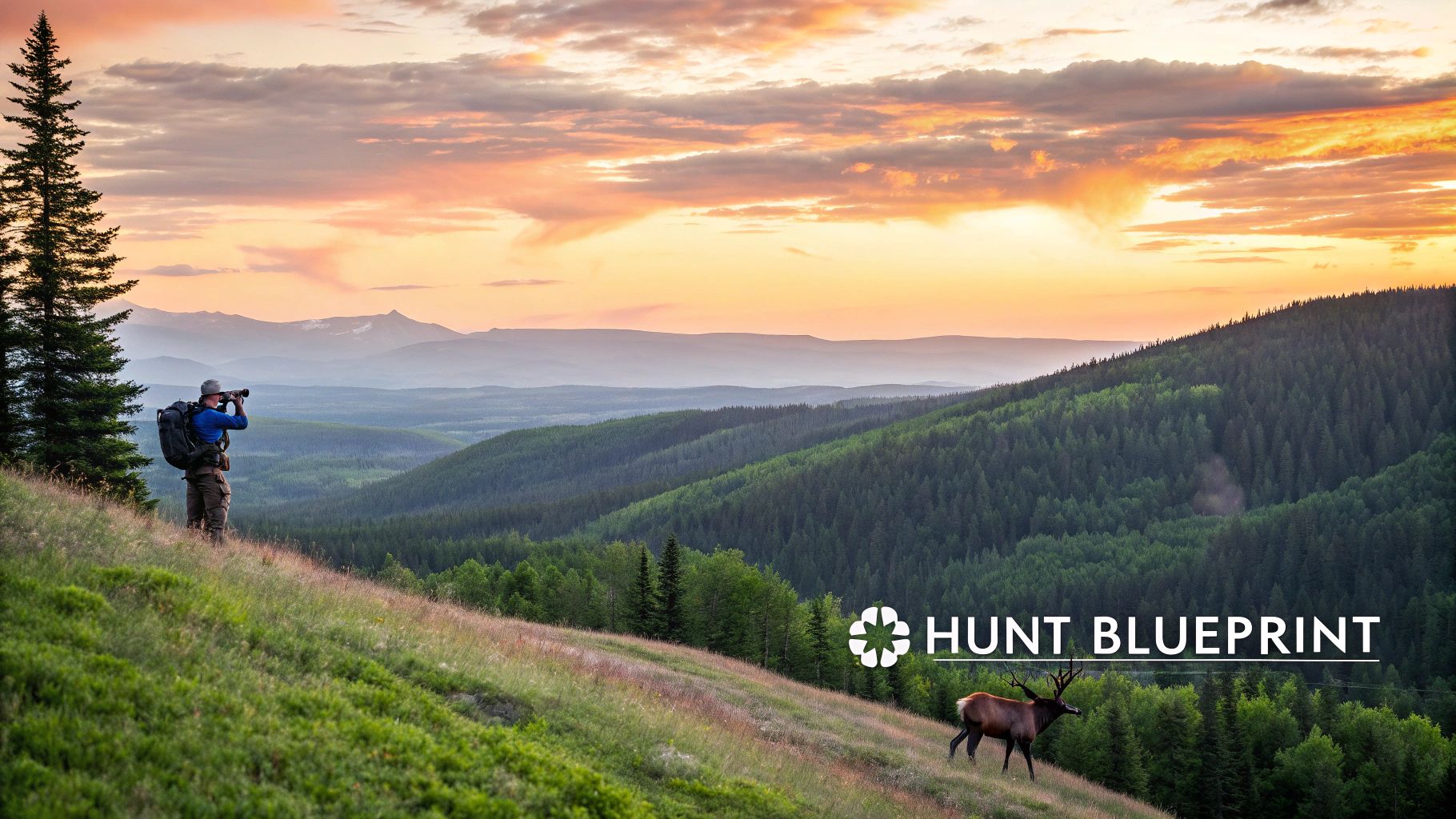
There's nothing quite like chasing elk across Alberta's varied terrain. It's a real adventure that tests your skill and your will, whether you're in the rugged Rocky Mountain foothills or the rolling parklands further east. It's a serious challenge, but the reward—the sound of a screaming bull echoing through the timber—is worth every ounce of effort.
Before you can get to that moment, though, you need a solid plan built on a real understanding of the system. That's exactly what we're here to do: give you the foundation you need to build a successful hunt from the ground up.
What This Guide Covers
Think of this as your field manual for planning and pulling off an ethical, memorable, and hopefully successful hunt. We’re cutting through the complexity to give you practical knowledge you can actually use. Here’s what we’ll get into:
- Regulations and Seasons: We'll break down Alberta’s Wildlife Management Unit (WMU) system and clarify the critical differences between buying a general season tag over the counter and applying for a special licence draw.
- Land Access: Finding a place to hunt is half the battle. We'll cover strategies for locating and legally accessing the huge tracts of Crown land that are the backbone of public hunting here. For a detailed primer, check out our guide on what Crown land in Canada is and how to use it.
- Scouting and Tactics: We’ll talk about proven methods for e-scouting from your computer and getting boots on the ground, plus hunting techniques that work in Alberta's unique landscapes.
- Essential Gear and Safety: You need the right gear and the right mindset. We'll give you a no-nonsense breakdown of essential equipment and crucial safety measures, especially bear awareness for anyone heading into the backcountry.
The secret is out. The number of hunters chasing elk in Alberta's general seasons has skyrocketed, nearly doubling from 17,045 in 1995 to 33,355 in 2020.
That surge in popularity tells you just how good the hunting can be. Even with more hunters in the field, the province's wildlife managers have done a solid job of keeping the opportunities sustainable. You can read the full research about Alberta's elk harvest trends for more details.
Decoding Alberta's Elk Seasons and WMUs
The first step to a successful elk hunt in Alberta is getting a handle on the province’s Wildlife Management Unit (WMU) system. The best way to think about it is like a giant puzzle map of the province. Each piece of the puzzle is a WMU, and every single one has its own specific set of rules, season dates, and tag requirements.
This system is how Alberta’s wildlife managers balance hunting pressure with local elk populations, keeping herds healthy from the southern prairies to the northern boreal forest. For us hunters, it means the rules in one WMU can be completely different from the unit right next door. Knowing where you are is everything.
General Season vs Special Licence Hunts
Alberta essentially offers two main paths for elk hunters, and your entire strategy will hinge on which one you choose. Grasping the difference is your first major decision.
General Season (Over-the-Counter Tags): These are your "walk-in" opportunities. For certain WMUs, you can simply buy a general elk licence online or at a vendor without going through a draw. It guarantees you a tag every year, but you'll often be sharing the woods with more hunters.
Special Licence (Draw Tags): These are the limited-entry hunts. They're for specific WMUs, often those known for bigger bulls, better odds, or just less hunting pressure. Getting one means entering a lottery-style draw, and there's no guarantee you'll be successful.
It's a classic trade-off. A general tag gets you out hunting this fall, no questions asked. A special licence, on the other hand, might lead to a higher-quality hunt, but you could be waiting years to draw it. A great starting point is to review the official Alberta elk seasons and specific WMU dates to see which units offer what.
Before you dive in, it’s helpful to see the pros and cons side-by-side. Your goals, your timeline, and how much competition you're willing to tolerate will all factor into which path is right for you.
Comparing General Season vs Special Licence Draw Hunts
| Attribute | General Season (OTC Tag) | Special Licence (Draw Tag) |
|---|---|---|
| Accessibility | Guaranteed tag; buy it and go. | Must apply and be drawn; success isn't guaranteed. |
| Competition | Higher hunting pressure is common. | Lower hunter density for a less crowded feel. |
| Opportunity | Hunt every single year. | May take several years of applying to draw a tag. |
| Trophy Potential | Can be good, but often lower on average. | Often managed for higher-quality animals. |
| Flexibility | Can decide to hunt last minute. | Requires planning months in advance of the draw deadline. |
Ultimately, a general season is perfect for gaining experience and just getting out there. A special licence is a long-term game for those targeting a specific, high-demand area. Many hunters do both—applying for a draw while still hunting general seasons each year.
The Alberta Hunting Draw System
That special licence draw might sound intimidating, but it runs on a simple concept: priority. Each time you apply for a specific elk draw and don't get picked, you earn one priority point for that series. The more points you have, the better your odds are next year, as tags are awarded to applicants with the highest priority first.
It's a system that rewards patience and persistence. Some of Alberta's most coveted elk tags can take a decade or more of accumulated priority points to successfully draw, making it a long-term goal for many dedicated hunters.
The demand for these hunts is a testament to the incredible experiences Alberta offers. In the 2023 season alone, resident hunters purchased 49,301 elk licences. That’s a big jump from the 43,865 sold back in 2019, which shows just how popular chasing elk has become here. You can dig into more of the numbers by checking out Alberta's official annual licence sales statistics.
Making Sense of It All with Modern Tools
Not long ago, figuring all this out meant spreading paper maps across the kitchen table and flipping through a thick, legalistic regulation book for hours. Trying to cross-reference WMU boundaries with season dates was a headache. Thankfully, those days are over.
Modern mapping tools like HuntScout are built to solve this exact problem. They layer all that crucial information—WMU boundaries, seasons, regulations, and land access—onto one simple, interactive map on your phone.
This visual approach cuts right through the complexity. You can see your exact location, instantly identify which WMU you're in, and pull up the specific rules for that unit in seconds. It takes the guesswork out of staying legal and lets you focus on the hunt itself.
Finding Your Hunting Grounds on Crown Land
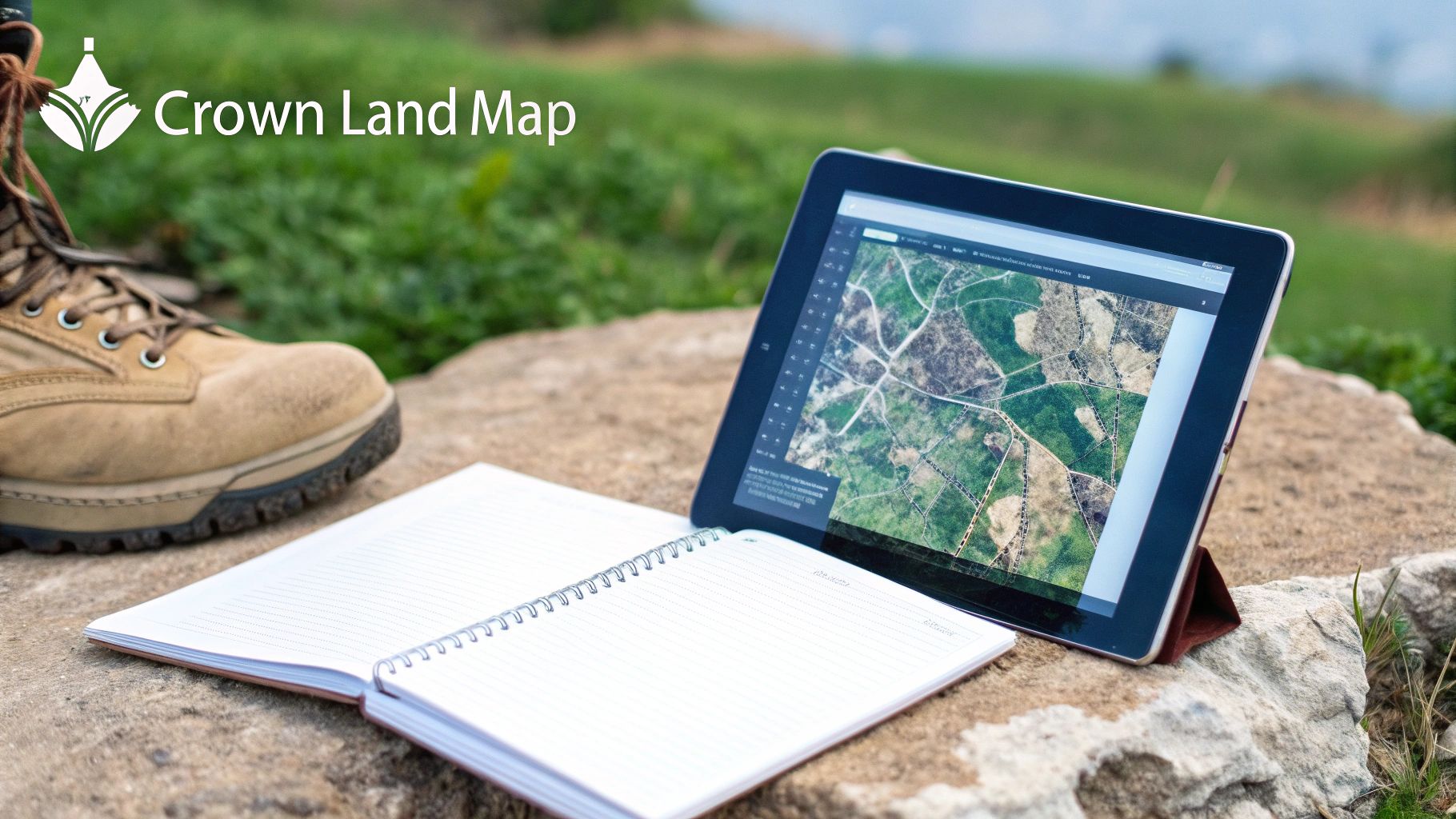
One of the best things about hunting elk in Alberta is the sheer amount of public Crown land available—we're talking millions of acres. This is where most of us have our adventures. But it's not as simple as just pulling the truck over and hiking in. You absolutely have to know where you can and can't be.
Think of Crown land less as a single block of green on a map and more like a quilt made of different patches. Each patch has its own rules and access points. Learning to read that quilt is the real key to finding those hidden, unpressured spots where elk like to live.
The vastness is both a blessing and a challenge. There's plenty of room to roam, but getting to the prime elk country often means navigating a maze of public and private parcels. Your success really hinges on doing the map work before you even think about lacing up your boots.
The Main Types of Public Land
From a hunter's perspective, not all Crown land is the same. You’ll run into a few main types, and telling them apart is crucial to staying on the right side of the law.
- Public Land Use Zones (PLUZs): You'll find these mostly in the "Green Area"—the forested, northern and western parts of the province. They’re managed for all sorts of recreation, including hunting. The key thing here is to check the specific rules on random camping and off-highway vehicle use, as they can vary.
- Agricultural Public Land: This is Crown land leased out to farmers and ranchers for grazing or cultivation. It's still public, but getting on it requires contacting the leaseholder for permission. It's both common courtesy and a legal must.
- Other Crown Parcels: Beyond the designated zones and leases, there are huge tracts of general-use Crown land. These are typically wide open for hunting but can be tricky to pinpoint without a good mapping tool.
Honestly, figuring out land access is your biggest logistical headache. The hunter who gets good at reading maps and understanding these designations is the one who consistently gets away from the crowds and into the elk. It's a skill that pays off every single season.
Solving the Access Puzzle
Finding a chunk of landlocked public ground on a map can feel like you've struck gold, but it immediately presents the age-old problem: how do you get in? A perfect-looking piece of Crown land might be completely boxed in by private property. This is where the real homework begins.
Your first step is to scour your maps for legal easements or designated public access corridors. Sometimes an undeveloped road allowance or a marked trail provides the legal path you need. But never, ever assume. Stepping onto private land without explicit permission is trespassing. Full stop.
This is exactly why modern digital mapping tools are no longer a luxury—they're a necessity. They do more than just show you lines on a screen; they give you the full picture.
Using Modern Maps to Find Your Spot
The days of squinting at a paper map and guessing where a property line might be are over. A good mapping app on your phone is the most powerful tool in your planning arsenal. It overlays all the critical data you need onto one simple map.
Here’s how it changes the game:
- Clear Boundaries: You can see the exact lines separating Crown land, private property, provincial parks, and other reserves where hunting might be restricted. No more guesswork.
- Landowner Information: Many platforms provide contact information for private parcels, making it way easier to respectfully call a landowner and ask for permission to cross their land.
- WMU Overlays: This is a huge one. You can layer the Wildlife Management Unit boundaries right over the land access map. This lets you e-scout a new area while knowing exactly which regulations will apply. For a closer look, you can explore the different WMUs in Alberta on an interactive map and see how they line up with public ground.
When you use these tools, you stop hoping you're in the right spot and start knowing you are. That confidence lets you push deeper into the backcountry and focus on what really matters: finding elk.
Proven Tactics for Scouting and Hunting Elk
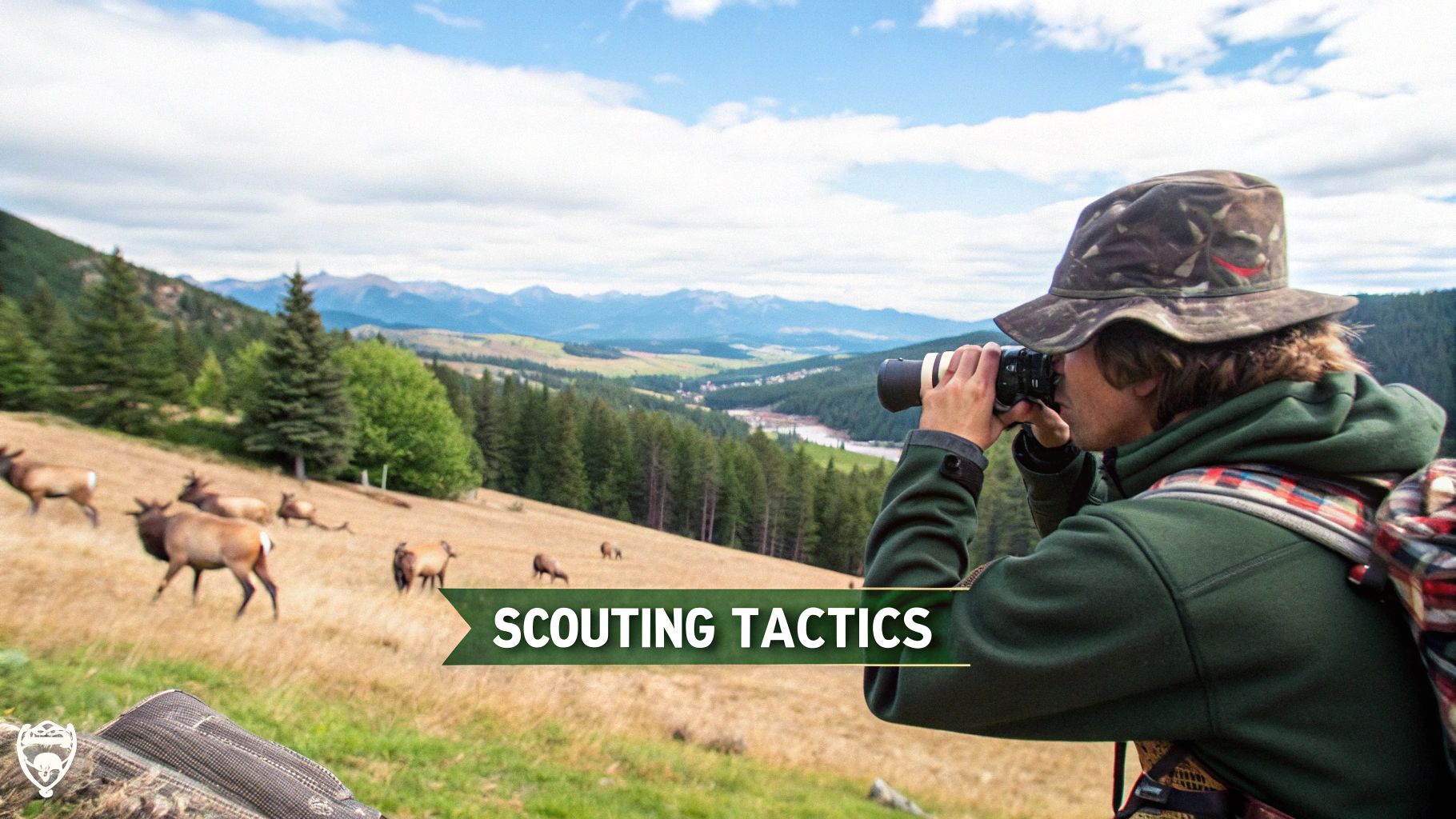
Here's a hard truth: success in the elk woods is earned long before you shoulder a pack. It's not about luck. The most effective elk hunting in Alberta starts on a screen, where your entire plan of attack gets hammered out. This digital groundwork, what we call e-scouting, is everything.
Think of e-scouting as drafting the blueprint for your hunt. You’re using satellite imagery and mapping tools to find the basic ingredients of good elk country. The goal is to identify key zones that will concentrate elk movement before you burn a single drop of fuel or wear out any boot leather.
This digital deep dive lets you take a massive WMU and systematically shrink it down to a handful of high-percentage spots, saving you an incredible amount of time and energy once you finally get out there.
Building Your Digital Blueprint
Your first pass at e-scouting should be all about the three core elements of an elk’s world. They need to eat, sleep, and travel between the two. Finding these places is the first step to figuring out exactly where you should be.
- Feeding Areas: Scan the map for meadows, old clear-cuts bursting with new growth, and south-facing slopes where the sun melts the snow first. These are the elk’s grocery stores.
- Bedding Zones: Elk crave security. Look for thick, dark timber on north-facing slopes, especially on steep terrain. This gives them thermal cover and a good vantage point to watch for predators.
- Travel Corridors: Connect the dots. Identify the natural funnels like saddles, benches, and creek bottoms that link feeding and bedding areas. These are the highways elk use every day.
By marking these potential hotspots on your digital map, you’re creating a network of targets. When you finally get your boots on the ground, you won’t be wandering aimlessly. You'll be moving with purpose, heading straight to these spots to verify what your homework already told you.
Boots-on-the-Ground Intelligence
Once you step out of the truck and into the woods, your job is to confirm what you suspected from your screen time. E-scouting tells you where elk should be, but on-the-ground scouting tells you where they are... right now. This is where you hunt for fresh, undeniable evidence.
Fresh sign is the difference between a spot that was good last month and a spot that's hot today. You're looking for tracks with sharp, crisp edges, not ones that are melted or washed out. You want to find droppings that are still moist and dark, and rubs on trees where the wood is still bright white—maybe even a little sticky with sap.
A single fresh track is a clue. A whole mess of fresh sign—tracks, droppings, and beds all in one area—is confirmation. And if you stumble on a wallow that stinks of elk and is full of churned-up, wet mud? That's a signed invitation to the party.
Adapting Tactics to the Season
How you hunt has to change with the calendar. The aggressive, vocal tactics that work during the September rut will get you nothing but cold, empty woods in November. You have to match your strategy to what the elk are doing.
The September Rut
This is the classic elk hunt, fuelled by screaming bugles and raging hormones. The game here is all about sound and aggression.
- Locate with Bugles: Use locator bugles at first and last light. You’re not trying to start a fight, just trying to get a bull to reveal his location.
- Close with Cow Calls: Once you’ve got a bull pegged, switch almost entirely to soft cow calls and mews. A herd bull will often come to investigate a new cow, and a satellite bull is always looking for an easy girlfriend.
- Be Aggressive: Don’t be afraid to make a racket. Raking a tree with a branch or snapping sticks can sound like a rival bull, sometimes triggering an immediate, reckless response.
Post-Rut and Late Season
Once the rut fizzles out, the bulls go quiet and retreat into their own worlds. Calling is mostly useless. Success now comes down to patience, optics, and stealth.
- Spot-and-Stalk: In the open foothills or prairie parklands, glassing is your number one tool. Plan to spend 80% of your time behind your binoculars, picking apart hillsides for bachelor groups of bulls feeding in the early morning or late evening.
- Still-Hunting: In the thick timber, you have to move at a glacial pace. Take one or two careful steps, then stop for several minutes to scan and listen. The goal is simple: see them before they see, hear, or smell you.
No matter the tactic, elk hunting in Alberta is a game of persistence. By layering methodical e-scouting with sharp in-field observation and adapting your approach to the season, you stop relying on luck and start making your own.
Outfitting for the Alberta Backcountry
Stepping into the Alberta wilderness for an elk hunt means entering some of the most rugged and unforgiving country in North America. This isn't the place to cut corners on gear. Being unprepared isn't just a recipe for a miserable, unsuccessful hunt—it's downright dangerous. Your equipment is your lifeline, the very thing that keeps you warm, dry, and safe when you're a long way from anywhere.
Packing for a hunt like this is a fine art. You're trying to find that sweet spot between being ready for anything—a freak September snowstorm, a multi-trip pack-out—and not being weighed down by a monstrously heavy pack. Every single item you carry has to earn its place.
Think of your gear as a complete system. Your clothing, optics, navigation tools, and safety equipment are all interconnected pieces of the puzzle. Let's dig into the absolute must-haves for staying safe and effective on your Alberta elk adventure.
Dress in Layers, Not in Bulk
If there's one thing you can count on in Alberta, it's that you can't count on the weather. It's famous for throwing sun, sleet, and snow at you all in the same afternoon, especially in the foothills and mountains. The only practical way to deal with this is a solid layering system.
The goal is simple: add layers when you're glassing or resting, and shed them when you're hiking hard. This keeps you from sweating out your clothes on the climb and freezing when you stop.
- Base Layer: This is your second skin. It needs to pull sweat away from your body. Merino wool is the gold standard, but high-quality synthetics work great too. Just remember the golden rule: cotton kills. Avoid it at all costs.
- Mid Layer(s): This is where your warmth comes from. Think fleece hoodies, grid-fleece pullovers, or a puffy jacket (either down or synthetic). I often carry a light fleece for moving and a warmer puffy that I throw on the second I sit down to glass.
- Outer Layer: Your shell is your shield against wind and water. You absolutely need top-notch, breathable rain gear—both a jacket and pants. Make sure it's tough enough to handle busting through thick brush without tearing.
Optics and Finding Your Way
Spotting an elk before it spots, hears, or smells you is the name of the game. Your optics are your most critical hunting tool, and your navigation gear is your most critical survival tool.
A quality pair of 10x42 binoculars is standard issue for a reason, but don't just hang them around your neck. Mount them on a lightweight tripod. It stabilizes your view, eliminates arm shake, and lets you methodically pick apart a distant mountainside for hours without fatigue. You'll see so much more. A laser rangefinder is another non-negotiable piece of kit for making an ethical shot.
Your GPS is a fantastic tool, but it's not foolproof. Batteries die, and electronics fail. Always, always carry a physical map of your area and a compass as a backup, and—more importantly—know how to use them together.
After the Shot: The Real Work Begins
Pulling the trigger is the easy part. Getting that animal broken down and off the mountain is where the real challenge lies. A well-thought-out "kill kit" makes the process clean and efficient.
Here's what mine always contains:
- A couple of sharp, lightweight knives and a small sharpener.
- Nitrile or latex gloves to keep things clean.
- High-quality, breathable game bags—don't cheap out here.
- A few feet of paracord or lightweight rope.
- A small, ultralight tarp can be handy for laying out meat.
You’ll also need a serious backpack. We're not talking about a daypack from the local sporting goods store. You need a rigid-frame pack built to haul heavy, awkward loads. An adult bull elk can easily yield over 200 pounds of boned-out meat, which usually means several gut-busting trips back to the truck.
Before your hunt, a great way to stay organized is to put together a comprehensive checklist. Here’s a table you can use as a starting point.
Alberta Elk Hunt Essential Gear Checklist
This checklist breaks down the critical gear you'll need, categorized to help you think through your systems and ensure nothing important is left behind.
| Category | Essential Items | Key Considerations |
|---|---|---|
| Clothing System | Merino or Synthetic Base Layers, Fleece/Puffy Mid Layers, Waterproof/Windproof Outer Shell | Absolutely no cotton. Pack for the worst possible weather. Include warm hats, gloves, and quality wool socks. |
| Optics & Navigation | Binoculars (10x42), Rangefinder, GPS/Phone with Offline Maps, Physical Map & Compass | Use a tripod for glassing. Always have a non-electronic backup for navigation and know how to use it. |
| Hunting Gear | Rifle/Bow, Ammunition/Arrows, Bipod/Shooting Sticks | Practice with your setup from field positions. Ensure your weapon is sighted in properly before you leave. |
| Pack-Out & Processing | Sturdy Frame Pack, Knives & Sharpener, Game Bags, Paracord, Gloves | Your pack must be capable of carrying 80+ lbs. Game bags protect the meat from flies and debris. |
| Safety & Survival | Bear Spray (in a holster), First-Aid Kit, Satellite Messenger (inReach/ZOLEO) | Keep bear spray immediately accessible, not buried in your pack. Test your sat-comm device before you go. |
| Camp & Shelter | Tent/Tarp, Sleeping Bag, Sleeping Pad, Stove, Fuel, Water Filter/Purifier | Choose a sleep system rated for temperatures at least 10 degrees colder than you expect. Test your stove at home. |
| Miscellaneous | Headlamp (plus spare batteries), Food & Snacks, Trekking Poles, Hunting Licences/Tags | Trekking poles are lifesavers on steep terrain, especially when packing heavy. Keep licences in a waterproof bag. |
Remember to tailor this list to your specific hunt's duration, location, and the time of year. Double-checking your gear is one of the most important parts of your pre-hunt preparation.
Uncompromising Backcountry Safety
When you're chasing elk in Alberta, you're in bear country. Both black bears and grizzlies call these mountains home. Carry bear spray, and not in your pack—it needs to be in a holster on your hip or chest rig where you can grab it in a split second. Yelling "Hey, bear!" every so often while hiking through thick brush is a simple but effective way to avoid a surprise encounter.
Beyond wildlife, you need a plan for yourself. Carry a proper first-aid kit and know how to use it. More importantly, have a reliable way to call for help when there's no cell signal. A satellite communication device like a Garmin inReach or ZOLEO is a critical piece of modern safety gear. It lets you text loved ones and, if the worst happens, trigger an SOS to summon rescue.
Finally, the simplest and most important safety net of all: leave a detailed trip plan with a reliable person back home. Tell them exactly where you're going, when you plan to be back, and when they should call for help if they don't hear from you. It costs nothing and could save your life.
Your Step-by-Step Elk Hunt Planning Timeline
A successful hunt in Alberta’s elk country doesn’t start on opening day—it's the end result of months of careful planning. Getting all your ducks in a row, from figuring out WMUs to breaking in new boots, takes time and a solid game plan.
Think of this planning phase as part of the hunt itself. It’s where you build your foundation for success. This timeline breaks it all down into manageable steps, so you can walk into the bush feeling confident and ready for whatever the mountains throw at you.
The Long Game: 9 to 12 Months Out
Your journey starts long before you ever smell the pines or hear a distant bugle. This is the time for big-picture thinking and getting your body ready for the grind.
- Apply for Your Draws: The deadline for Alberta's hunting draws usually lands in June. This is when you need to have your target WMUs picked out and your applications submitted. Remember, building priority points is a marathon, not a sprint.
- Get in Shape: Elk hunting is a physical game. Start a fitness routine that builds cardio endurance and strengthens your legs. Honestly, the best training is just loading up a pack with some weight and hiking every chance you get.
- Budget and Book: If you’re going with an outfitter, now’s the time to do your research, lock in your spot, and pay the deposit. For a DIY trip, you’ll want to start mapping out your budget for travel, tags, fuel, and any new gear you might need.
Dialing It In: 3 to 6 Months Out
With the big stuff sorted, it’s time to zero in on your gear and your exact hunting spot. This is when the hunt starts to feel real.
One of the biggest mistakes hunters make is leaving gear testing until the last minute. You want to find out your new boots give you blisters at home, not halfway up a mountain in the middle of a rainstorm.
Get your kit together and start putting it through its paces. Shoot your rifle or bow from realistic field positions—kneeling, sitting, using a tree for a rest—not just off a comfortable bench at the range. This is also the perfect time to fire up your mapping tools and do some serious e-scouting. Pinpoint those remote basins, potential feeding areas, and key access points in your WMUs.
The image below gives you a simple look at how to tackle your gear prep over a few months.
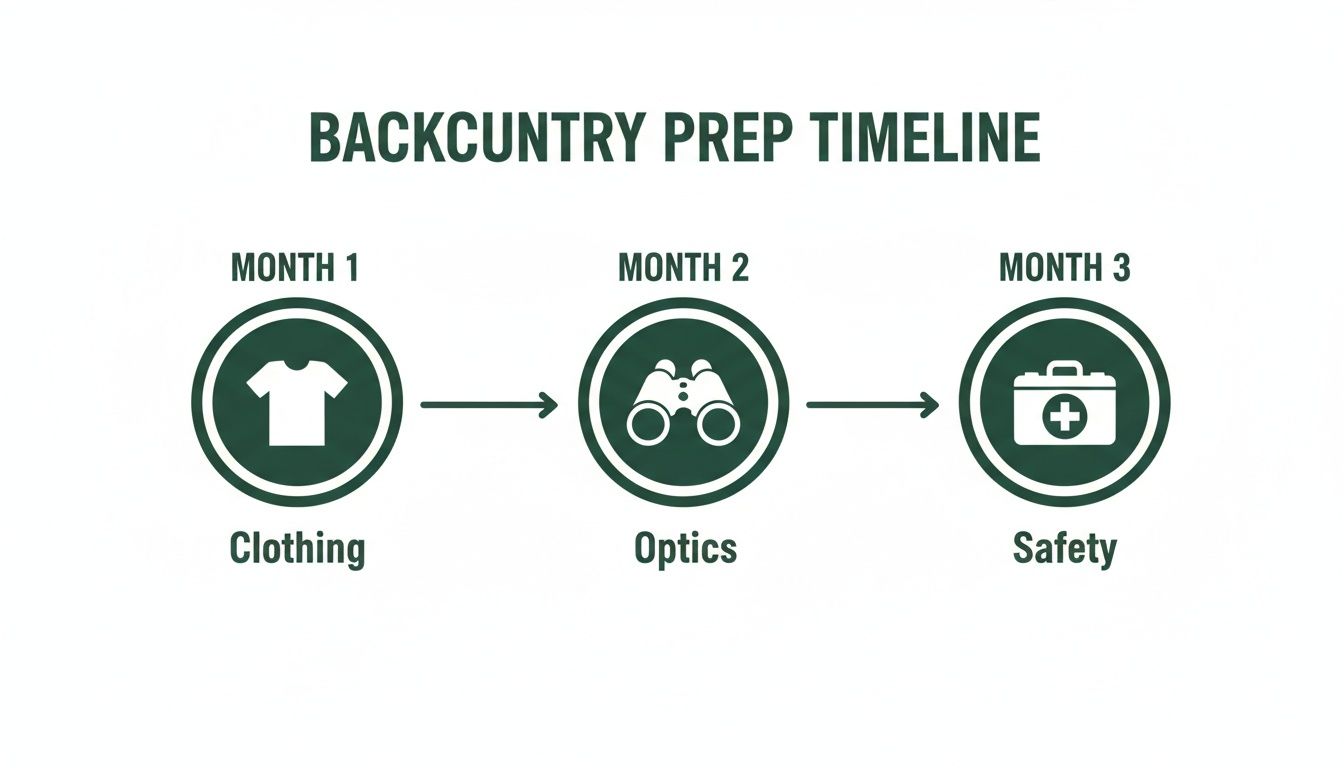
Breaking it down like this—focusing on clothing, optics, and safety gear—helps you avoid that frantic, last-minute rush to the store.
Final Preparations: The Last Month
The final countdown is all about logistics. Double-check your travel arrangements, make sure your truck is in good shape, and get your food plan sorted out. Pack your bags and bins using a detailed checklist so you don’t forget something critical like your release or your hunting licence.
And maybe the most important thing: leave a detailed hunt plan with someone you trust back home. It needs to include exactly where you're going, when you plan to be back, and when they should call for help if they haven't heard from you. A safe hunt is a successful hunt. Getting this final step right, on top of all your other prep, is what truly sets you up for the incredible experience of chasing elk through Alberta's wild country.
A Few Common Questions About Alberta Elk Hunting
Getting into elk hunting in Alberta, or even just hunting a new zone, can feel like you're drinking from a firehose. There are a lot of rules, seasons, and strategies to sort out. To help clear things up, I've pulled together answers to some of the questions I hear most often.
Think of this as a quick reference to double-check the key points on licencing, timing, and getting onto the land.
Do I Need a Guide to Hunt Elk in Alberta?
This is a big one, and the answer comes down to one simple thing: where you call home.
- Non-Resident Hunters (from outside Canada): Yes, you must either hire a licensed outfitter or be accompanied by an eligible Alberta resident (a "hunter host"). There's no getting around this one.
- Non-Resident Alien Hunters (from outside North America): The rules are even tighter here. You have to go with a licensed outfitter.
- Canadian Residents (from other provinces): You're in luck. You don't need a guide. Once you have the right licences and tags for your Wildlife Management Unit (WMU), you can head out on your own.
Even if you're a seasoned hunter going it alone, tools that show you exactly where you are in relation to property boundaries are a game-changer. It’s about more than just staying legal; it's about hunting with confidence in new country.
What Is the Best Time of Year to Hunt Elk in Alberta?
"Best" really depends on what kind of hunt gets your blood pumping. Are you an archery hunter who lives for the sound of a screaming bull, or a rifle hunter who enjoys the quiet patience of a spot-and-stalk?
The early archery season, kicking off around the start of September, lines up perfectly with the peak of the rut. It's pure chaos in the woods. Bugles echo through the valleys, and bulls are constantly on the move, making it an incredible time to hunt with calls. It’s an experience every elk hunter should have.
On the other hand, the general rifle seasons usually open up in late September or October, after the rut has fizzled out. The bulls are often quieter and running solo, focused on recovering. Success here is less about calling and more about covering ground, glassing from good vantage points, and mastering your spot-and-stalk game. Don't overlook the late-season hunts in November, either. A good dump of snow can push elk herds down into more accessible, lower-elevation areas, making them much easier to find and pattern.
How Does the Alberta Hunting Draw System Work for Elk?
Alberta runs on a priority-based draw system for its coveted Special Licences. The whole system is designed to reward patience.
It's pretty straightforward: every year you apply for an elk draw in a specific zone and don't get drawn, you earn one priority point for that hunt code. The next year, you apply with all your built-up points. The tags go to the folks with the most priority points first.
What this means in practice is that for the really popular, top-tier WMUs, you might have to put in your time and build priority for several years before you finally draw that tag.
Can I Hunt Elk on Agricultural Leased Land?
Absolutely, but this is where hunter etiquette and the law meet. You must get permission from the leaseholder before you set foot on that land.
Agricultural Crown land is public land, but it's leased out to ranchers and farmers for things like grazing cattle or growing crops. While we as the public retain the right to access it, the leaseholder is the one managing it day-to-day. Contacting them first isn't just a courtesy—it's a legal requirement.
Pulling off a successful hunt starts long before you lace up your boots. With a tool like HuntScout, you can see WMU boundaries, Crown land parcels, and season dates all on one map. It takes the guesswork out of planning. Get the confidence to tackle new ground by downloading the app at https://huntscout.app.