Quebec's entire hunting system is built around a network of designated areas called Wildlife Management Units (WMUs), or as most of us know them, hunting zones. This isn't just bureaucratic map-drawing; it’s the absolute bedrock of how hunting is managed across the province. Think of it as the rulebook that governs every single hunt, ensuring our wildlife populations thrive for generations to come.
Your licence, the legal hunting seasons, and even what species you can target are all tied directly to the specific rules of the hunting zones Quebec has established.
Why Do Hunting Zones Matter So Much?
Imagine Quebec as a massive patchwork quilt. Each patch represents a different zone, with its own unique ecosystem, wildlife population, and environmental pressures. The rules for hunting in one patch can be completely different from the one right next to it, and for very good reason.
A moose herd living deep in the boreal forests of Zone 28 faces a completely different world than the white-tailed deer browsing in the southern farmlands of Zone 8. The WMU system gives wildlife biologists the flexibility to set rules—like season dates, bag limits, and legal weapons—that are perfectly suited to the specific needs of each local area. This is smart, targeted conservation in action.
The Foundation of a Legal and Ethical Hunt
Let's be blunt: misidentifying your hunting zone is one of the easiest and most serious mistakes you can make. It's not a minor technicality. Crossing a zone line can instantly turn a legal hunt into a poaching incident.
A licence to hunt deer in Zone 5 means nothing if you step a few metres across the boundary into Zone 4, where the season might be closed or restricted to archery only. This is the core principle every hunter must understand.
Knowing your zone inside and out determines:
- Where you can legally hunt: Your licence is geographically locked to a specific WMU.
- When you can hunt: Open seasons for big game like moose, deer, and bear can vary by weeks from one zone to the next.
- How you can hunt: A rifle season might be open in one zone, while an adjacent one is strictly for bows and crossbows during that same week.
The entire framework of Quebec hunting rests on this system of zones. When you master it, you're not just staying on the right side of the law—you're becoming an informed and effective participant in the province’s conservation strategy.
Ultimately, a successful hunt doesn't start when you load your pack; it starts with a map. Correctly identifying your hunting zones Quebec regulations and understanding the rules for that specific piece of ground is the first, most critical step. This knowledge lets you plan your trip with confidence and focus on what really matters: a safe, ethical, and memorable time in the wild.
How to Find and Read Your Hunting Zone Map
Knowing your zone is one thing, but being able to point to your exact spot on a map is where the rubber meets the road. In the old days, this meant unfolding a massive paper map in the truck, trying to line up a creek or a logging road with the faint boundary lines. It worked, but it left a lot of room for honest mistakes. Thankfully, modern tools have taken the guesswork out of the equation, making it easy for any hunter to be 100% certain they're in the right place.
The simplest and most reliable way to figure out your exact location within the vast network of Quebec's hunting zones is to use a GPS-enabled app on your smartphone. Tools like HuntScout were built for this very task, overlaying the official WMU boundaries right on top of detailed satellite and topographic maps. All the info you need is literally in the palm of your hand.
Pinpoint Your Location Instantly
It’s about as straightforward as it gets. Just turn on your phone's location services, and the app will show your real-time position as a dot on the map. As you walk, drive, or paddle, that dot moves with you, showing you exactly where you stand in relation to those all-important zone lines. No more wondering if you’ve crossed a boundary.
This simple process—finding your zone first—is the foundation of every legal and successful hunt. Everything else, from the species you can target to the season dates you must follow, flows from that one crucial piece of information.
Once you’re looking at the map, you can just tap anywhere to pull up the details for that specific spot. It’s a simple four-step process:
- Open the App: Fire up HuntScout on your phone.
- Find Yourself: Use the GPS function to centre the map on your current location.
- Tap to Scout: Press your finger on the screen right where you plan to hunt.
- Get the Zone: The app instantly tells you the WMU number for that exact point.
This tap-to-identify feature is a real game-changer. It means no more flipping back and forth between government PDFs and your map. You get the answer you need, right when you need it. You can explore all the tools for navigating Quebec's WMU system on the HuntScout app.
Using a real-time digital map means you aren’t just guessing—you’re verifying. This quick check is often the difference between a great day in the woods and a very expensive mistake.
This visual clarity is especially critical when you're hunting near a boundary, where rules for deer or moose can change from one side of a road to the other. This modern approach turns what used to be a mapping headache into a quick, confident check before you head out.
How Zones Dictate Your Seasons and Licence
Once you’ve nailed down your exact hunting zone, you’ve basically found the master key to Quebec's hunting regulations. Think of your hunting licence less like a universal park pass and more like a specific key cut for a single lock. That lock is your chosen Wildlife Management Unit (WMU), and the key will only turn during a very precise window of time—the open season for that specific zone.
This connection is non-negotiable. A licence to hunt white-tailed deer in Zone 5 is completely useless if you step a few feet over the boundary into Zone 4, where the rules might be entirely different. The season could be shorter, the only legal weapon might be a crossbow instead of a rifle, or it might be closed to hunting altogether. This is why confirming the rules for your specific hunting zones Quebec location isn't just a good idea; it's the most critical step you'll take.
Let's break this down with a real-world scenario to see how it all clicks together.
A Practical Example: Planning a Deer Hunt
Imagine you've been scouting a great-looking piece of Crown land for white-tailed deer. Here's the simple process you'd follow to stay legal and safe:
- Pinpoint Your Zone: First things first, you use a mapping tool to find your spot. You zoom in and confirm it’s located squarely within Zone 6 North.
- Check the Season Dates: With your zone confirmed, you look up the specific regulations for Zone 6 North. You discover the rifle season for antlered deer runs for a two-week period in November.
- Get the Right Licence: Finally, when you buy your licence, you make sure it is explicitly for white-tailed deer in Zone 6 North.
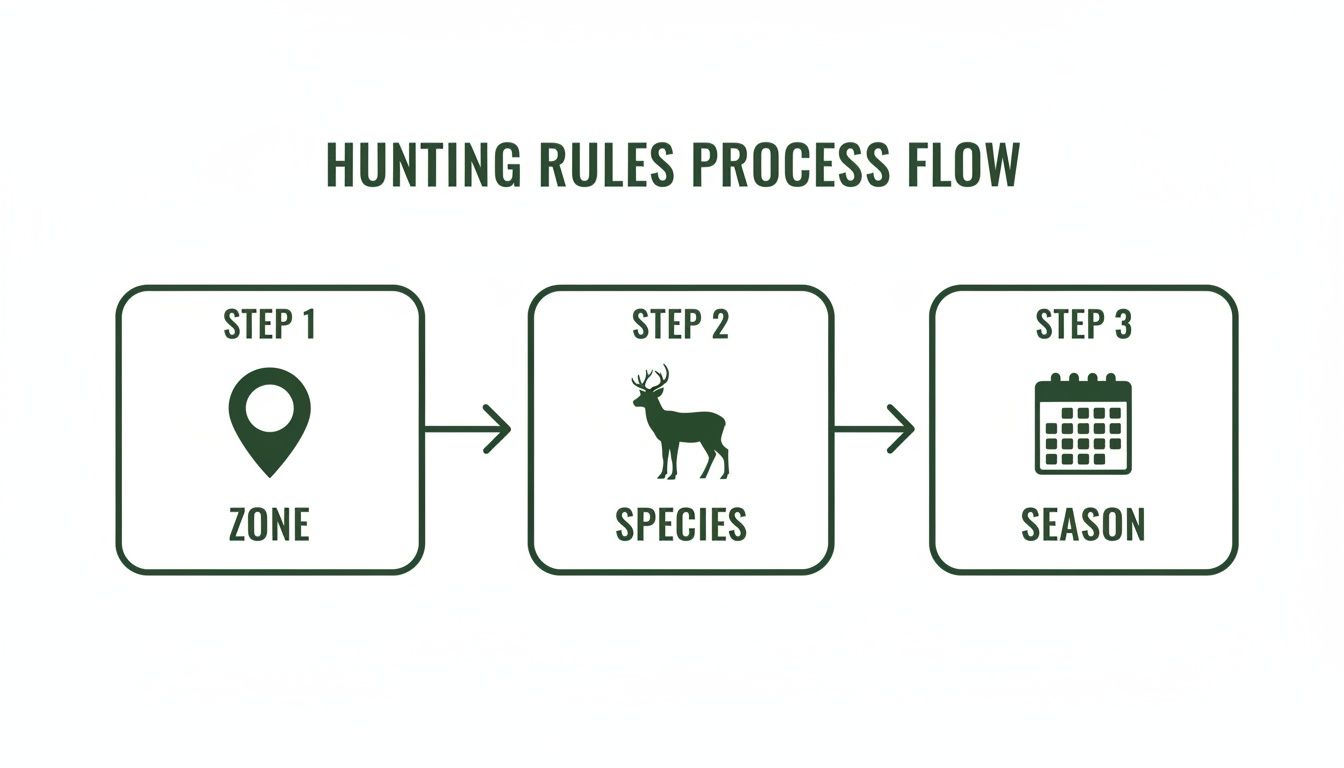
This three-step check connects your geography (the zone), the calendar (the season), and the law (your licence). By doing this every single time, you eliminate the risk of the most common hunting violations and can head out with total peace of mind. To get started, you can look through our detailed breakdown of Quebec's hunting seasons and find the dates for your zone.
A hunting licence is only valid when used in the correct zone, during the correct season, for the correct species. All three pieces have to line up perfectly.
The proof of this zone-based management is in the harvest numbers. While over 142,000 hunters took roughly 59,500 deer across the province, the story changes when you look at individual zones. For instance, Zone 06S saw the highest harvest with 6,698 deer, where crossbow hunters accounted for a staggering 45% of the total.
These results don't happen by accident. They come from carefully tailored regulations designed to balance harvest pressure with local wildlife populations, often guided by data from organizations that monitor biodiversity. You can learn more about how this data influences WMU management. It's this careful, zone-by-zone approach that keeps Quebec’s wildlife healthy and its hunting opportunities so diverse.
Navigating Crown Land Within Hunting Zones
For many of us, public land is what hunting is all about. Quebec’s hunting zones are crisscrossed with vast stretches of Crown land that offer incredible opportunities, but getting out there takes more than just a licence. You need to understand that not all public land is the same, and the rules for accessing it are another layer on top of the WMU regulations you've already figured out.
The biggest mistake I see hunters make is thinking that all Crown land is automatically open for hunting. It's just not true. Some parcels might be leased out for forestry, while others are designated as parks or ecological reserves where hunting is strictly forbidden. Just because your map shows a block of green doesn't mean it's fair game.
This is where having the right tools in your pack becomes absolutely critical for staying on the right side of the law.
Differentiating Huntable Land from Restricted Areas
A successful public land hunt starts with knowing exactly where you can and can't go. An app like HuntScout takes the guesswork out of it by overlaying land ownership data right on your hunting zone map. This kind of visual clarity gives you the confidence to explore new spots without worrying about accidentally stepping onto private property.
When you're e-scouting a new area within your chosen hunting zone, you’ll run into a few common land types:
- General Use Crown Land: This is your bread and butter—typically the most accessible land for hunting. Still, it's always smart to double-check for any local access rules.
- Leased Crown Land: The government owns this land, but it's leased to companies or individuals for activities like trapping or forestry. Your hunting rights might be restricted, so you'll often need to get permission first.
- Private Land: These are clearly marked parcels that are completely off-limits unless you have explicit permission from the landowner. Trespassing is a serious offence with big consequences.
Getting these distinctions straight is fundamental. For a more detailed breakdown, our guide on what is Crown land in Canada covers all the essential background you'll need.
Think of it this way: your hunting zone rules are like provincial traffic laws, but the Crown land access rules are the local town bylaws. You have to follow both. Knowing the WMU regulations gets you halfway there; understanding the specific land status gets you the rest of the way.
Choosing between public and private land involves different trade-offs in planning and execution. Here’s a quick comparison to help you decide where to focus your efforts.
| Consideration | Crown Land | Private Land |
|---|---|---|
| Accessibility | Open to the public, but can have physical barriers (e.g., washed-out roads). | Requires landowner permission; access is exclusive but not guaranteed. |
| Hunting Pressure | Can be higher, especially in easily accessible areas close to cities. | Usually very low to none, depending on the landowner's rules. |
| Scouting | Requires significant digital and boots-on-the-ground effort to find productive spots. | Can be easier to pattern game, as animals are often less pressured. |
| Regulations | Governed by provincial WMU rules plus specific land use restrictions. | Governed by WMU rules, but landowners can impose additional restrictions. |
| Cost | Free to access, but may require investment in gear for remote areas. | Often requires lease fees, gifts, or a strong personal relationship. |
Ultimately, both options offer unique experiences. The key is to do your homework and choose the path that best suits your hunting style and resources.
Common Pitfalls and How to Avoid Them
It’s not just about public vs. private. Other restrictions can pop up and derail a hunt if you’re not prepared. For example, some areas within a perfectly legal hunting zone might be temporarily closed for logging, or a regional municipality might have its own specific access rules. The only way to know for sure is to use an up-to-date mapping platform that shows these details.
By using a tool that draws a clear line around huntable Crown land, you eliminate all the ambiguity. It lets you plan your hunt with precision, so you can focus your time and energy on productive spots you know you’re allowed to be in. This kind of careful preparation isn’t just smart—it's the mark of a responsible hunter.
Special Rules and Restrictions by Zone
Okay, so you’ve got your dates and licence sorted. Now for the part that trips up even seasoned hunters: the fine print. Mastering Quebec’s hunting zones means digging into the specific rules for each one, because assuming the regulations are the same everywhere is a rookie mistake that can end your hunt with a hefty fine.
Think of it like this: the zone is the city, but these special rules are the specific parking regulations on each street. They cover everything from the type of weapon you can use to bag limits and baiting rules. These aren't just suggestions—they're law, tailored to the unique wildlife management needs of that small piece of land.
For instance, you might find that rifle season is open in one zone, but the moment you cross an invisible line into the next, it's archery or crossbow only. This is exactly why you can't just apply what you learned last year to a new spot.

Decoding Zone-Specific Nuances
These local rules have a massive impact on how you hunt and your odds of success. You can see it clear as day in the provincial harvest statistics. In the various hunting zones Quebec offers, the numbers tell the story of what works where.
Take Zone 04, for example, where rifles were used for 5,025 of the 7,511 deer harvested. But just over in Zone 06S, muzzle-loaders took 2,988 of 6,698 deer—a huge difference that reflects the local terrain and, more importantly, the regulations. This data proves how critical it is to check weapon rules before you even pack the truck. You can dig into more of these harvest statistics and trends yourself.
Understanding ZECs and Wildlife Reserves
Just when you think you have it figured out, there’s another layer: special territories like ZECs (zones d'exploitation contrôlée) and wildlife reserves. These areas sit inside the larger WMU boundaries but play by their own, additional set of rules.
Think of a ZEC or wildlife reserve like a members-only club inside a public park. You still have to follow the park’s main rules (the WMU regulations), but to get into the exclusive area, you need to buy a membership and follow the club's specific policies.
This means that to hunt in one of these territories, you’ll usually need to:
- Hold the correct provincial hunting licence for the WMU it's located in.
- Buy a separate access pass or daily registration directly from the ZEC or reserve.
- Abide by their supplementary rules, which could include mandatory check-ins and specific harvest quotas.
Ignoring these extra steps is a surefire way to get turned away at the gate. Before you head out, always double-check if your spot falls within a ZEC or reserve and get familiar with their access rules ahead of time.
Your Quebec Hunting Zone Questions, Answered
Once you start digging into the maps, you’ll inevitably run into some specific questions, especially when planning a hunt or standing out in the field. Let's tackle some of the most common head-scratchers so you can hunt with confidence, covering everything from boundary lines to multi-species trips and keeping up with rule changes.
What Happens if I’m Hunting on the Border of Two Zones?
Hunting on a boundary line is a game of inches, and the law is crystal clear. The rules that apply—season, weapon type, bag limit—are determined by the zone where both you and the animal are physically standing the moment you pull the trigger.
Think about it like this: Zone A allows rifles, but the neighbouring Zone B is archery-only. You can't stand in the archery zone (B) and shoot a deer in the rifle zone (A) with your rifle. The location of the shot is what counts, so you must follow the rules for that single spot.
When in doubt, always play it safe. If you're anywhere near a boundary, stick to the rules of the more restrictive zone. This simple habit will keep you out of trouble, no questions asked.
This is where a GPS-enabled app becomes your best friend. Seeing your real-time position on a map with precise WMU boundaries drawn in takes all the dangerous guesswork out of the equation.
Can I Hunt Multiple Species in the Same Zone on the Same Trip?
Absolutely. It’s one of the great things about hunting in Quebec. You can often pursue more than one species during a single trip, but you have to do your homework first. The key is that you must hold the correct, valid licence for every animal you plan to hunt.
Just as important, the open seasons for those species must actually overlap in that specific WMU. For instance, in some zones, the small game season runs at the same time as deer season, which is a fantastic opportunity for a mixed-bag hunt.
To make sure you’re doing it legally, you need to:
- Carry all the right permits for each species on your person.
- Know and follow the specific rules for each animal, from bag limits to legal shooting hours.
- Stick to the weapon restrictions that apply to each species during that time.
Before you even think about planning a multi-species outing, double-check the official Quebec hunting regulations for your zone to confirm the season dates line up.
How Do I Stay Updated on Annual Hunting Zone Rule Changes?
Hunting regulations aren't set in stone. Boundaries can be tweaked, and season dates shift almost every single year based on wildlife population data and conservation efforts. The only truly official source for these updates is the latest sport hunting regulations published by the Government of Quebec.
While you should always have a copy of the official government rules, a more practical way to stay on top of things is by using a modern hunting app. A tool like HuntScout automatically updates its map layers and regulation data to reflect the most current rules.
This means the information you're using in the field is always up-to-date. It saves you the headache of manually cross-referencing new documents each year and gives you peace of mind that your hunt is planned according to today's laws, not last year's.
What Is a ZEC and How Does It Relate to a Hunting Zone?
A ZEC, which stands for zone d'exploitation contrôlée (or controlled harvesting zone), is a special territory managed by a local non-profit organization. The most important thing to understand is that a ZEC is located within the boundaries of one or more of the larger provincial WMUs.
Here’s an easy way to think about it: the WMU rules are the provincial law, while the ZEC rules are like local bylaws. To hunt inside a ZEC, you first have to follow all the provincial regulations for the WMU it sits in.
But on top of that, you also need to purchase an access pass from the ZEC itself and follow its own specific rules. This often includes things like mandatory check-in and check-out stations, specific local quotas, and registration procedures. You have to meet both sets of requirements to legally hunt there.
Planning your next trip into one of Quebec's hunting zones demands precision and the right information. HuntScout puts all the critical data you need—from WMU boundaries and Crown land layers to up-to-date season information—right in the palm of your hand. Stop guessing and start scouting with confidence by downloading the app today. Learn more at https://huntscout.app.