Selecting the right canine partner is one of the most critical decisions a Canadian hunter can make. The ideal dog not only enhances the success and enjoyment of the hunt but also becomes a trusted companion in the field and at home. From the dense forests of British Columbia to the open prairies of Saskatchewan and the waterfowl-rich wetlands of Ontario, Canada’s diverse landscapes demand specialised skills. A dog bred for flushing grouse in thick bush may not be the optimal choice for retrieving ducks from icy northern lakes. This is why understanding a breed's innate drive, physical attributes, and temperament is paramount.
This comprehensive guide is designed to simplify that decision. We will explore the best hunting dog breeds, categorised by their primary hunting discipline, to help you make an informed choice tailored to your specific needs and environment. We move beyond simple descriptions to provide actionable insights into each breed's strengths and weaknesses within a Canadian context.
You will learn how to:
- Identify the ideal breed for specific game, from upland birds to waterfowl.
- Match a dog's temperament and energy level to your lifestyle and hunting frequency.
- Understand the unique training and care requirements for peak field performance.
Furthermore, we will integrate practical advice on how to use modern tools like the HuntScout app to complement your canine partner. We'll cover how mapping Wildlife Management Units (WMUs), marking prime training spots with waypoints, and using offline maps can transform your preparation and execution in the field. This guide provides the framework for choosing a four-legged hunting partner that will excel for seasons to come.
1. Labrador Retriever
The Labrador Retriever is arguably the most iconic and one of the best hunting dog breeds in North America, and for good reason. Originally bred in Newfoundland to retrieve ducks and haul fishing nets from icy waters, their lineage is perfectly suited for Canada's demanding hunting landscapes. This breed's legendary versatility, intelligence, and eager-to-please nature make them a top choice for both seasoned professionals and new hunters.
Labs excel in multiple disciplines, but they are unparalleled in waterfowl retrieval. Their dense, water-resistant double coat provides excellent insulation against the cold waters of a late-season goose hunt in an Albertan grain field. Their powerful "otter tail" acts as a rudder, guiding them efficiently through choppy lakes. Beyond the water, their keen nose and stamina make them equally effective for flushing and retrieving upland birds like pheasant and grouse in the thick brush of Southern Ontario.
Key Strengths & Canadian Suitability
- Versatility: A true all-rounder, the Lab is capable of seamlessly transitioning from a duck blind to an upland field, making it an economical choice for hunters who pursue various game.
- Trainability: Their high intelligence and desire to work with their handler make them relatively easy to train, even for novice owners.
- Temperament: Known for their friendly and reliable disposition, they make excellent family companions during the off-season.
- Endurance: Built for long days in harsh conditions, they possess the stamina required for a full day's hunt, from the wetlands of Manitoba to the fields of Saskatchewan.
Training & Care in the Field
To get the most out of your Labrador, consistent training and proper care are non-negotiable. Early socialization and obedience training from puppyhood are crucial for developing a reliable field partner. During the off-season, maintain their physical condition with at least an hour of vigorous exercise daily.
When planning training sessions, use HuntScout's offline maps to scout new public land and mark ideal training grounds with waypoints, simulating real-world hunting scenarios. For more detailed guidance, discover our 7 expert hunting season planning tips to integrate your canine partner into your strategy. Due to their genetic predisposition for hip and elbow dysplasia, always source puppies from reputable breeders who conduct health screenings.
2. English Springer Spaniel
The English Springer Spaniel is a powerhouse of energy and a specialist among the best hunting dog breeds, revered for its prowess in flushing upland game. Named for their distinctive method of "springing" birds from dense cover, these medium-sized dogs are tireless workers. Their compact and athletic build makes them perfectly suited for navigating the thick brush and challenging terrain that Canadian partridge, grouse, and woodcock call home.
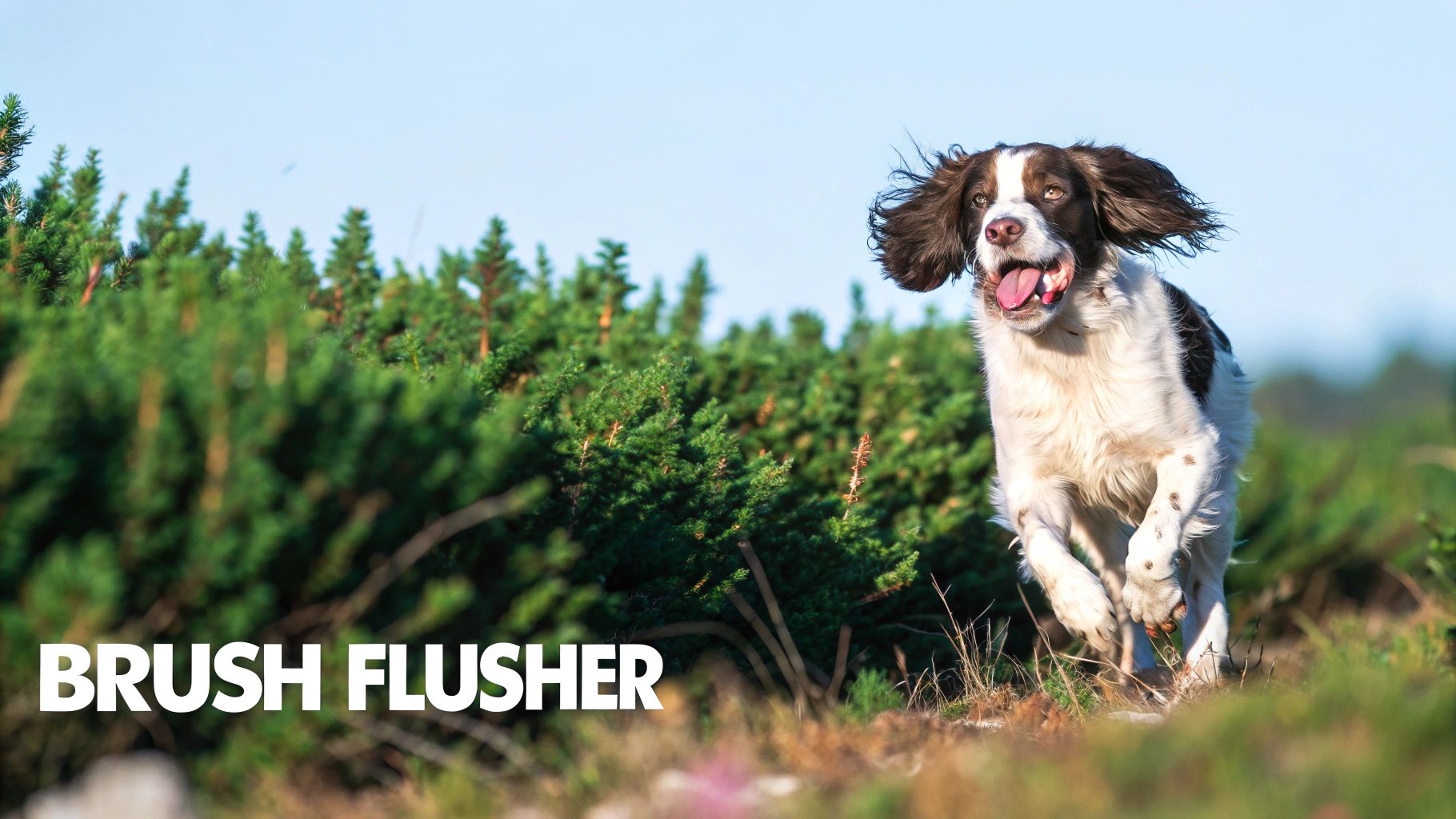
This breed truly shines in the dense forests of Ontario and the scrublands of the prairie provinces where they work methodically within gun range. Unlike wide-ranging pointers, a Springer typically quarters back and forth in a windshield-wiper pattern, ensuring no patch of cover is missed. This close-working style is ideal for hunters on foot who need a thorough and reliable partner to put birds in the air. Their eagerness to please and boundless enthusiasm make every hunt an exciting and productive experience.
Key Strengths & Canadian Suitability
- Upland Specialist: Unmatched at flushing and retrieving game birds like pheasant, grouse, and partridge in thick Canadian cover.
- Compact & Agile: Their smaller size allows them to penetrate dense brush and navigate difficult terrain inaccessible to larger breeds, a key advantage in backcountry hunts.
- Close-Working: Naturally hunts within a 15-to-25-yard range of the handler, making them highly effective for foot hunters without pointing genetics.
- Enthusiastic Temperament: Possesses a joyful and energetic disposition, showing immense drive in the field while being a friendly family companion at home.
Training & Care in the Field
Effective training for a Springer focuses on control and cooperation. Consistent whistle commands are vital for directing them in the field, and a solid "sit" or "hup" command is crucial to prevent them from chasing wildly flushed birds. Their primary job is to flush, so they must learn to hold steady until commanded to retrieve. This impulse control is the cornerstone of a great Springer.
Due to their floppy, feathered ears, they are prone to infections, so regular cleaning and drying after a wet day in the field are essential. To prepare your dog for varied terrain, use HuntScout to map out different types of cover and conditioning routes. Remember to introduce water work early if you plan to use them for occasional waterfowl retrieves, as their natural love for water can be easily channelled into a secondary skill set.
3. German Shorthaired Pointer
The German Shorthaired Pointer (GSP) is an elite, all-purpose hunting machine and one of the best hunting dog breeds for the versatile hunter. Developed in Germany to be a jack-of-all-trades, this breed excels at pointing and retrieving upland birds like pheasant and partridge, tracking small game, and even retrieving waterfowl. Their boundless energy, striking intelligence, and powerful athletic build have made them a favourite among serious Canadian hunters who need a single dog for multiple pursuits.
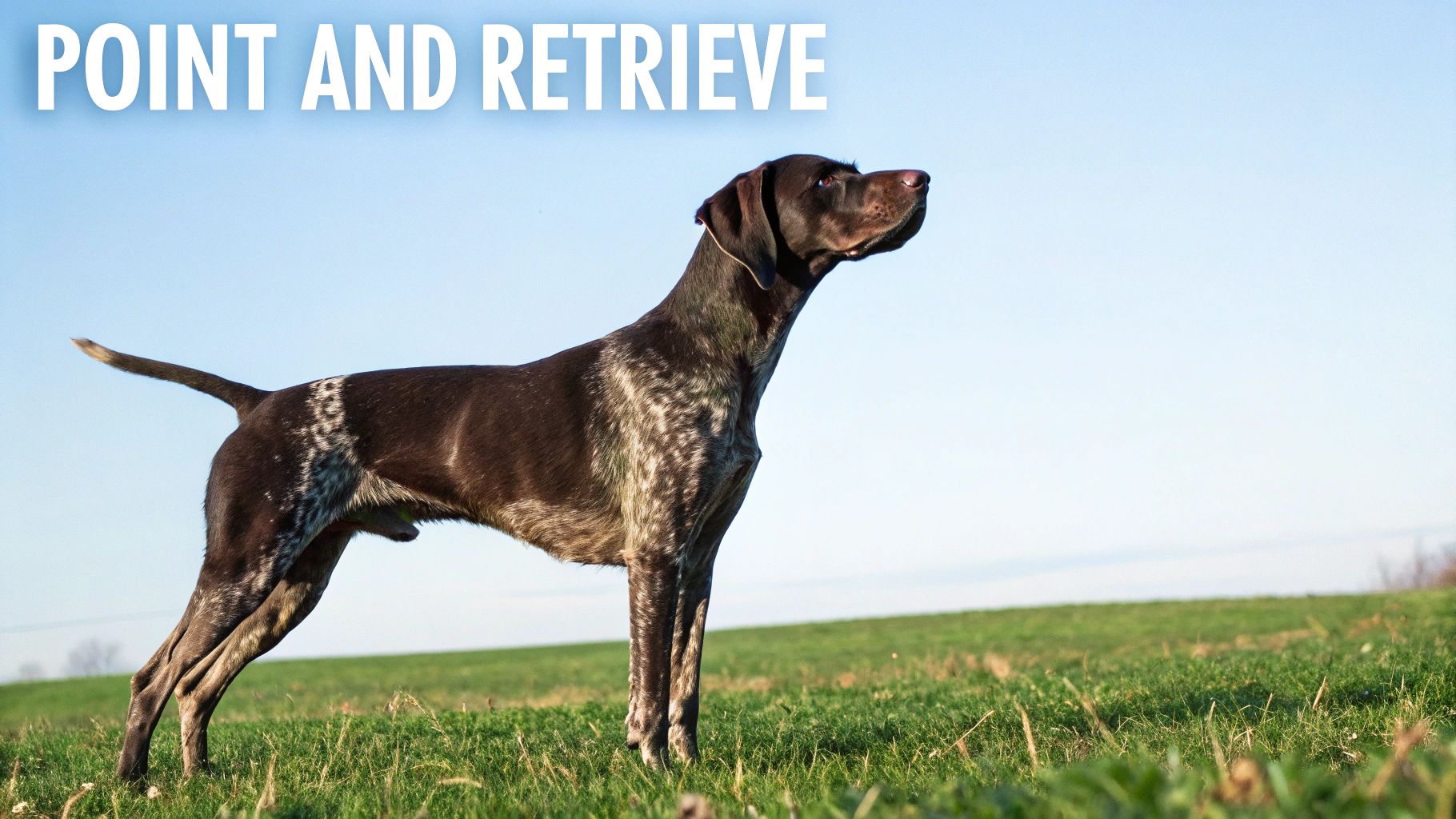
From the vast prairie provinces to the dense forests of Ontario, the GSP’s drive and adaptability shine. Their short, ticked coat is dense enough to protect them from thick brush while being easy to maintain, a significant advantage when hunting rugged terrain in Alberta or British Columbia. Their keen nose and methodical quartering pattern make them incredibly effective at locating and holding birds, giving the hunter ample time to get into position for a clean shot.
Key Strengths & Canadian Suitability
- Versatility: The GSP is the quintessential multi-purpose gun dog, capable of hunting upland birds, waterfowl, and even tracking fur-bearing animals.
- Athleticism: With incredible stamina and speed, they can cover vast amounts of ground, making them ideal for the wide-open spaces of the Canadian prairies.
- Intelligence: Highly trainable and eager to work, GSPs respond well to consistent training and form a strong bond with their handler.
- Pointing Instinct: Their natural pointing ability is second to none, providing a clear and steady indication of where game is holding.
Training & Care in the Field
A German Shorthaired Pointer thrives on activity and purpose; this is not a breed suited for a sedentary lifestyle. Early training, beginning as early as eight weeks, is critical to channel their high energy into productive field work. They require at least an hour or two of vigorous daily exercise to maintain their physical and mental well-being, especially during the hunting season.
When planning your training, use HuntScout’s WMU maps to identify different types of terrain on public lands and challenge your GSP's adaptability. For those looking to explore new hunting grounds, understanding access rules is crucial; read our guide on what Crown Land is in Canada to plan your next outing. While their coat is low-maintenance, their short fur offers less insulation, so a neoprene vest or winter coat is recommended for late-season waterfowl hunts in colder Canadian climates.
4. English Pointer
The English Pointer represents the pinnacle of upland hunting dogs, known for its elegant style, incredible nose, and staunch pointing ability. These graceful athletes have been bred for over 300 years specifically for locating and pointing game birds. For Canadian hunters pursuing partridge, grouse, and pheasants across open fields and rolling terrain, Pointers offer an unmatched combination of efficiency and a classic hunting experience, making them one of the best hunting dog breeds for covering vast landscapes.
Pointers are built for speed and endurance, allowing them to range far and wide to locate birds. Their short, fine coat is easy to maintain and keeps them cool while working hard under the prairie sun, a common scenario for hunters in Saskatchewan and Manitoba. When a Pointer catches the scent of game, it freezes into its characteristic, statue-like point, providing a clear and beautiful signal to the hunter. This makes them a favourite not only for practical hunting but also for field trial competitors across Canada.
Key Strengths & Canadian Suitability
- Exceptional Scenting: Their nose is legendary, capable of detecting birds from remarkable distances, giving hunters an edge in sparse cover.
- Range and Speed: Perfectly suited for the wide-open prairies and agricultural fields of Western Canada, where they can effectively cover huge tracts of land.
- Natural Instinct: Their pointing instinct is deeply ingrained, often requiring minimal training to bring out their natural talent.
- Stamina: These dogs are high-octane athletes built for all-day hunts, from the rolling foothills of Alberta to the expansive fields of Southern Ontario.
Training & Care in the Field
Training a Pointer requires a gentle, consistent hand; they are sensitive dogs that respond poorly to harsh corrections. Early introduction to birds, starting around 6-9 months, is crucial for developing their natural abilities. Due to their instinct to run wide, firm and reliable recall training is a non-negotiable aspect of their development into a safe and effective hunting partner.
Before a hunt, use HuntScout to analyze satellite imagery, identifying ideal open country and marking likely bird cover with waypoints. This allows you to plan a route that plays to the Pointer's strengths. To connect with other owners and find experienced training partners, network through Canadian Pointer clubs or use the HuntScout community forums to find local enthusiasts in your region. Always source your puppy from a reputable breeder who focuses on proven hunting lines and performs necessary health screenings.
5. Chesapeake Bay Retriever
The Chesapeake Bay Retriever, or "Chessie," is a powerhouse built for the most demanding waterfowl hunting imaginable. Developed in the icy, unforgiving waters of its namesake bay, this breed is the epitome of toughness and one of the best hunting dog breeds for serious waterfowlers. Their legendary grit, powerful build, and uniquely oily, water-resistant coat make them exceptionally suited for the brutal late-season hunts on Canada’s lakes and rivers.
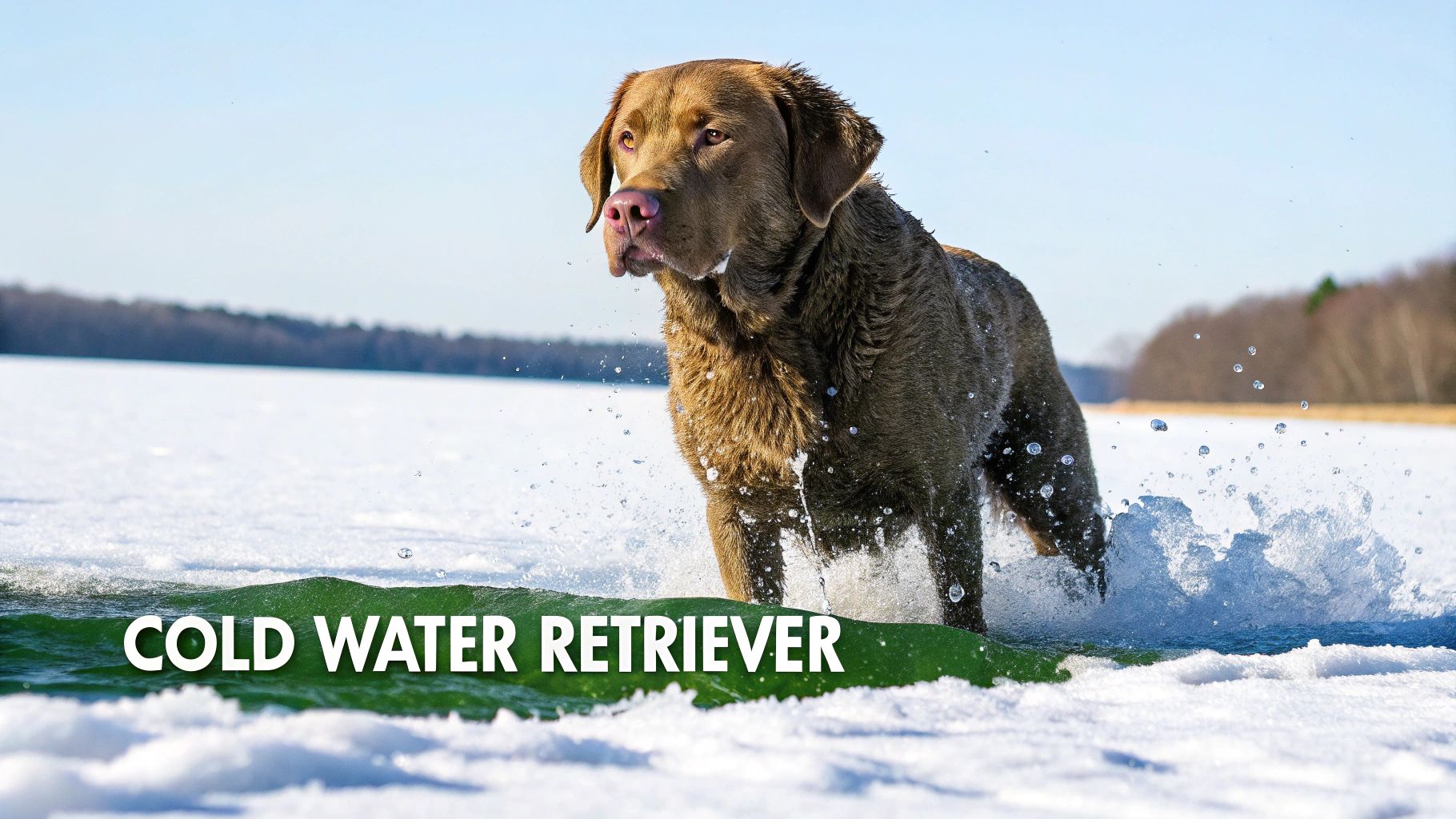
Unlike the more biddable Labrador, the Chessie is known for its determined and sometimes stubborn personality. This independence, however, translates to incredible perseverance in the field. They possess an unmatched drive to retrieve, breaking through ice and battling rough waves to complete their task. This makes them a favoured choice for dedicated hunters from the windswept shores of the Great Lakes in Ontario to the frigid prairie potholes of Manitoba and Saskatchewan.
Key Strengths & Canadian Suitability
- Extreme Weather Tolerance: Their dense, wavy coat has a distinctly oily texture that repels water and provides superior insulation, allowing them to work longer in dangerously cold conditions.
- Powerful Drive: The Chessie’s tenacity is legendary. They are single-minded in their pursuit and will stop at nothing to retrieve a downed bird.
- Protective Nature: Fiercely loyal to their handler and family, they are known to be more reserved with strangers, making them excellent watchdogs in remote hunting camps.
- Stamina & Strength: Their muscular, robust build gives them the power needed to navigate challenging terrain and icy waters for extended periods.
Training & Care in the Field
Training a Chesapeake Bay Retriever requires a confident and consistent handler. Their intelligence is matched by a strong will, so early, positive-reinforcement training is essential to channel their drive effectively. Firm but fair leadership will earn their respect and create an unbreakable bond. It's crucial to source a puppy from a reputable breeder focused on hunting lines rather than show lines to ensure the right temperament and instincts.
During the off-season, maintain their conditioning with at least an hour of vigorous daily exercise. Use HuntScout's satellite imagery to locate and save waypoints for remote lakes or rivers, perfect for advanced water retrieval drills. To prevent hard-mouthing, a common trait, consistently drill a gentle "deliver to hand" command. For more community-sourced advice, connect with experienced Chessie handlers through Canadian hunting forums.
6. Golden Retriever
Often celebrated as the quintessential family dog, the Golden Retriever’s roots are firmly planted in the hunting fields of Scotland. This breed combines the waterfowl versatility of its retriever cousins with an exceptionally gentle and trainable temperament. While many lines are bred for companionship, hunting-line Goldens possess a powerful retrieving drive, making them one of the best hunting dog breeds for those who value both field performance and a calm household presence.
Goldens are highly capable in waterfowl scenarios, from the marshlands of British Columbia to the pothole regions of Alberta. Their love for water and dense, water-repellent coat make them well-suited for retrieving ducks and geese in challenging conditions. They also perform admirably as upland flushing dogs, using their intelligence and methodical pace to work through pheasant cover in Southern Ontario. Their eagerness to please makes them a particularly excellent choice for new hunters learning to handle a retriever for the first time.
Key Strengths & Canadian Suitability
- Trainability: Exceptionally intelligent and eager to please, Goldens are renowned for their responsiveness to training, which simplifies the process for novice handlers.
- Gentle Temperament: Their patient and reliable nature makes them a superb family companion, transitioning seamlessly from the field to the home.
- Adaptability: They handle various Canadian climates well and are just as comfortable in a duck blind as they are working through light upland brush.
- Strong Retrieving Instinct: Field-bred Goldens have a strong natural desire to retrieve, marked by a soft mouth that protects game.
Training & Care in the Field
Maximizing a Golden Retriever’s potential requires a commitment to proper training and responsible breeding. It is crucial to source a puppy from a reputable breeder focused on hunting lines, not show lines, to ensure strong working instincts. Begin positive reinforcement training early, around 8-10 weeks, and introduce your pup to water gradually to build confidence.
During field training, use a check cord for controlled recalls and focus heavily on drills for marking (remembering where a bird fell) and blind retrieves. Before heading out, ensure your permits are in order; you can learn more about the importance of proper paperwork by reading our guide on why hunting licensing compliance matters in Canada. Given their susceptibility to hip and elbow dysplasia, always confirm that a puppy's parents have been screened and cleared.
7. Brittany Spaniel
The Brittany Spaniel is a high-energy, compact upland specialist gaining significant favour among Canadian hunters who value efficiency and agility. Hailing from the Brittany province of France, this breed uniquely combines the close-working flushing instincts of a spaniel with the pointing prowess of a setter. Their smaller stature and keen intelligence make them one of the best hunting dog breeds for those seeking a versatile partner without the size of larger pointing dogs.
Renowned for their exceptional nose and boundless energy, Brittanys excel at covering ground in the dense coverts of Ontario’s grouse woods or the open fields of the Prairies. They typically work closer to the hunter than many other pointers, a trait highly valued in thick brush where visibility is limited. This natural tendency, combined with their pointing ability, allows hunters to get into position before the bird is flushed, making them a superb choice for both foot hunters and those new to upland game.
Key Strengths & Canadian Suitability
- Versatility: This breed is a true dual-function dog, adept at both pointing and retrieving upland birds like pheasant, woodcock, and grouse, making them a valuable asset from British Columbia to Nova Scotia.
- Compact Size: Their smaller, athletic build allows them to navigate dense undergrowth with ease and makes them suitable for hunters with less space at home or in their vehicle.
- High Energy & Stamina: Brittanys possess incredible endurance, capable of hunting all day in the rolling fields of Saskatchewan or the rugged terrain of the Canadian Shield.
- Trainability: Their intelligence and eagerness to please make them highly responsive to training, particularly with positive reinforcement methods.
Training & Care in the Field
A Brittany’s success hinges on channelling its abundant energy through structured training. Begin with early socialization and foundational obedience to build a strong bond and reliable recall. It is crucial to source a puppy from reputable field-line breeders who prioritize hunting instincts and health clearances, as the breed can be prone to hip dysplasia.
When planning your hunts, leverage HuntScout to mark promising cover on your maps, like thickets or field edges where birds are likely to hold. Use the app's waypoint feature to log points and flushes during training sessions, helping you pattern both your dog's behaviour and local game movements. Due to their lighter coat, monitor them for signs of overheating in early-season hunts and ensure they have adequate protection in late-season cold.
8. Vizsla
The Vizsla is an elegant and affectionate Hungarian pointer that is rapidly gaining favour among Canadian upland hunters. Often called the "Velcro dog" for its desire to stay close to its owner, this breed combines a sleek, athletic build with a sensitive and highly cooperative nature. With their striking golden-rust coat and boundless energy, Vizslas are exceptional partners for hunting pheasant, grouse, and partridge across Canada’s diverse landscapes.
This breed’s versatility and natural retrieving instinct make them a superb pointer-retriever. Vizslas thrive in the rolling fields of southern Alberta and the dense aspen parklands of Saskatchewan, where their methodical quartering and staunch pointing abilities shine. Their short coat is an asset in warmer early-season hunts, but their strong bond with their handler truly sets them apart, creating a highly intuitive and responsive hunting dynamic. They are one of the best hunting dog breeds for those who value a deep connection with their canine partner.
Key Strengths & Canadian Suitability
- Close-Working Nature: Ideal for hunters who prefer a dog that works in close range, especially in the thick cover of Eastern Canadian forests.
- Versatility: Functions as both a pointer and a retriever, capable of handling upland birds and making occasional water retrieves in moderate conditions.
- Trainability: Their intelligence and intense desire to please make them highly receptive to training, particularly with positive reinforcement methods.
- Temperament: A loving and gentle disposition makes the Vizsla an excellent family dog that integrates seamlessly into the home during the off-season.
Training & Care in the Field
Training a Vizsla requires a patient hand and a focus on building a strong, trust-based relationship. Their sensitive nature means they do not respond well to harsh correction; positive reinforcement is essential. Early and consistent socialization is key to developing a confident and reliable field dog. They require significant daily exercise, at least an hour of vigorous activity, to maintain physical and mental well-being.
When scouting for training areas, use HuntScout to identify public lands with varied cover that mimics real upland hunting environments in provinces like Ontario or British Columbia. Mark coveys or promising thickets with waypoints to structure your training sessions effectively. Because their short coat offers little insulation, invest in a quality neoprene vest for late-season hunts or when working in colder Canadian climates. Always source a puppy from a reputable breeder focused on proven hunting lines to ensure good health and natural instinct.
9. Irish Setter
Often admired for its stunning mahogany coat and elegant build, the Irish Setter is far more than just a show dog. Field-bred lines produce some of the most spirited and effective upland hunting dogs available, renowned for their boundless energy and remarkable speed. Originally developed in Ireland to locate game birds in wide-open country, their natural pointing instincts and impressive range make them a superb choice for dedicated upland hunters tackling Canada's expansive prairies and rolling woodlands.
The Irish Setter’s greatest asset in the field is its incredible athleticism and wide-ranging search pattern, allowing it to cover vast amounts of ground quickly. This makes them exceptionally well-suited for hunting sharp-tailed grouse in the grasslands of Saskatchewan or ruffed grouse in the sprawling forests of Northern Ontario. Their high-energy, independent nature requires a confident handler, but for those willing to invest the time, they are a joy to watch work a field, combining grace with an intense, unwavering focus on finding birds.
Key Strengths & Canadian Suitability
- Exceptional Range & Speed: Ideal for covering large, open terrains like the Canadian Prairies, where their ability to quarter a field at high speed is a distinct advantage.
- Natural Pointing Instinct: Field-bred Setters possess a strong, innate ability to find and hold birds, making them effective on pheasant, grouse, and partridge.
- Endurance: Built for long days, their stamina allows them to hunt from dawn until dusk in demanding conditions without losing enthusiasm.
- Aesthetic & Spirited: For hunters who appreciate a stylish and energetic partner, the Irish Setter offers a unique and visually striking hunting experience.
Training & Care in the Field
The Irish Setter is an intelligent but often independent thinker, making them a poor fit for novice trainers. They demand an experienced handler who can establish clear leadership and provide consistent, firm guidance from an early age. Their high energy level is non-negotiable; they require a minimum of one to two hours of vigorous exercise daily to remain focused and well-behaved, especially during the hunting season.
When training, focus on channelling their energy and reinforcing a strong recall. Use HuntScout to identify large, open public lands where you can safely work on long-range drills without interruption. Before heading out, mark potential training areas with waypoints and download your WMU maps for offline use. It is absolutely crucial to source puppies exclusively from proven field-line breeders to ensure you get a dog with the necessary hunting drive and temperament, not one bred for the show ring.
10. Weimaraner
The Weimaraner, often called the "Gray Ghost" for its striking silvery-grey coat, is a powerful and versatile German breed gaining favour among serious Canadian hunters. Developed for European nobility to hunt big game like deer and boar, their role later shifted to upland birds and waterfowl. This background makes them a superb multi-purpose gun dog for the hunter who demands athleticism, intelligence, and a strong work ethic from their canine partner.
Weimaraners are particularly adept at upland hunting, using their incredible speed and keen nose to cover vast amounts of ground in the open fields of Alberta or the rolling terrain of British Columbia. Their natural pointing instinct, combined with a strong retrieving drive, makes them highly effective on pheasant, grouse, and partridge. While not as specialized as a Lab for icy water, a Weimaraner from a hunting line will readily retrieve waterfowl, showcasing the breed's impressive adaptability.
Key Strengths & Canadian Suitability
- Versatility: This breed truly excels as an all-purpose hunter, capable of pointing, flushing, and retrieving both upland birds and waterfowl, making it ideal for the diverse hunting opportunities across Canada.
- Athleticism: Their boundless energy and stamina allow them to work tirelessly all day, a crucial trait for challenging hunts in rugged Canadian landscapes.
- Intelligence: Weimaraners are exceptionally smart, but this intelligence requires a firm, experienced handler to channel it effectively into fieldwork.
- Close-Working Nature: They form a very strong bond with their handler and tend to hunt closely, a desirable trait for hunters who prefer a more collaborative and responsive partner in the field.
Training & Care in the Field
A Weimaraner is not a breed for the novice handler. They require consistent, firm leadership and extensive physical and mental stimulation to thrive. Early socialization and obedience training, starting from eight weeks, are non-negotiable to establish handler authority and prevent behavioural issues. Their high energy demands at least an hour or two of vigorous exercise daily, especially during the off-season.
When training, focus on channelling their drive with structured drills. Use HuntScout's offline maps to plan training routes on Crown land in Ontario or other public areas, setting waypoints to practice retrieves and quartering patterns. It is vital to source a puppy from a reputable breeder specializing in field-proven hunting lines, as this will significantly impact their natural instincts and trainability. Connect with Canadian Weimaraner clubs for mentorship and advanced training resources.
Top 10 Hunting Dog Breeds Comparison
| Breed | Training Complexity 🔄 | Resource Requirements ⚡ | Expected Effectiveness ⭐ | Ideal Use Cases 📊 | Key Advantages 💡 |
|---|---|---|---|---|---|
| Labrador Retriever | Beginner–Intermediate — steady, consistent training | High: 1–2h exercise/day, heavy shedding, medium-large food intake | ⭐⭐⭐⭐ — highly versatile waterfowl + upland retriever | Waterfowl, upland, large-game retrieval in cold/wet conditions | Versatile, easy to train, durable in cold; start puppy training early |
| English Springer Spaniel | Intermediate — responsive but high drive | High: daily stamina, ear care, higher grooming | ⭐⭐⭐⭐ — excellent upland flushing and scent work | Dense brush/backcountry upland (partridge, grouse, woodcock) | Compact flusher with strong nose; use consistent whistle/control |
| German Shorthaired Pointer | Intermediate–Advanced — needs firm, skilled handler | Very high: 2+ hr exercise, early socialization, athletic conditioning | ⭐⭐⭐⭐⭐ — elite all-purpose pointing + retrieving | Competitive field, open country, mixed upland & waterfowl | Exceptional athleticism and pointing; best with experienced handlers |
| English Pointer | Intermediate–Advanced — independent, range-focused | High: extensive daily exercise, experienced handling, low grooming | ⭐⭐⭐⭐⭐ — supreme upland range and endurance | Open prairie and long-range upland hunting, field trials | Superior endurance and nose; excels in open-country locating |
| Chesapeake Bay Retriever | Intermediate–Advanced — strong-willed, consistent training | High: cold-water conditioning, confident handler, muscular needs | ⭐⭐⭐⭐⭐ — unmatched in extreme cold-water retrieval | Cold water/open water waterfowl hunting (Great Lakes, icy lakes) | Exceptional cold-water tolerance and power; buy hunting lines |
| Golden Retriever | Beginner–Intermediate — eager and trainable | High: 1–2h exercise, heavy shedding, hip screening advised | ⭐⭐⭐⭐ — very reliable waterfowl/light upland retriever | New hunters, family dual-purpose use, waterfowl & light upland | Gentle, highly trainable; prefer hunting-line for drive |
| Brittany Spaniel | Intermediate — sensitive, responsive to positive methods | Moderate: efficient energy use, easier transport, moderate grooming | ⭐⭐⭐⭐ — efficient close-range upland hunter | Backcountry upland, hikers, closer-range flushing/pointing | Compact, versatile flusher/pointing dog; best with positive training |
| Vizsla | Intermediate–Advanced — relationship-based training required | High: bonding time, 1–2h exercise, limited cold protection | ⭐⭐⭐⭐ — elegant pointer/retriever with strong handler bond | Upland fields, field trials, handlers valuing close bond | Loyal, athletic, low-shed; requires strong handler relationship |
| Irish Setter | Advanced — independent, high-drive training needed | Very high: 2+ hr exercise, long-coat grooming, confident handler | ⭐⭐⭐⭐ — outstanding speed and endurance for upland | Prairie and open-country upland, field trials, long-range searches | High endurance and creativity; source field-line breeders |
| Weimaraner | Intermediate–Advanced — firm, consistent leadership required | Very high: 2+ hr exercise, strong leadership, early training | ⭐⭐⭐⭐ — versatile across upland, waterfowl, and tracking | Multi-purpose hunters covering varied terrain and game types | Powerful, versatile athlete; excels with experienced handlers |
Making Your Final Choice and Preparing for the Hunt
The journey to finding the perfect canine hunting partner is as much about self-reflection as it is about evaluating different breeds. From the unwavering retrieve of a Labrador to the elegant point of a Vizsla, we've explored some of the best hunting dog breeds suited for Canada’s diverse landscapes. But the "best" dog isn't a universal title; it's a personal one, defined by the unique intersection of your hunting style, your chosen quarry, and your home environment.
Your final decision hinges on an honest assessment of your needs. Are you braving the icy waters of the Great Lakes for late-season ducks, where a Chesapeake Bay Retriever’s rugged coat is a necessity? Or are you trekking through the dense aspen parklands of Alberta, where a versatile German Shorthaired Pointer can seamlessly switch between pointing grouse and retrieving waterfowl? The ideal breed for a weekend upland hunter in Southern Ontario will differ significantly from the one best suited for a serious big-game tracker in British Columbia.
From Breed Selection to Field Partnership
Once you've narrowed down your choice, the real partnership begins. This is where dedication, training, and strategic planning transform a promising puppy into a reliable field companion. Remember, a dog’s genetics provide the blueprint, but consistent training and exposure build the skilled hunter. This is a decade-plus commitment, and the efforts you invest now will pay dividends for years to come.
Key Takeaway: The most successful hunting partnerships are built on a foundation of compatibility. Match the dog’s inherent traits (energy, prey drive, coat type) to your specific hunting context (game, terrain, climate) to create a synergistic and effective team.
Actionable Next Steps: Preparing for Success
Making the right choice is just the first waypoint on your map. To truly set your new partnership up for success, focus on these critical next steps:
- Find a Reputable Breeder: Seek out breeders who prioritize health, temperament, and proven hunting lineage. Ask for health clearances for the parents and, if possible, observe them in a field environment. A good breeder is your first and most important resource.
- Establish a Training Plan: Begin with foundational obedience from day one. Socialisation is crucial. Introduce your puppy to various sights, sounds, and environments, including the sound of gunfire, in a controlled and positive manner. A structured, progressive training regimen that builds on simple commands and slowly introduces more complex hunting scenarios is essential.
- Utilise Modern Technology for Training: The landscape is your training ground. Use a tool like HuntScout to your advantage long before the season opens.
- Scout Training Areas: Use the Crown Land and WMU layers to identify legal and safe areas to train your dog off-leash. Map out these zones to practise quartering, retrieving, and scent work.
- Simulate the Hunt: Drop waypoints on your map to mark planted training dummies or scent trails. This allows you to create repeatable drills and track your dog’s progress in a specific area.
- Safety First: Map out your training routes using the offline maps feature. Knowing your precise location relative to property boundaries, roads, and water sources is paramount for your dog's safety.
Choosing from the best hunting dog breeds is a profound decision that will shape countless sunrises in the marsh and long walks through the autumn woods. It’s an investment of time, energy, and heart. By thoughtfully matching a breed to your lifestyle and leveraging modern tools to prepare, you are not just acquiring a dog; you are forging a partnership that will create a lifetime of shared adventures and unforgettable memories in the great Canadian outdoors.
Ready to turn your preparation into a precise plan? HuntScout gives you the detailed maps, property layers, and planning tools needed to train your new partner and scout your next successful hunt. Start planning your adventures and make every moment in the field count by visiting HuntScout today.