Crown land in Manitoba is, for many of us, the heart of our outdoor heritage. It’s a massive expanse of public land managed by the province, holding incredible potential for hunting, fishing, and just getting out there. Think of it as our shared backyard—a wild, beautiful space that comes with its own set of rules and a fascinating history that every hunter should know.
A Hunter's Introduction to Manitoba's Public Lands
When you hear "Crown land," you probably picture vast, untouched wilderness filled with game. And in many ways, you're right. But the reality is a bit more complex. Getting to know Crown land in Manitoba isn't just about finding a spot on a map; it's about understanding why the rules exist and how this land is managed for everyone.
At its simplest, Crown land is territory that belongs to the province, meaning it hasn't been sold off to private owners. This makes it a cornerstone of public access, but it's not a free-for-all. The province categorizes these lands for different uses, and each designation comes with its own set of rules that can directly affect your hunt.
A Quick History Lesson
To really get what’s going on today, you have to look back. A huge shift happened in 1930 when the federal government handed over control of Crown lands to the province. Before that, everything was managed under the Dominion Land Act of 1872. This transfer gave Manitoba the power to manage its own natural resources, which ultimately shaped the hunting regulations and access rights we have now.
This bit of history isn't just trivia. It’s the reason why the province, not Ottawa, sets the rules for hunting on public land.
What This Means for You
So, how does this affect your next trip for whitetail or waterfowl? It means everything. Provincial management dictates access, land-use restrictions, and what you can and can't do on different types of Crown land. The rules for a Wildlife Management Area (WMA) are completely different from those for General Use Crown land or an agricultural lease.
Here's the bottom line: Crown land is public, but your right to be there is tied to your responsibility to know and follow the rules for that specific parcel.
This guide will walk you through exactly how to do that. We're going to break down everything you need to know:
- Telling Land Types Apart: Learn the difference between General Use land, agricultural leases, WMAs, and other classifications.
- Figuring Out Access: We’ll cover trespass laws, how to respectfully contact leaseholders, and when you can assume you have permission.
- Finding Your Next Honey Hole: Discover how to use modern mapping tools like HuntScout alongside old-school map-and-compass skills.
- Planning a Safe and Ethical Hunt: Learn how to confirm boundaries on the ground and practice leave-no-trace ethics.
Get a handle on these concepts, and you'll be ready to responsibly explore the amazing opportunities Crown land in Manitoba offers. For a bigger picture, you can start with our general explainer on what Crown land is across Canada.
Understanding the Different Types of Crown Land
When you start looking into hunting on Crown land in Manitoba, it’s a bit like opening a toolkit—you quickly realize there's a right tool for every job. Not all public land is created equal, and figuring out the different classifications is your first step to a safe, legal, and successful hunt. Each type comes with its own set of rules, access rights, and specific purpose.
Think of it as a spectrum. On one end, you've got wide-open, general-access areas. On the other, you’ll find lands managed for very specific ecological or commercial goals. Knowing where your chosen spot falls on this spectrum is critical before you even think about lacing up your boots.
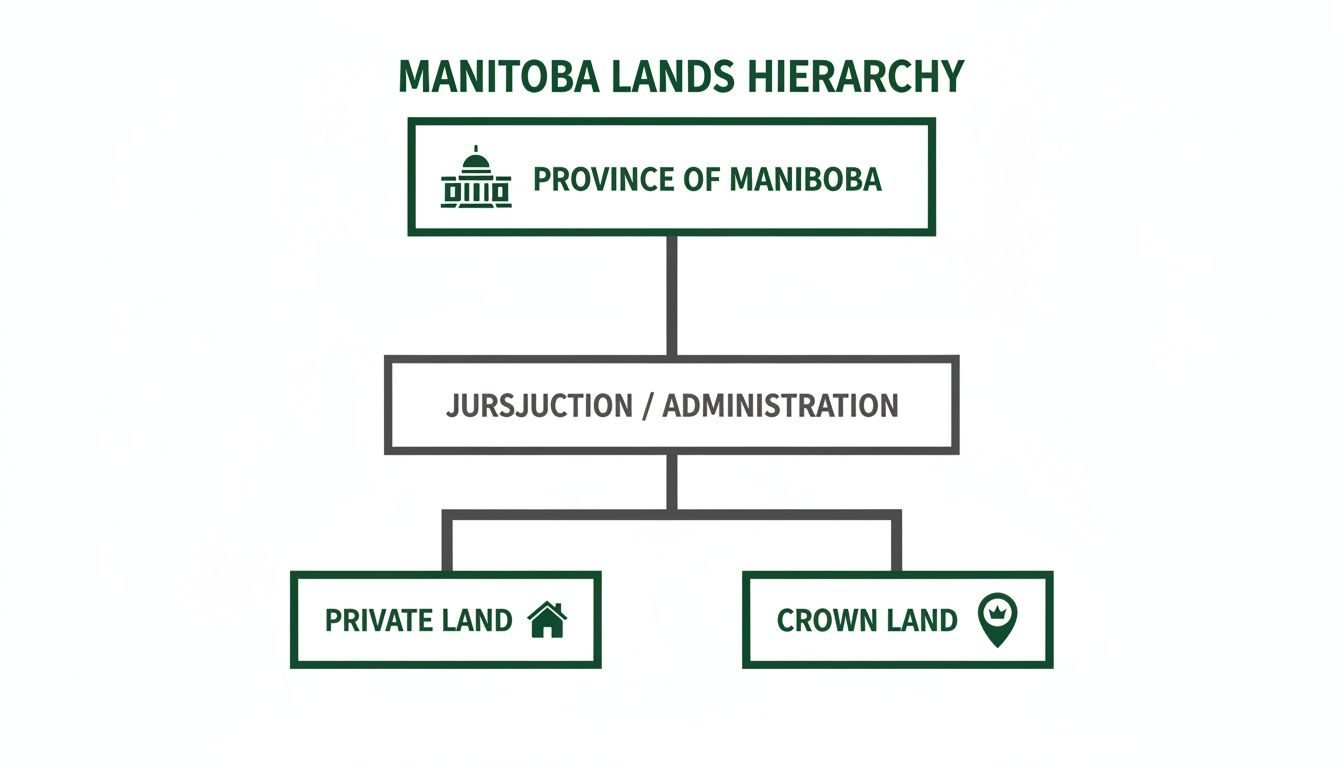
This diagram neatly shows how all land in the province, whether private or Crown, falls under provincial jurisdiction. It's a good reminder that no matter where you are, you're playing by Manitoba's rules.
General Use Crown Land: The Go-To Starting Point
This is the bread and butter for most hunters. General Use Crown Land is the default category for public land that hasn’t been set aside for a specific purpose, like a park or an agricultural lease. It's the most common and accessible type of Crown land out there.
On these lands, as long as you have the proper licenses, you can generally hunt during open seasons and even camp temporarily without needing a special permit. But "general use" doesn't mean it's a free-for-all. You still have to follow all provincial hunting regulations, stick to established trails where required, and pay attention to any posted signs.
Agricultural Crown Land: Leased But Not Locked Out
Here’s where things get a bit tricky, and where a lot of hunters get tripped up. Agricultural Crown lands are public parcels leased to farmers for things like grazing cattle or cutting hay. Even though it's technically Crown land, you don't have automatic permission to be there.
You must get permission from the leaseholder before setting foot on these lands. Entering without that permission is trespassing—no different than walking onto someone's privately owned farm.
These lands are actively managed, with grazing and haying leases lasting up to 15 years, while cropping leases are usually for five. If you're using a tool like HuntScout with its Crown land layers, these agricultural areas will be marked. It’s a heads-up that you need to do your homework and find out who holds the lease. To get a better sense of how these lands are managed, you can review Manitoba's agricultural land stories.
Wildlife Management Areas: Focused on Habitat
Wildlife Management Areas (WMAs) are chunks of Crown land specifically set aside to conserve and manage wildlife habitat. This sounds like a hunter's paradise, and often it is, but WMAs come with their own specific rulebook.
While hunting is a primary activity in most WMAs, they often have restrictions you won't find on General Use land. For example, you might find:
- Vehicle Restrictions: Motorized vehicles may be banned or limited to designated trails only.
- Firearm Rules: Some WMAs have specific regulations on firearm discharge or the type of firearms allowed.
- No-Hunting Zones: It's common for parts of a WMA to be designated as wildlife refuges where all hunting is prohibited.
Before you head into a WMA, always double-check the specific regulations for that particular area.
Provincial Parks and Forest Reserves: A Mixed Bag
Last up are the Provincial Parks and Forest Reserves. These areas are a mixed bag, managed for conservation, recreation, and sometimes sustainable forestry. The hunting rules here can vary dramatically from one spot to the next.
In many Provincial Parks, hunting is completely off-limits. However, some larger parks do have designated zones where hunting for specific species is permitted during set seasons. Provincial Forest Reserves are generally more open to hunting, but access and regulations can still be different from General Use land.
The golden rule here is to never assume. Always verify the rules for the specific park or reserve you have in mind before you plan your trip.
To help you keep it all straight, here's a quick-reference table that breaks down the access rules for each major type of Crown land you'll encounter.
Hunter Access on Manitoba Crown Land Types
| Crown Land Type | General Hunting Access | Key Considerations for Hunters |
|---|---|---|
| General Use Crown Land | Permitted | Most accessible, but follow all provincial regulations and posted signs. Temporary camping is usually allowed. |
| Agricultural Crown Land | Permission Required | You must get explicit permission from the leaseholder. Treat it like private property to avoid trespassing. |
| Wildlife Management Area (WMA) | Generally Permitted | Check for area-specific rules like vehicle restrictions, no-hunting zones, or special firearm regulations. |
| Provincial Park / Forest Reserve | Varies Widely | Hunting is often prohibited in parks but may be allowed in designated zones or in Forest Reserves. Always verify the rules for the specific location. |
This table is a great starting point, but remember that it's your responsibility as a hunter to confirm the specific rules for the exact piece of land you plan to visit. When in doubt, call your local conservation office.
Navigating Access Rights and Trespass Laws
Knowing the rules of access is just as important as knowing how to read a map or sight in your rifle. When you're out on Crown land in Manitoba, the line between a legal hunt and a costly mistake often comes down to one thing: knowing exactly where you stand, both on the ground and with the law. The rules aren't designed to be tricky, but they do demand that every hunter does their homework.
The whole idea of access usually begins with what's called implied permission. On General Use Crown Land—those wide-open spaces not set aside for specific things like farming or parks—the right to be there for recreation like hunting is generally a given. This means you don't need to track anyone down for a special pass, as long as you've got your hunting licence and are following all the standard regulations.
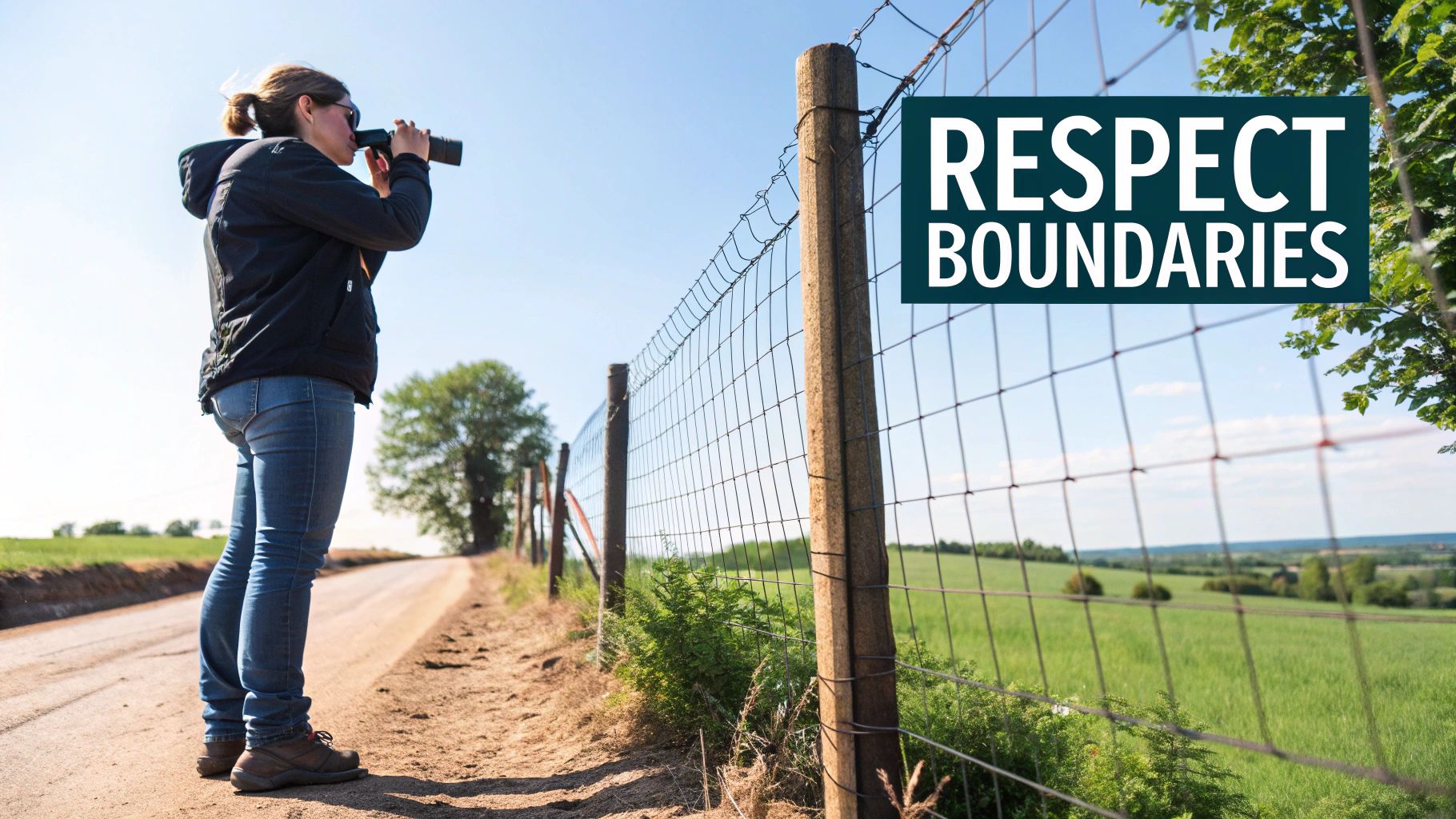
But that implied welcome mat gets pulled right out from under you the moment you see signs of private use or a different land designation. Fences, gates, "No Trespassing" signs, or even just evidence of farming are all crystal-clear signals that the rules have changed. Respecting these boundaries isn’t just good manners; it's a non-negotiable part of ethical hunting.
The Rules for Agricultural Crown Land
The biggest and most common exception to the "go-ahead" rule is Agricultural Crown Land. These are public lands, but they're leased out to farmers for things like grazing cattle or cutting hay. Even though it's technically Crown-owned, the person holding the lease controls who comes and goes.
Crucial Takeaway: You must get clear, explicit permission from the leaseholder before you set foot on any Agricultural Crown Land. Going on without it is trespassing, plain and simple.
Figuring out who holds the lease and how to contact them can feel like a bit of a hurdle, but it's a step you can't skip. Your local municipal office or the provincial lands branch is the place to start. A respectful phone call or visit explaining what you'd like to do is often the key to gaining access.
Understanding Manitoba's Petty Trespasses Act
There are real consequences for getting this wrong. The Petty Trespasses Act is the law that handles unauthorized access in Manitoba. It's very direct: entering a property after you've been told not to, or where signs are posted, is against the law. This applies just as much to leased Crown land as it does to private property.
The penalties can be steep, ranging from fines to a potential suspension of your hunting privileges. Worse yet, it gives all hunters a bad name and can lead to more land being closed off for good. The law doesn't care if you made an honest mistake or just didn't bother to check—the responsibility falls squarely on your shoulders. Knowing the legal ins and outs of property lines is a vital skill for hunters everywhere. You can see how these same ideas play out in other provinces in our guide to staying legal while hunting boundaries in Ontario and Alberta.
A Real-World Scenario
Picture this: you're scouting a great-looking spot on your map, which shows a big block of Crown land. When you get there, you find a wire fence running right through it, with cattle grazing on the far side. This is a textbook example of stumbling upon leased Agricultural Crown Land.
So, what's the play?
- Stop Immediately. Don't even think about crossing that fence. The fence and the livestock are your sign that any implied permission is officially off the table.
- Verify Your Location. Pull out your GPS or a mapping app like HuntScout to double-check your exact position and see how the land is classified. A good app will have layers that show the difference between General Use and leased lands.
- Assume It's Off-Limits. Until you have permission straight from the source, treat that fenced-off area like private property. The golden rule is simple: when in doubt, stay out.
- Do Your Research. If you're set on hunting that piece of land, your next move is to find out who the leaseholder is and ask them for access properly.
This careful, respectful approach doesn't just keep you on the right side of the law; it protects the reputation of the entire hunting community. By truly understanding and respecting the access rules on Crown land in Manitoba, you help ensure these incredible resources are here for generations of hunters to come.
How to Find Huntable Crown Land in Manitoba
Alright, now that you’ve got the rules down, we can get to the fun part: finding that perfect hunting spot. Hunting Crown land in Manitoba used to involve spreading out paper maps on the kitchen table and burning a tank of gas driving backroads, hoping to find an access point. And while there's still a place for that classic approach, modern tools have made the whole process faster and way more accurate.
The real key is to blend old-school woodsmanship with today's technology. Start with a bird's-eye view. Look at provincial maps to spot the big tracts of Crown land or Wildlife Management Areas (WMAs) in the regions you’re interested in. Think about the geography—rivers, dense bush, and the edges of farmland are all clues that can point you toward prime habitat for different game.
The Old-School Way: Traditional Scouting Methods
Before we all had smartphones, hunters had to rely on government-issued resources. These are still incredibly useful for getting a feel for an area.
- Provincial Government Maps: The Government of Manitoba still offers various maps, many of which show Crown land dispositions. You can often find these online or order paper copies from a provincial office.
- Topographical Maps: These are a hunter's best friend for understanding the lay of the land. They show you every hill, valley, creek, and swamp, helping you pinpoint potential game corridors, bedding areas, and good glassing spots before you even leave home.
- Local Intel: This one’s huge. Never underestimate what you can learn by striking up a friendly conversation with local hunters, trappers, or even a Conservation Officer. A five-minute chat at the local coffee shop can sometimes give you more practical info than any map ever could.
The catch with these traditional methods is that they often lack the nitty-gritty, up-to-date details you need for precise planning. A paper map might show a big block of Crown land, but it probably won’t tell you if it’s a General Use parcel or an agricultural lease—a critical difference for legal access.
A Modern Edge: Using Digital Tools for Pinpoint Accuracy
This is where digital mapping apps completely change the game. Tools built specifically for Canadian hunters, like the HuntScout app, eliminate the guesswork by layering all the vital information you need onto a single, interactive map. No more flipping between different maps and websites; it's all right there.
For instance, a traditional map might just show a big green blob labelled "Crown Land." But an app can instantly show you that one part of that blob is General Use, while the section right next to it is a grazing lease where you need to get permission from the leaseholder. That distinction is everything when it comes to staying on the right side of the law.
This screenshot from the HuntScout app shows exactly what I mean. The different land types are clearly colour-coded, so you can immediately see what's accessible Crown land, what's private, and what's something else entirely. Being able to overlay Wildlife Management Unit (WMU) boundaries and satellite imagery means you can plan your hunt with confidence, right from your phone.
A Quick Guide to Digital Scouting
Using a tool like HuntScout makes finding huntable Crown land incredibly simple. Here’s a quick rundown of how I do it:
- Pick Your Zone: First, zoom into the general area of Manitoba where you're planning to hunt.
- Turn on the Crown Land Layer: With one tap, the map lights up with colours. General Use Crown land shows up in one shade, while leased lands are another, making them dead simple to tell apart.
- Overlay WMU Boundaries: Next, add the Wildlife Management Unit layer. This makes sure the spots you’re eyeing are actually inside the zone your licence is valid for.
- Switch to Satellite View: Toggle over to the high-resolution satellite imagery to get a real look at the terrain. You can spot clearings, thick bush, water sources, and hidden access trails—all the features that attract and hold game.
- Drop Your Pins: Start marking potential spots—a promising ridge for glassing, a hidden waterhole, or the best place to park the truck. These waypoints are saved right to your map, so you can use them even when you're out of cell range.
Pro Tip: Use the satellite view to trace the edges where forests meet fields. Deer and other game love these "edge habitats" and often use them as travel corridors. Mark these spots on your map; they’re absolute magnets for wildlife.
This digital approach lets you scout dozens of potential locations in the time it used to take to physically check out just one. While the core principles of finding good hunting ground are the same across Canada, having a tool that’s dialed in for our specific regulations is a massive advantage. To see how these same techniques work in another province, take a look at our guide on how to find Crown land in Ontario. By pairing smart tech with solid hunting sense, you can uncover some incredible hidden gems on Manitoba's vast public lands.
Verifying Boundaries and Planning Your Hunt
Finding a great-looking spot on a digital map is a fantastic starting point, but the real work begins when your boots hit the ground. For any hunt on Crown land in Manitoba, knowing exactly where you stand is just as important as knowing where you're headed. A GPS coordinate is one thing; a rusty fence post in the mud is another. The ability to connect the two is what separates a successful, legal hunt from an accidental trespassing charge.
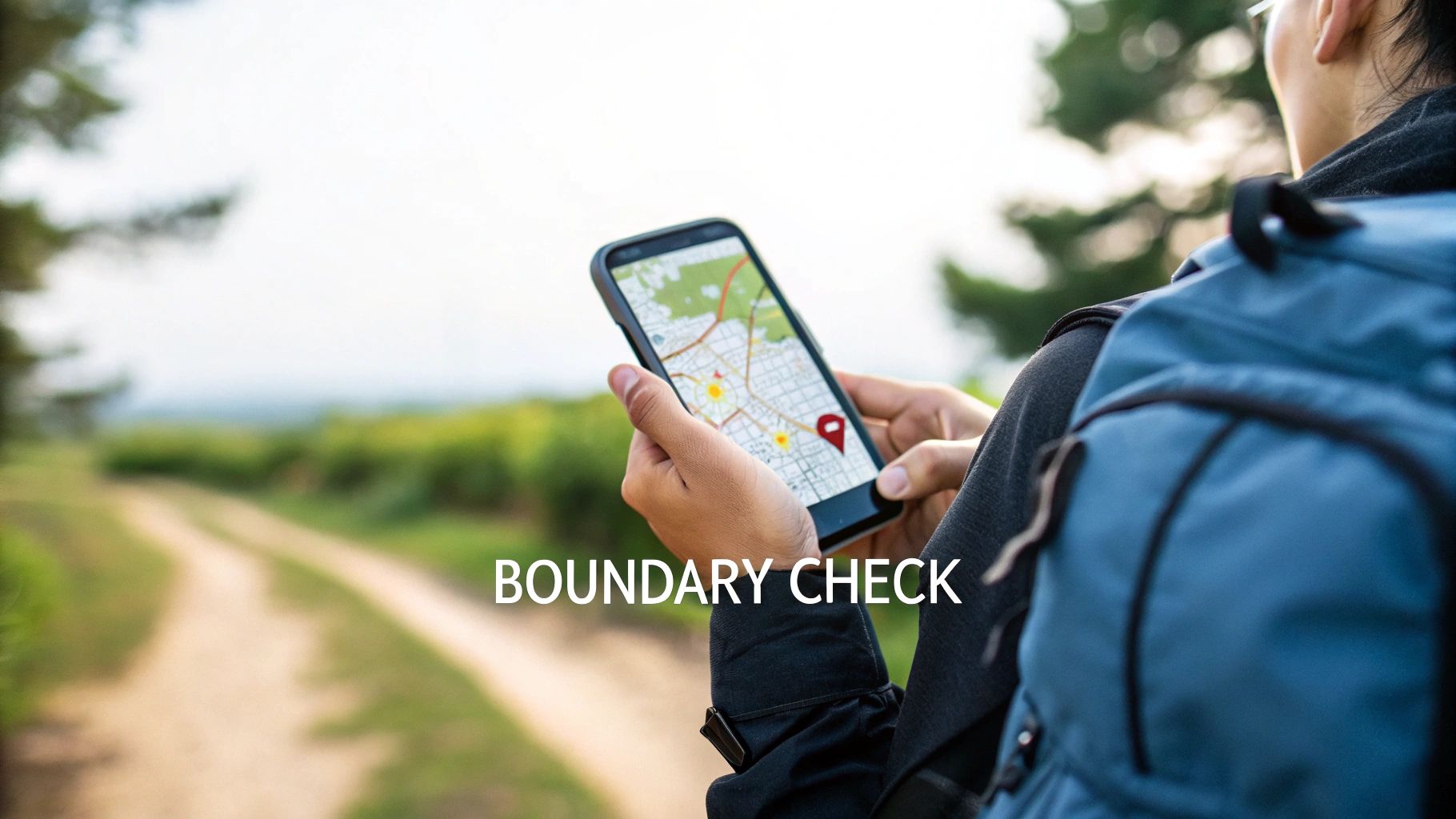
Modern tools have made this much easier, but they don't replace old-fashioned situational awareness. The moment you arrive, your first job is to square what your screen says with what you see around you. Keep your eyes peeled for physical boundary markers—fences, gates, no-trespassing signs, or even an abrupt change from dense bush to a neatly cut hayfield. These are your real-world clues that the land status might be changing, no matter what the map shows.
Navigating Without a Signal
Part of the appeal of Crown land is its remoteness, but that often means one thing: zero cell service. This is where a little prep work pays off big time. A good hunting app like HuntScout is invaluable here, letting you download maps for offline use. It basically turns your phone into a reliable GPS unit that works anywhere.
Before you even think about losing service, save the maps for your entire hunting zone. Doing this ensures all the critical information—Crown land boundaries, your saved waypoints, and satellite imagery—is stored right on your device. This isn’t a luxury; it’s a non-negotiable piece of safety and compliance gear for any hunter heading into the backcountry.
Planning for a Safe and Ethical Hunt
The best hunts are born from careful planning long before the truck is even loaded. Crown land, in particular, demands a specific game plan that goes well beyond just packing the right gear. You have to think about access, unique regulations, and your personal impact on the landscape.
Understanding the history of these lands helps frame our responsibility today. A huge reclamation project back in 1884 saw over a quarter of a million acres of marginal land repurposed, with 112,146 acres eventually falling under provincial control. Early on, settlers often had to actively farm the land to earn ownership. This history highlights the transition from settlement-focused parcels to the multi-use public lands we now cherish for hunting and recreation. You can read about Manitoba's land settlement history to get a deeper appreciation for these places.
Key Planning Considerations
Your pre-hunt checklist needs to go beyond your gear list. For a safe, respectful, and successful trip on Crown land, you have to nail down a few key details.
- Vehicle Access Rules: Can you drive your truck right up to your spot, or is it a park-and-hike situation? Motorized vehicle use, especially for ATVs, is almost always restricted to established trails to protect the habitat. Never assume you can just drive off-trail.
- Leave No Trace Principles: The golden rule is simple: pack out everything you pack in. That means every spent shell casing, every granola bar wrapper, and every bit of your camp. The goal should be to leave the area even cleaner than you found it.
- Firearm Discharge Regulations: Know your backstop and beyond. Provincial law is clear that you cannot shoot across or down a road. Always be aware of any nearby cabins, trails, or farm operations that might be hidden just over a ridge or behind a stand of trees.
Hunter's Responsibility: At the end of the day, the onus is on you to know the rules for the specific area you're in. Giving the Manitoba Hunting Guide a quick scan for local restrictions or firearm prohibitions before you leave is an absolute must.
This kind of proactive planning ensures you're not just staying legal, but also acting as a good steward of our shared public lands. A well-planned hunt is a safe hunt, an ethical hunt, and almost always, a more rewarding one.
Common Questions About Hunting on Manitoba Crown Land
Even after you've got a handle on the basics, there are always those nagging little questions that pop up when you're actually planning a hunt on Crown land in Manitoba. That's perfectly normal. The details are what make the difference between a great trip and a frustrating one, so let's clear up some of the most common points of confusion.
Think of this as a practical Q&A session, covering the kinds of "what if" scenarios that trip people up in the field. We'll get into everything from permits and campfires to ATV use and figuring out if that piece of land is leased.
Do I Need a Special Permit to Hunt on General Use Crown Land?
This is easily the question I hear most often, and thankfully, the answer for Manitoba residents is refreshingly simple: No, you don't need a special access permit to hunt on General Use Crown Land. Your standard, valid Manitoba hunting licence for whatever game you're after is your key to accessing these lands.
Now, the word "permit" does come up with Crown land, but usually for much more involved activities. For instance, if you wanted to build a semi-permanent hunting cabin or cut a bunch of firewood to sell, you'd absolutely have to go through a formal permitting process with the government.
But for the sake of recreational hunting—scouting, walking the land, setting up a temporary ground blind or a treestand for the season—your hunting licence is all the permission you need.
Can I Camp or Build a Fire While Hunting on Crown Land?
Yes, you can. Setting up a temporary camp is generally allowed on General Use Crown Land when you're there for a recreational activity like hunting. This is a massive plus, letting you stay right in the heart of your hunting spot for a few days. The key word, though, is temporary. You can't establish a permanent, year-round camp.
When it comes to campfires, the rules are just as simple but demand your full attention.
- Fire Bans Are Law: You can usually have a campfire, but it is your legal duty to check if a fire ban is in effect. The Manitoba Wildfire Service is the definitive source for up-to-the-minute information.
- Practice Real Fire Safety: Keep it small and contained in a proper pit. Never, ever leave a fire unattended, and make sure it's dead out—cool to the touch—before you walk away.
- Leave No Trace: This one’s not up for debate. Everything you pack in, you must pack out. That means all your gear, food scraps, and garbage. The goal is simple: leave the site looking like you were never even there.
A Quick Reality Check: The privilege of camping and having fires on Crown land hinges on everyone being responsible. One careless mistake can spark a devastating wildfire, which could easily lead to much tighter rules for all of us down the road.
How Can I Tell if Crown Land Is Leased to a Farmer?
Learning to tell the difference between open General Use land and leased Agricultural Crown Land is probably one of the most important skills you can develop. A mistake here can land you in a trespassing situation. While modern mapping apps are your best bet, you still need to know what to look for on the ground.
Your eyes are your first line of defence. Keep them peeled for:
- Fences and Gates: Any kind of fencing, even a single rusty strand of wire, is a huge red flag that the land is being managed for something.
- Livestock: Seeing cattle, horses, or other farm animals is a dead giveaway you're looking at a grazing lease.
- Farming Activity: Freshly cut hay, crop stubble, or the presence of farm equipment are also clear signs the land is likely leased.
The problem is, not all leased land is so obvious. This is where a trustworthy mapping tool becomes absolutely essential. An app like HuntScout uses clear, colour-coded layers that show you exactly where the boundary is between General Use land and a private lease, taking all the guesswork out of it.
If you ever find yourself in doubt, always play it safe. Treat the land as private until you can prove otherwise with an official map or by getting in touch with the local lands branch.
Are ATVs Allowed on Crown Land for Hunting?
You can use an ATV on Crown land in Manitoba, but its use is tightly controlled to protect the habitat. You can't just rip around wherever you want. The number one rule is that you must stay on established and designated trails. Going off-trail tears up sensitive vegetation, causes soil erosion, and can badly disrupt wildlife.
On top of that, many specific areas like Wildlife Management Areas (WMAs) have their own set of stricter rules. You’ll often find restrictions such as:
- Designated Routes Only: Motorized traffic might be confined to just a few marked trails.
- Seasonal Closures: Some trails could be closed during spring thaw, nesting seasons, or other critical times of the year.
- No-Vehicle Zones: Parts of a WMA may be completely off-limits to all vehicles to create an undisturbed sanctuary for animals.
It's your responsibility to check the local rules for that specific WMA or Crown land unit before you unload your quad. And it goes without saying, your machine must be registered and insured as required by law.
A successful Crown land hunt is a mix of good knowledge and the right tools. HuntScout was built to give you that critical edge, transforming complex land ownership data into a simple, clear map on your phone. From telling leased land apart to navigating when you have no cell service, it's the partner you need for a confident and legal hunt.