A successful grouse bird hunting trip is so much more than a walk in the woods. It's a blend of classic woodsmanship and smart, modern strategy. This guide is built to give you a complete framework for hunting grouse here in Canada, showing you how to bring everything together—from careful planning and staying legal to ethical, effective work in the field.
We'll also dig into how you can use tools like the HuntScout app to sharpen your approach at every stage, from scouting at home to bringing home your harvest.
Your Blueprint for a Successful Grouse Hunt
Think of this guide as a modern playbook for the thoughtful hunter, not just another checklist. We’re moving past the basics to give you a real-world framework that works. You won't just learn what to do, but how to think strategically about every part of the hunt.
A big piece of that modern approach is integrating technology smartly. I'll show you how tools like HuntScout can give you a serious leg up. It's perfect for navigating huge tracts of Crown land, making sense of complex Wildlife Management Unit (WMU) regulations, and pinpointing prime habitat before you even pull on your boots.
The Modern Hunting Framework
A modern grouse hunt really breaks down into three distinct phases: the plan, the hunt, and the harvest. Each one builds on the last, creating a cycle of preparation and execution that will lead to more consistent success and, frankly, a much deeper appreciation for the chase. It’s all about working smarter.
This is the flow that I’ve found leads to the best results.
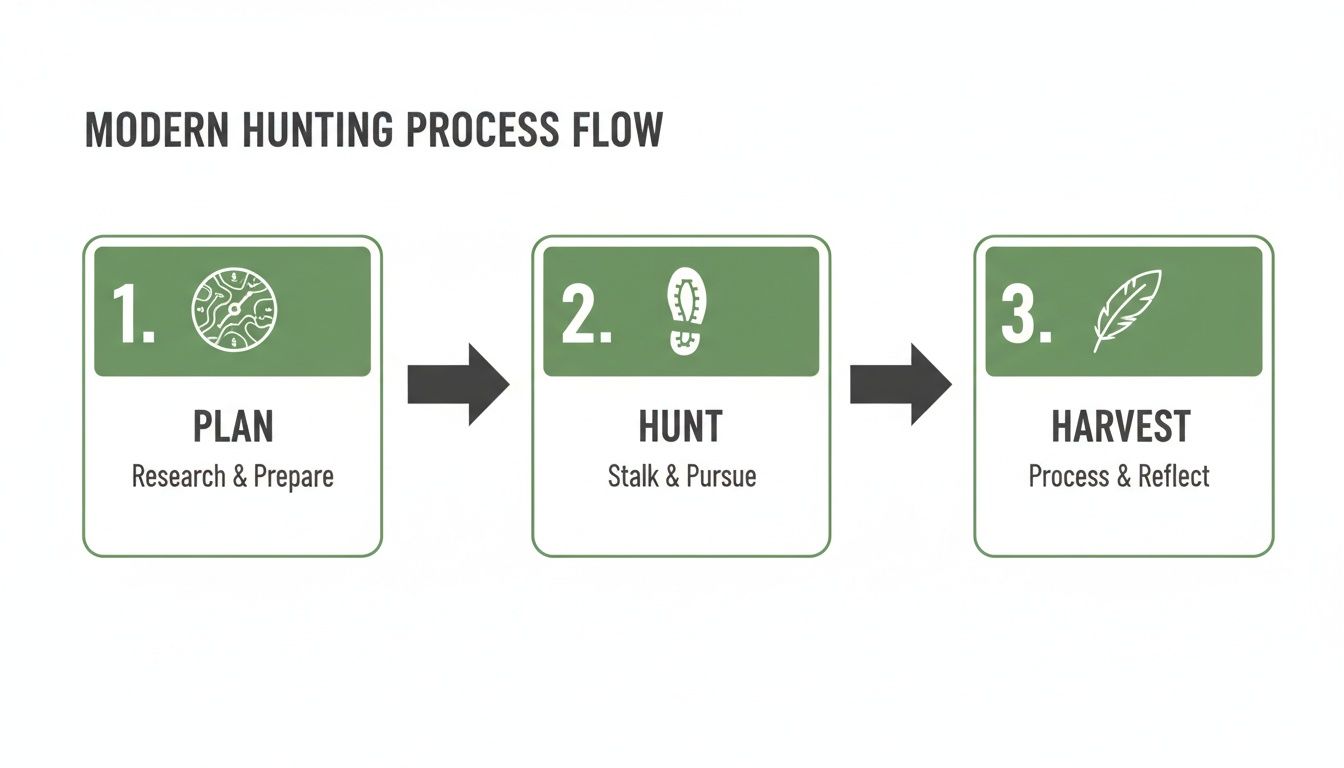
The real secret here is understanding that a great hunt often starts weeks before you ever step foot in the bush. Your digital prep work sets the stage for everything that happens in the field. This structured approach is what turns a random walk into a purposeful, well-executed hunt.
Let's break down what this modern framework looks like from a bird's-eye view.
Anatomy of a Modern Grouse Hunt
This table gives a high-level overview of the key phases, showing how digital scouting at home connects directly to your actions in the field.
| Phase | Core Objective | Essential Tools |
|---|---|---|
| Plan | Identify promising habitat, confirm regulations, and create a strategic hunt plan. | Topographic/satellite maps (HuntScout), WMU layers, provincial regulations |
| Hunt | Execute the plan, navigate effectively, and adapt to conditions on the ground. | GPS or mapping app (offline mode), compass, appropriate shotgun & choke |
| Harvest | Make an ethical shot, safely recover the bird, and document hunt details. | Game bag, blaze orange gear, waypoint/track recording |
It’s a simple but powerful cycle: solid preparation leads to a more focused hunt, which in turn leads to a respectful and successful harvest.
A successful day in the grouse woods is often measured by the quality of the dog work and the number of birds flushed, not just what ends up in the bag. It's the culmination of good planning and good fortune.
What You Will Learn
Throughout this guide, we'll focus on skills you can put to use right away. This is all practical knowledge that makes a real difference when you're out there.
- Scouting and Habitat: You'll learn how to read the land, spotting the key food sources and transitional edges that grouse absolutely love, using both old-school know-how and modern satellite maps.
- Legal Compliance: We'll make sure you can confidently navigate WMU boundaries and season dates, ensuring every hunt is safe and completely legal under Canadian regulations.
- Field Techniques: Get the hang of flushing birds in thick cover, picking the right gear for the job, and working as a team with your gun dog.
- Ethical Harvesting: We'll cover why shot placement is so critical, how to ensure you recover every bird, and your role as a conservationist in preserving this sport for the next generation.
This guide is for any hunter who wants to blend proven fieldcraft with today's best tools. The goal is a smarter, safer, and more rewarding time in the grouse woods.
Finding Grouse Before You Leave Home
Some of my best grouse hunts were decided weeks before I ever laced up my boots, usually while staring at a map on my computer screen. This is what smart, digital scouting is all about—it’s the real difference between a long, pointless walk in the woods and a focused, successful day. It's how you find birds before you even burn a litre of gas.
The whole process starts with getting inside a grouse's head and understanding what it needs to survive. Each of Canada's main grouse species has a pretty specific preference for habitat, and learning to spot these differences on a satellite map is the first skill you need to master. You’re not just looking for green space; you’re looking for a very particular set of ingredients.
Decoding Grouse Habitat from Above
Before you can pick a spot on the map, you need to know what you’re looking for. Our three primary species—Ruffed, Spruce, and Sharp-tailed grouse—all like their own kind of neighbourhood.
Ruffed Grouse: These guys are the masters of the edge. You want to find young, thick stands of aspen (poplar) and alder. They absolutely thrive in what’s called early successional forest—areas that were logged or burned 5-15 years ago. On a satellite map, these spots often show up as a lighter, almost fuzzy green, usually pushed up against darker, more mature woods.
Spruce Grouse: As you’d guess from the name, these birds stick to the conifers. I look for dense stands of spruce and fir, especially places with a thick understory and maybe a bog or wetland nearby. From the air, these forests look like solid, dark green carpets.
Sharp-tailed Grouse: Sharptails are birds of the open country. They prefer native grasslands and prairie parklands with scattered shrubs or aspen groves for cover. You'll be looking for big, open areas that transition into brushy draws or the edges of farm fields.
The one thing they all have in common is a love for transitional edges—those places where one type of habitat crashes into another. A line where a thick aspen stand meets an old hayfield, or where a spruce bog borders a hardwood ridge, is a five-star location to check out. These edges give them both food and a quick escape route, all in one convenient package.
The best grouse covers are never one-dimensional. The real trick is learning to see those subtle seams and changes in the vegetation where birds love to concentrate. An old, overgrown logging road cutting through the bush is a classic example—it’s a perfect edge that grouse use for travel and feeding.
Using HuntScout for Digital Scouting
Once you have a good picture in your mind of what you're looking for, a tool like HuntScout is where you turn that knowledge into a plan. This is how you stop guessing and start finding, saving yourself hours of wandering around in unproductive bush. The end goal here is to build a solid list of promising spots you can go check out in person.
The very first thing I do is turn on the Crown Land map layer. This instantly filters the world into places I can legally hunt and places I can't. There’s nothing worse than finding the perfect-looking cover, only to realize it's private property.
With that sorted, I switch to the satellite imagery. I’ll start zooming in on the Crown Land parcels, looking for those habitat signatures we just talked about. I’m hunting for that textured, lighter green of a young aspen stand for ruffies, or the dark, dense evergreen blocks for spruce grouse. I’ll pan around, following creek bottoms and old logging cuts—these are natural funnels and edge-makers.
Building Your Hunt Plan with Waypoints
As you find these promising-looking areas, don't just try to remember them. Drop a waypoint right on the spot in the app. I like to give them descriptive names like "Young Aspen Cut" or "Spruce Bog Edge" so I know exactly what I was thinking later. This builds up your own personal library of potential hotspots.
Now for the most important part: layer on the WMU boundaries. This is absolutely critical. By tapping on any of your waypoints, the app will instantly tell you which Wildlife Management Unit it’s in. This is non-negotiable for checking the regulations. You can take a look at our guide to Canadian hunting seasons and regulations to see just how vital this step is.
By the time you're finished, your map should be dotted with a dozen or more waypoints, each one a high-percentage spot worth investigating. This is your game plan. Believe it or not, you've just done 80% of the work from your couch, making sure that when you finally get your boots on the ground, your time is spent hunting smart, not just wandering.
Navigating Canadian Hunting Regulations with Confidence
Hunting legally in Canada is about more than just glancing at the regulations guide once a year. It's about knowing with absolute certainty that you're compliant, especially when a promising patch of grouse cover leads you over a hill and potentially into a new Wildlife Management Unit (WMU).
Provincial rules can be a maze. WMUs, season dates that shift year to year, and specific bag limits can change from one side of a logging road to the other. Getting it wrong is not an option, and this is where all that digital scouting homework really starts to shine.
Pinpointing Your WMU and Season Dates
The foundation of any legal hunt is simple: being in the right place at the right time. The old way meant juggling paper maps and dense regulation booklets, a clumsy process that left too much room for error. Thankfully, those days are over.
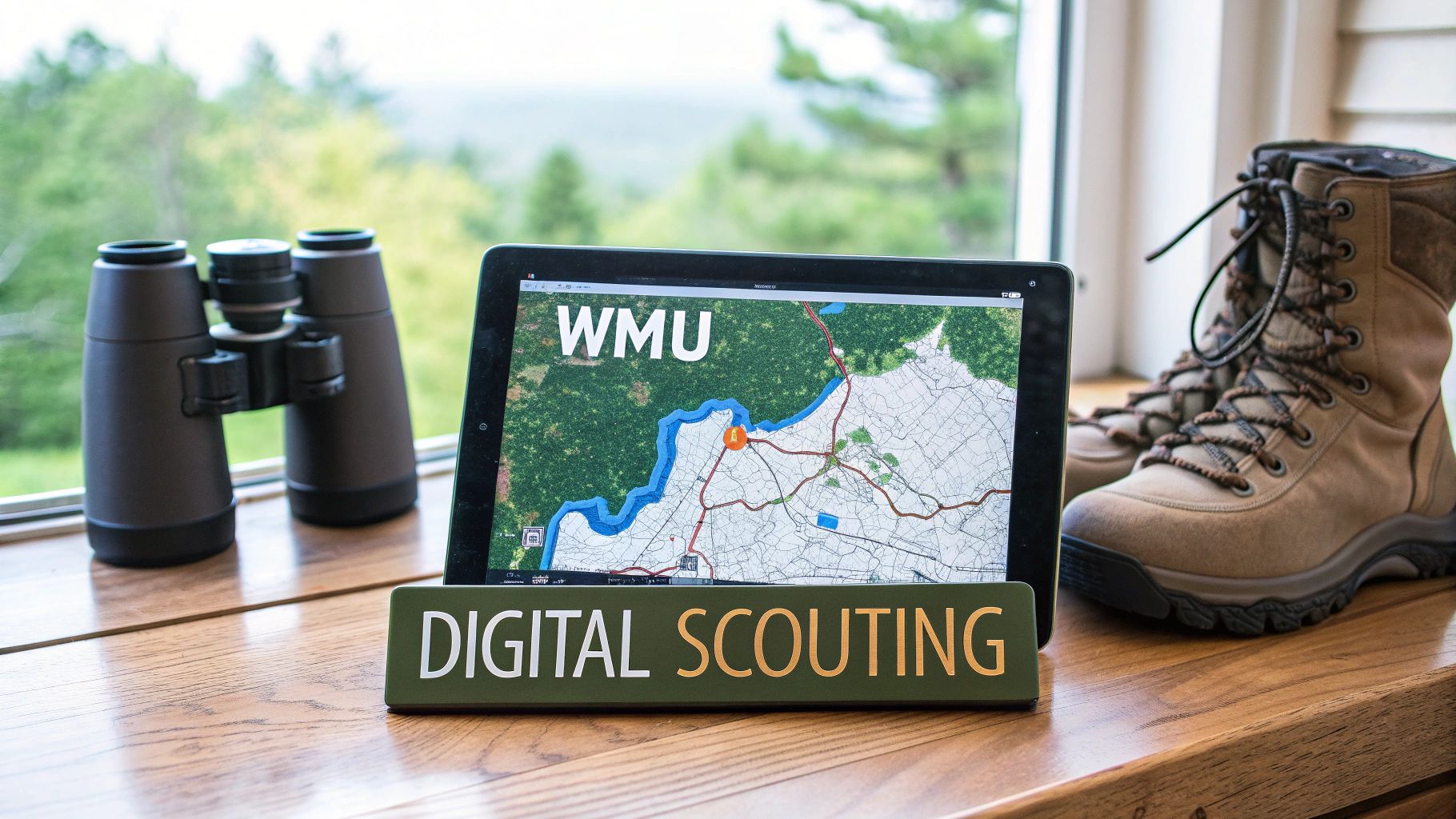
With a modern tool like HuntScout, the WMU boundaries are layered right onto the satellite and Crown land maps you've been studying. There’s no more guesswork.
As you walk through the bush, your phone's GPS pinpoints your exact location, showing you which unit you’re standing in at that very moment. A quick tap on the screen pulls up the current, official season dates and possession limits for ruffed, spruce, or sharp-tailed grouse in that specific zone. This real-time check is a game-changer, especially when you're hunting new ground near a WMU border. You can dig deeper into accessing these areas in our guide on what Crown land is in Canada.
A good grouse hunt is built on certainty. When you know you are 100% compliant with the local regulations, you can stop worrying and focus on what matters—reading the habitat, working your dog, and enjoying your time afield.
This kind of precision is more than just a convenience; it's a critical part of modern conservation. For a sharp reminder of why this is so important, just look at the plight of the greater sage-grouse in California. Population crashes forced regulators to set the hunting quota to zero across all zones back in 2017, a closure that has been upheld for 2025. It’s a sobering story that shows how quickly opportunities can vanish and why we, as Canadian hunters, need the best tools to stay within legal boundaries and ensure our own wildlife populations thrive. You can learn more about the sage-grouse status in California from the Department of Fish and Wildlife.
Getting Clear Answers on Complex Rules
What about those nagging questions that always pop up? The rules for transporting a firearm, the specifics of party hunting, or how to properly leave evidence of species can be confusing and vary widely between provinces. Sifting through pages of legalese to find a simple answer is a frustrating way to kill the excitement of planning a hunt.
This is where a feature like HuntScout's AI Assistant comes in handy. You can just ask it direct questions in plain English.
Here are a few examples of what you could ask:
- "What are the daily bag limits for ruffed grouse in WMU 47 in Ontario?"
- "Do I need to leave a wing attached for species identification in Alberta?"
- "What are the legal shooting hours for upland birds in Saskatchewan?"
Think of it as having a regulations expert in your pocket, ready to give you clear answers 24/7. It helps you understand not just what the rules are, but why they exist, ultimately making you a more knowledgeable and responsible hunter.
By layering visual map boundaries with on-demand access to the specific rules, you eliminate the grey areas. From planning at home to walking a trail in the field, you can move with the confidence that you're hunting safely, legally, and ethically. That peace of mind is the hallmark of a well-prepared modern hunter.
Choosing the Right Gear and Hunting with a Dog
Effective grouse hunting isn't about having the fanciest, most expensive kit; it's about choosing practical gear that works when you're deep in the bush. When you're pushing through thick alder tangles or navigating steep poplar ridges, simplicity and function always win out.
At the heart of it all is your shotgun. Forget about heavy magnum loads and long barrels. Grouse are almost always taken at close range with fast, instinctive shots, so a lightweight and quick-handling shotgun will be your best friend.
That’s why so many seasoned hunters swear by a 20-gauge or even a featherlight 28-gauge. These shotguns are a pleasure to carry over kilometres of rough country and they come up to your shoulder in a flash. A classic 12-gauge will certainly do the job, especially with lighter field loads, but it can start to feel like an anchor by the end of a long day.
Selecting Your Shotgun and Choke
The real secret sauce isn't just the gauge—it's the choke. The choke is the constriction at the end of your barrel that controls how your shot pattern spreads. Since most shots at a thundering grouse happen well inside 25 metres, you want a pattern that opens up quickly and gives you a bit of room for error.
- Improved Cylinder (IC): This is the gold standard for most grouse hunters. It throws a wide, forgiving pattern that’s perfect for the close, fast shots you'll get in thick cover.
- Skeet or Cylinder: If you're hunting the super-dense bush of the early season where a shot over 20 metres is rare, an even more open choke like Skeet or Cylinder can be a real advantage.
- Modified (Mod): Later in the season, when the leaves are down, you'll often be hunting more open aspen stands or field edges where shots might stretch out a bit. A Modified choke gives you that extra reach without being overly tight.
I usually start the season with an Improved Cylinder in my over-and-under and might switch the top barrel to Modified once the woods open up. It’s all about matching your setup to the terrain you’re in.
Choosing Your Grouse Hunting Shotgun Setup
This table breaks down the most common setups to help you match your shotgun and choke to the conditions you’ll likely face in the Canadian uplands.
| Gauge | Best For | Recommended Choke | Typical Shot Distance |
|---|---|---|---|
| 12-Gauge | All-around use, especially for hunters who also pursue other game. | Improved Cylinder, Modified | 15-35 metres |
| 20-Gauge | The quintessential grouse gun; lightweight for all-day carry in thick cover. | Improved Cylinder, Skeet | 15-30 metres |
| 28-Gauge | The specialist's choice; extremely light for fast handling and close shots. | Skeet, Improved Cylinder | 10-25 metres |
| .410 Bore | Experts only; requires precise shooting in very close-quarters cover. | Full, Modified | 10-20 metres |
Remember, patterning your shotgun with your chosen loads is crucial. What works on paper will give you the confidence you need when a bird explodes from under your feet.
A perfectly tuned shotgun is only half the battle. Your ability to move quietly through the woods and spot the subtle signs of bird activity is what actually puts you in a position to use it.
Essential Apparel and Navigation Tools
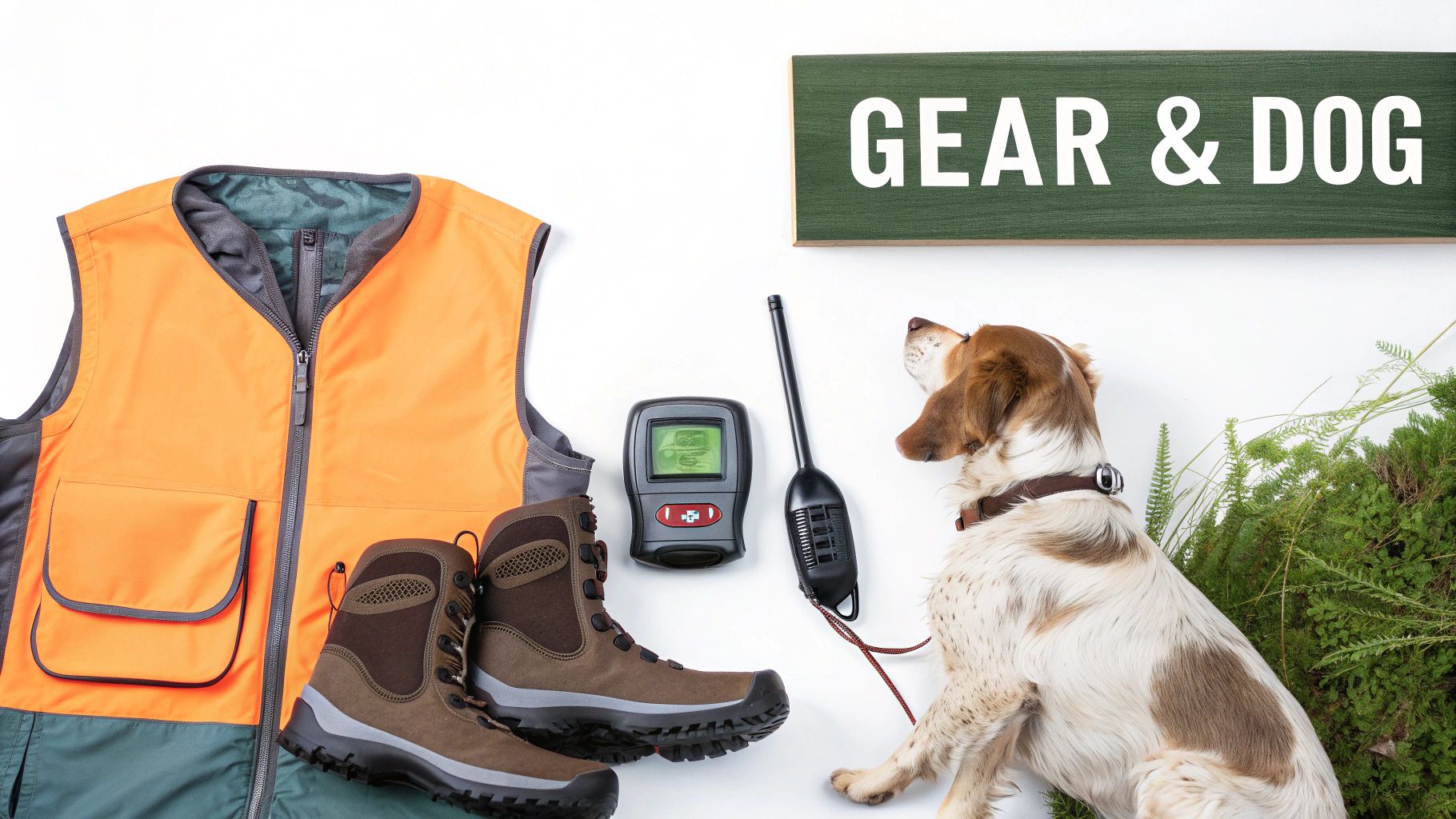
Beyond your firearm, a few key pieces of gear can make or break your hunt, both in terms of comfort and safety. A good pair of boots is absolutely non-negotiable. You need something waterproof with excellent ankle support to handle wet ground, tangled deadfall, and rocky terrain without a second thought.
Blaze orange isn't just a good idea; it's a critical piece of safety equipment. A vest and a hat are the bare minimum to make sure you're highly visible to other hunters and your own partners in the thick bush.
Finally, never head out relying just on your sense of direction. A dedicated GPS unit or a mapping app on your phone, like HuntScout, is essential. The ability to download and use offline maps is a game-changer, since cell service is often a fantasy in prime grouse country. Being able to track your route and drop a waypoint for your truck or a bird flush provides an invaluable safety net.
Working with a Canine Partner
Hunting grouse over a good bird dog is one of the most rewarding experiences you can have in the uplands. A dog's nose will find birds you would walk past 99% of the time. But it's important to match the dog to your hunting style.
Generally, gun dogs fall into two camps for grouse hunting:
- Pointers: Breeds like English Setters, Pointers, and German Shorthaired Pointers are born to range out, lock up on scent, and "point" the bird. They hold that point until you move in for the flush. They cover a ton of ground but need consistent training to hunt at a comfortable range in the woods.
- Flushers: Spaniels and retrievers, like English Cockers or Labradors, are all business and work much closer to the gun. Their job is to find birds within shooting range and push them into the air. They are an amazing choice for hunters who prefer a close-working companion that stays within a 20-metre bubble.
No matter the breed, a successful partnership comes down to control and safety. Your dog must be trained to obey commands, especially a rock-solid recall. If you want to dive deeper into breeds and their strengths, check out our guide on the best hunting dog breeds for different game.
Keeping your dog safe in the field means packing extra water, a canine first-aid kit, and being aware of potential hazards like traps or predators. A GPS tracking collar is also a fantastic investment, giving you total peace of mind by showing your dog's exact location, even in the thickest cover imaginable.
Boots on the Ground: In-Field Strategies for Flushing and Shooting
All that digital scouting and careful gear prep leads to this exact moment. You’re finally in the woods, shotgun in hand, moving through what looks like prime grouse country. This is where real woodsmanship takes over. How you move, how you anticipate the flush, and how you react to that sudden explosion of wings—that’s what fills the game bag.
The trick is to hunt with purpose, not just wander around hoping to get lucky. Every step you take should be a calculated move designed to put you in the best possible position when a bird finally decides to bolt.
How to Move Through the Cover
If you're hunting solo through thick brush, the zig-zag pattern is your best friend. Instead of just plowing ahead in a straight line, you weave back and forth, effectively covering a much wider piece of ground. This constant change of pace and direction has a way of getting on a tight-holding bird's nerves, often pushing it to flush when it otherwise might have let you walk right by.
Things change a bit when you’re hunting with a partner. The idea is to work together, almost like a slow-motion pincer movement. One of you can stick to the edge of a logging road or clearing, while the other pushes through the woods about 20-30 metres in. You stay in touch, either by sight or just by calling out, and this two-pronged approach covers both the deep stuff and the easy escape routes. More often than not, it flushes birds towards the hunter with the clearer shot.
And a quick tip: slow down. Resist that urge to cover ground quickly. A slow, deliberate walk with frequent pauses is far more effective. Stop for a moment, look around, and listen. That silence is often the final straw that makes a hidden grouse lose its nerve.
Reading the Woods and Expecting the Flush
As you're walking, your eyes should be constantly scanning—not for the bird itself, but for the little pockets of habitat where a grouse should be. Grouse are creatures of habit, and they're almost always hanging around two things: good food and good cover.
Keep an eye out for these classic grouse magnets:
- Downed Logs: Ruffed grouse are famous for their drumming logs, and the thick regrowth and cover around a big fallen tree is a perfect hiding spot.
- Creek Bottoms: The damp ground along small streams and beaver ponds supports dense thickets of alder and willow, which are like five-star hotels for grouse.
- Food Sources: In the fall, zero in on patches of high-bush cranberries, hawthorn, or young aspen and poplar stands where the birds will be feeding on buds.
When you start getting close to one of these high-percentage spots, get your shotgun up and into a ready position, held across your chest. It might feel a bit tiring at first, but that simple change shaves precious fractions of a second off your mount, which is often the difference between a hit and a miss.
Anticipating the flush isn't about X-ray vision; it's about reading the landscape. When you walk up to a spot that just looks perfect—a thick tangle of brush right next to a berry patch—you should be expecting a bird to go up. That mindset keeps you from being caught flat-footed.
The Two-Second Shot
A flushing grouse gives you maybe two seconds to make it happen. There's simply no time to line up a perfect shot like you would with a rifle. It all comes down to instinctive shooting.
Think of it as pointing, not aiming. It’s a smooth, fluid motion where you mount the gun to your cheek, focus hard on the bird, and swing the barrel through its flight path. You pull the trigger just as you pass its head. Your brain does all the hard work of calculating the lead as long as your eyes stay glued to the target. The single biggest mistake hunters make is trying to aim right at the bird, which almost guarantees a miss right behind it.
Of course, safety is everything in that adrenaline-filled moment. Always know your safe zones of fire, especially if you have a partner or a dog out with you. Never, ever shoot at a low bird, and be 100% certain of where your hunting companions are at all times.
Using HuntScout in the Moment
This is where all your pre-hunt homework on the HuntScout app pays off big time. With your waypoints for promising coverts already saved, you can easily navigate from one spot to the next using the offline maps. You’ll never have to worry about getting turned around, even when you're deep in the bush with no cell service.
When a bird flushes—whether you got a shot off or not—drop a waypoint on the app immediately. Just label it "Flush" and add the date. Do this consistently, and over a season or two, you’ll build an incredibly detailed personal map of grouse activity, revealing patterns you’d never notice otherwise.
If you do connect with a bird, the next step is crucial.
Marking Your Bird:
- Keep your eyes locked on the exact spot you saw the bird fall. Don't look down at your feet or up at the sky. Stare at that spot.
- Walk straight to it. Before you do anything else, pull out your phone and drop a "Downed Bird" waypoint in HuntScout.
- Even if you find it right away, that pin is your anchor. If you have to search in thick cover, it gives you a reliable starting point so you don't end up wandering in circles.
This simple habit prevents lost birds and is a cornerstone of ethical hunting. Plus, the app's tracking feature leaves a breadcrumb trail of your entire route, making the hike back to the truck a piece of cake, no matter how far you've roamed.
The Ethical Harvest and Your Role in Conservation
When the shot finally echoes through the woods, the hunt isn’t over. In a lot of ways, the most important work has just begun. What you do next—making a clean harvest, caring for the bird, and contributing to conservation—is what truly defines you as a hunter. This is the responsibility we carry, and it's the part that secures the future of the sport we love.
A good day of grouse bird hunting isn't just about a full game bag. It’s measured by the respect you show for the animal and its home. This is where we honour the harvest and step up as stewards of the wild places we get to explore.
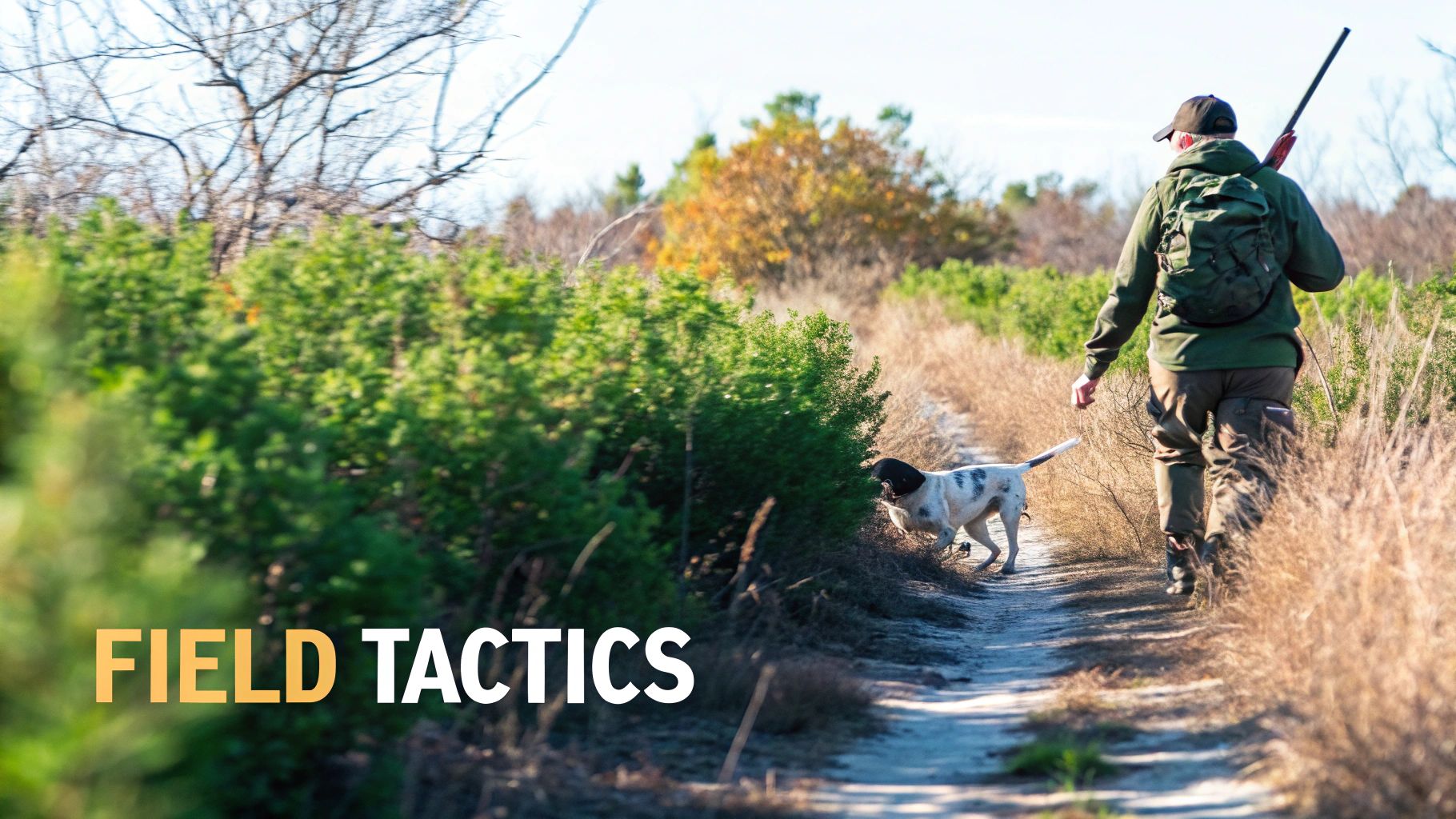
Humane Shot Placement and Recovery
Every hunter's goal should be a quick, clean dispatch. With flushing birds like grouse, that means putting your shot pattern on the front half of the bird. Centring your pattern on the head and chest area delivers an instant, ethical kill, preventing wounded birds and unnecessary suffering.
Of course, that’s much easier said than done when a grouse thunders out of thick cover right at your feet. With practice, though, swinging through the bird and pulling the trigger as your barrel overtakes its head becomes almost second nature. It’s the best way to concentrate the shot where it counts. And if a whole covey gets up, resist the urge to "flock shoot"—always pick a single bird and stick with it.
Finding a downed bird in dense bush can be a real challenge.
- Mark the Spot: As soon as you shoot, lock your eyes on the exact spot where you saw the bird fall. Don't look away for a second.
- Walk a Straight Line: Head directly to that spot. Don't let anything distract you. Once you get there, leave your hat or a glove to mark it.
- Search Systematically: If the bird isn't right there, start walking in small, expanding circles or a grid pattern out from your marker. This is where a good dog proves its weight in gold; their nose will find birds you'd walk past ten times.
The moments you spend searching for a downed bird say everything about your commitment as a hunter. A bird in the hand is the end result of a well-placed shot and a diligent, respectful recovery.
Field Care for Quality Meat
Proper field care begins the moment the bird is in your hand. This is how you honour the animal—by ensuring none of it goes to waste. Your absolute number one priority is to cool the meat down as quickly as possible to prevent spoilage and guarantee a great meal later.
Many seasoned hunters field dress their grouse right away. Pulling the entrails allows cool air to circulate inside the body cavity, dropping the temperature fast. It’s also why a game vest with a mesh back is so much better than a plastic bag; it lets the birds cool properly. On those warm, early-season days, getting them into a cooler with ice as soon as you’re back at the truck is always a smart move.
Our Role as Hunter-Conservationists
Our responsibility doesn't end with our own hunt. As hunters, we’re on the front lines of conservation, and our actions have a direct impact on the future of upland bird populations. This stewardship really boils down to two things: respecting the habitat and contributing good data.
When you’re out there, practice leave-no-trace principles. That means packing out everything you pack in, especially your spent shotgun shells. Stay on established trails with your vehicle to avoid tearing up vegetation, and be mindful of not disturbing non-game wildlife. These small acts add up, preserving the integrity of the wild places we all rely on.
Just as crucial is our role in wildlife management. Provincial agencies depend on hunter-supplied data to make sound decisions on seasons and bag limits. When you participate in wing and tail feather surveys or accurately report your harvest, you're giving biologists the information they need on population trends, age ratios, and breeding success.
If you need a stark reminder of why this is so important, just look at the greater sage-grouse situation in California. Plunging populations forced regulators to shut down hunting completely, with quotas set at zero for all zones since 2017. It's a cautionary tale, and it underscores why it's so vital for Canadian hunters to use tools like HuntScout to stay on top of regulatory changes and help prevent a similar fate for our grouse species. You can read the specifics in the California Department of Fish and Wildlife’s official documentation.
By taking these responsibilities seriously, we do more than just hunt. We become active participants in a cycle of conservation that ensures the thunder of a flushing grouse will continue to echo through Canadian forests for generations to come.
Ready to plan your next hunt with the most accurate maps and regulations at your fingertips? Download HuntScout today and hunt smarter this season. Visit https://huntscout.app to get started for free.