Think of Ontario's Crown lands as the province's massive, shared backyard. It’s a staggering 87% of our total landmass—a huge territory managed by the government for everyone to use and enjoy for activities like hunting. This is an incredible resource for outdoorspeople, but it comes with a specific set of rules and responsibilities that every hunter needs to get right.
What Exactly Is Ontario Crown Land?
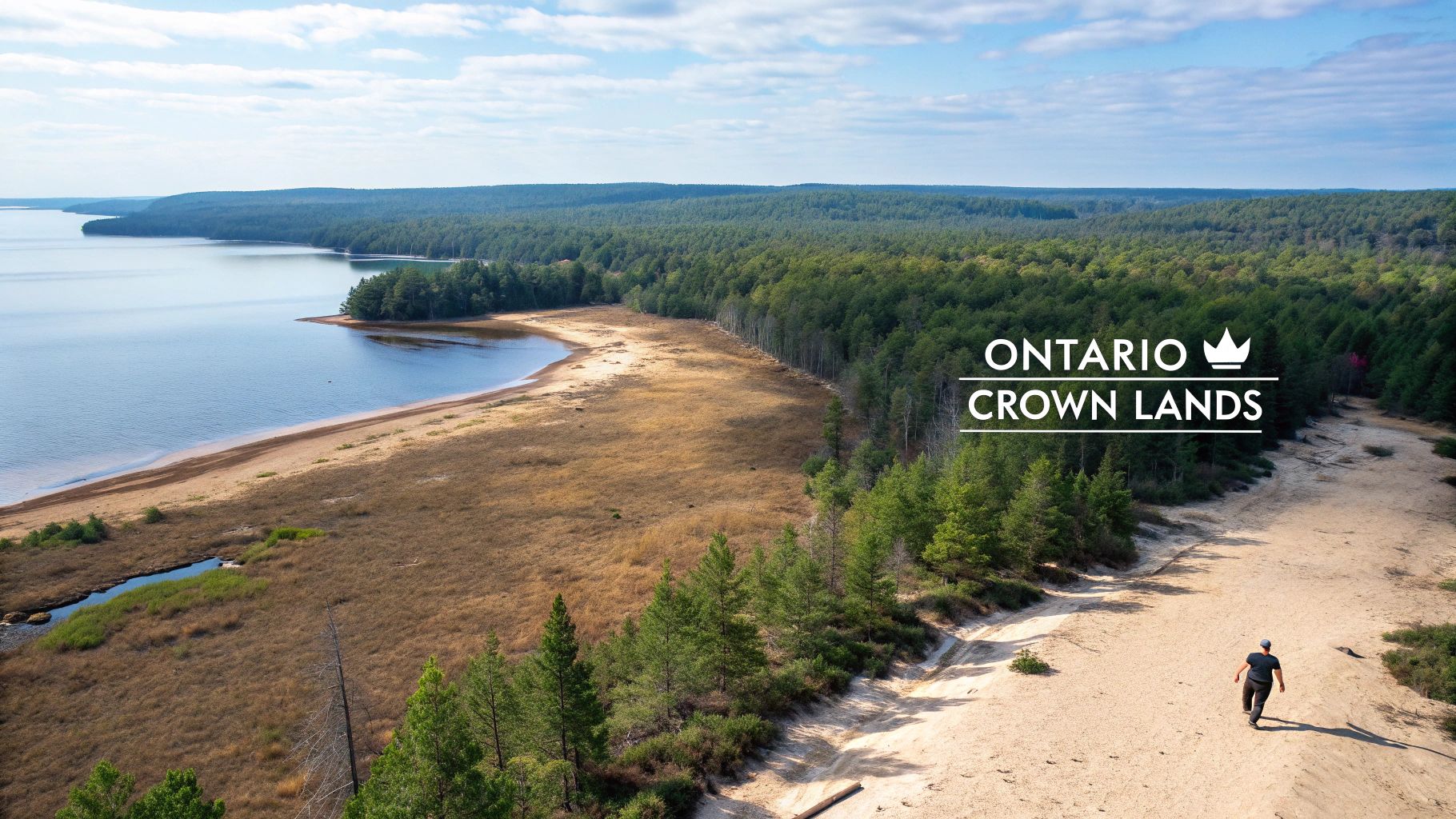
At its heart, Ontario Crown land is any piece of land or waterway the provincial government owns and the Ministry of Natural Resources and Forestry (MNRF) manages. It’s a unique category of public space, distinct from private property, national parks, or conservation reserves. For hunters, that translates into millions of hectares of potential hunting ground.
The word "Crown" is a bit of a historical holdover from Canada's ties to the British Commonwealth. In practice today, it simply means public land. This territory isn't just set aside for recreation, though; it serves a whole host of purposes.
- Economic Development: This is where sustainable logging, mineral exploration, and other resource industries operate.
- Tourism and Recreation: The land supports everything from camping and fishing to hiking and, of course, hunting.
- Ecological Preservation: It protects vital habitats, wetlands, and ecosystems that are the backbone of Ontario's incredible biodiversity.
Getting your head around this balance is crucial. While you have the right to use this land, it's a shared resource that demands our respect.
A Quick Look Back in Time
The idea of Crown land isn't new; it has deep roots in our history. Picture the late 1700s, when this vast wilderness was directly controlled by the British government. Between 1763 and 1865, more than 82,000 land petitions were filed by people seeking their own piece of it, many of them United Empire Loyalists. Today, that legacy lives on, with about 87% of Ontario—roughly 87 million hectares—still held as Crown land. The Archives of Ontario holds incredible records if you're keen to dig deeper into this history.
Key Takeaway: Crown land isn’t a free-for-all. It’s a carefully managed public asset with designated uses. For hunters, step one is always confirming that a specific parcel of Crown land is open for hunting and knowing the rules that apply there.
Why This Matters for Hunters
This background knowledge is more than just trivia; it's essential for any hunter. Not all Crown land is created equal. Some spots are General Use Areas, which are widely open for recreation. Others might be leased out for logging or mining, which can completely change your access.
Before you even think about packing the truck, you have to be able to tell the difference to make sure you’re hunting legally and safely. For a wider view of how this all works across the country, take a look at our guide on what Crown land is in Canada. It provides valuable context that helps every hunter, from seasoned pros to newcomers, start their adventure on the right foot.
Mastering the Rules of Crown Land Hunting
Hunting on Ontario’s Crown lands offers a kind of freedom that’s hard to find anywhere else. But that freedom isn’t a free-for-all; it’s built on a foundation of rules designed to keep hunting safe, fair, and sustainable for generations to come. Think of these regulations less as restrictions and more as the shared etiquette for enjoying our province's greatest outdoor asset. Getting these basics down is absolutely essential before you even think about heading out.
The first and most important rule circles back to residency. If you’re a Canadian resident, you generally have the right to hunt on Crown land, as long as you have a valid Outdoors Card and the right licences and tags for whatever you're after. For non-residents of Canada, however, the doors aren't quite as wide open. If you’re targeting big game like moose or bear, you can't just go it alone—you're required to hunt with a registered outfitter.
This isn't just red tape. This key distinction helps manage hunting pressure on local wildlife and ensures that the economic benefits of tourism are handled sustainably.
Camping and Blinds: Your Temporary Home in the Bush
One of the questions I hear most often is about setting up camp or putting up a blind. The core principle here is simple: temporary use. The rules are in place to make sure no single person or group can lay claim to a piece of public land.
For Canadian residents, you can camp on a single Crown land site for up to 21 days in a calendar year at no charge. Once your 21 days are up, you have to pack up and move your camp at least 100 metres away. It’s a straightforward rule that prevents people from setting up permanent homesteads and keeps these beautiful spots open for everyone to enjoy.
A Quick Note for Non-Residents: If you're visiting from outside Canada, you’ll need a non-resident camping permit to camp on Crown land north of the French and Mattawa rivers. There are a few exceptions, like if you're renting a camper from an Ontario-based business.
The same "leave no trace" idea applies to your hunting structures.
- Tree Stands & Blinds: You can absolutely set up temporary tree stands and ground blinds. The key word is temporary. You can't cause any permanent damage, which means no nails or bolts screwed into trees. Use straps or cables that won't harm the tree.
- Pack It Out: These structures are meant for the season. When the hunt is over, your stand or blind comes down with you. Leaving it behind is essentially littering, and it can land you a fine.
Know Your Land Designations
It's a common mistake to think all Crown land is created equal. It’s not. The government has different classifications, and each one comes with its own set of rules that can make or break your hunting plans. Most of the land you'll encounter is a General Use Area, which is usually fair game for hunting and other recreational activities.
But you have to watch out for other designations. Some areas might be leased out for logging or mining operations. While you might still be able to get in, you'll need permission from the company holding the lease first. Other spots, like certain conservation reserves or provincially significant wetlands, might be completely off-limits to hunting to protect sensitive habitats.
This is where doing your homework beforehand is critical. The responsibility is on you to know the status of the land you’re on. Guessing can lead to trespassing charges and serious fines. The official Ontario Hunting Regulations Summary is always the final word, but it can be a lot to digest. For a clearer breakdown of the essentials, check out our guide on step-by-step hunting regulations for Ontario, which untangles licensing, tags, and species-specific rules.
In the end, it's not about memorizing a rulebook. It's about adopting a mindset of respect—for the land, for the animals, and for the countless others who also cherish this incredible public resource.
Finding Huntable Crown Land with Modern Tools
Knowing the rules is one thing, but for most hunters, the real challenge boils down to a simple question: where, exactly, can I hunt? Ontario has millions of hectares of Crown land, and staring at a provincial map can feel like trying to find a needle in a haystack. The key is to stop thinking in terms of vast wilderness and start pinpointing specific, huntable locations.
Thankfully, we've come a long way from relying on dog-eared paper maps and pure guesswork.
The official starting point for any digital scouting mission is the government's Crown Land Use Policy Atlas, better known as CLUPA. Think of it as the original, authoritative rulebook for every piece of public land. It’s a powerful online tool, but let's be honest—it can be a bit clunky.
While CLUPA is indispensable, it can be painfully slow and tough to use on a phone when you're actually out in the bush. It gives you the raw data, but it's on you to interpret it, cross-reference it with Wildlife Management Unit (WMU) maps, and figure out where private property lines are.
The Old Way Versus the New Way
The traditional method meant hours chained to a desktop computer. You'd find a potential spot on CLUPA, zoom in, click through policy reports, and try to piece together your access points and boundaries. It works, but it’s a slow, fragmented process that leaves a lot of room for error.
This is where modern hunting apps have completely changed the game. They take all that essential information—data from CLUPA, private property databases, and WMU regulations—and layer it onto a single, intuitive map on your phone.
The Modern Advantage: Instead of juggling multiple websites and maps, a good hunting app becomes your command centre. It fuses Crown land boundaries, property lines, WMU zones, and your real-time GPS location into one seamless view, taking all the ambiguity out of your scout.
Before you start your search, it helps to have the basic rules down. This simple chart covers the essentials of residency, camping, and building structures.
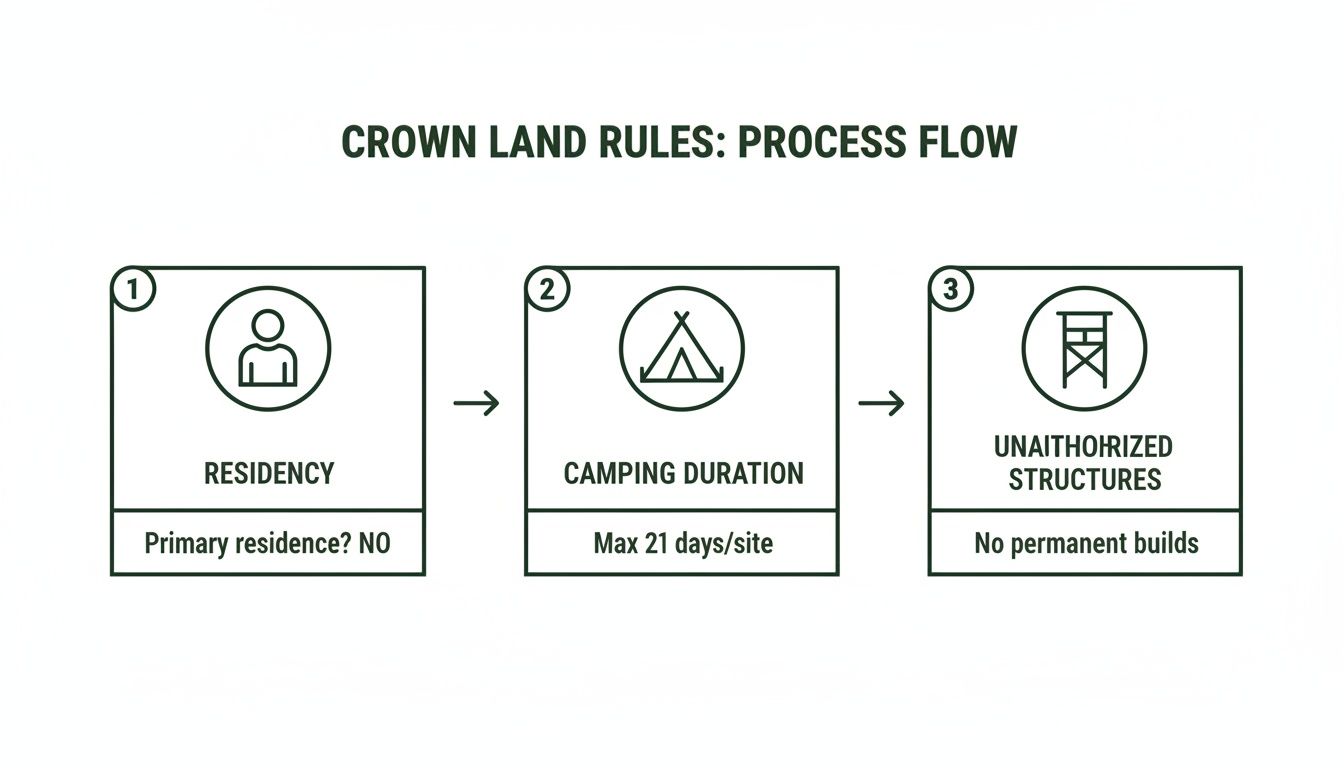
Think of this as the foundation. Getting these core principles right ensures your hunt is both legal and ethical from the get-go.
How HuntScout Makes Finding Spots Easy
Tools like HuntScout were built from the ground up for Canadian hunters. The app translates the complex data from sources like CLUPA into something you can use instantly in the field. It saves you countless hours of research and helps you avoid the classic mistake of accidentally trespassing. It’s like having a digital land-ownership expert right in your pocket.
Here’s how it transforms your scouting:
- Instant Boundary ID: The map layers immediately show you the difference between Crown land, private property, and conservation areas. There’s no more second-guessing where one begins and the other ends.
- WMU Overlays: HuntScout puts clear WMU boundaries right on the satellite map. You can tap anywhere to see exactly which unit you're in, which is crucial for checking season dates and regulations for your target species.
- Offline Maps: This isn't just a nice-to-have; it's a must. Before you head out, you can download detailed maps of your hunting area. Once you lose cell service, the app uses your phone’s internal GPS to show your precise location on the saved map. You'll never get turned around or wander onto private land again.
For a more detailed walkthrough of these techniques, our guide on how to find Crown land in Ontario breaks it down step-by-step.
A Practical Scouting Example
Let's put this into practice. Imagine you're planning a deer hunt in WMU 57. Instead of starting with a massive, generic map, you open HuntScout. Right away, you can see all the large tracts of Ontario Crown lands within that unit highlighted.
You zoom into a promising area that has a good mix of forest and clearings. A quick tap confirms it’s a General Use Area. From there, you can trace the property lines to find legal access points from public roads, making sure to steer clear of private driveways. While scanning the satellite imagery, you spot a beaver pond that looks like a great water source and a ridge that could be the perfect vantage point.
You can then drop custom waypoints on these spots, adding notes like "Potential Stand Location" or "Deer Trail." By the time you’re ready to put boots on the ground, you have a solid, well-researched plan built on reliable data—all done from your couch. That level of preparation builds real confidence and dramatically boosts your chances of a safe, successful, and legal hunt.
Essential Gear and Safety in the Backcountry
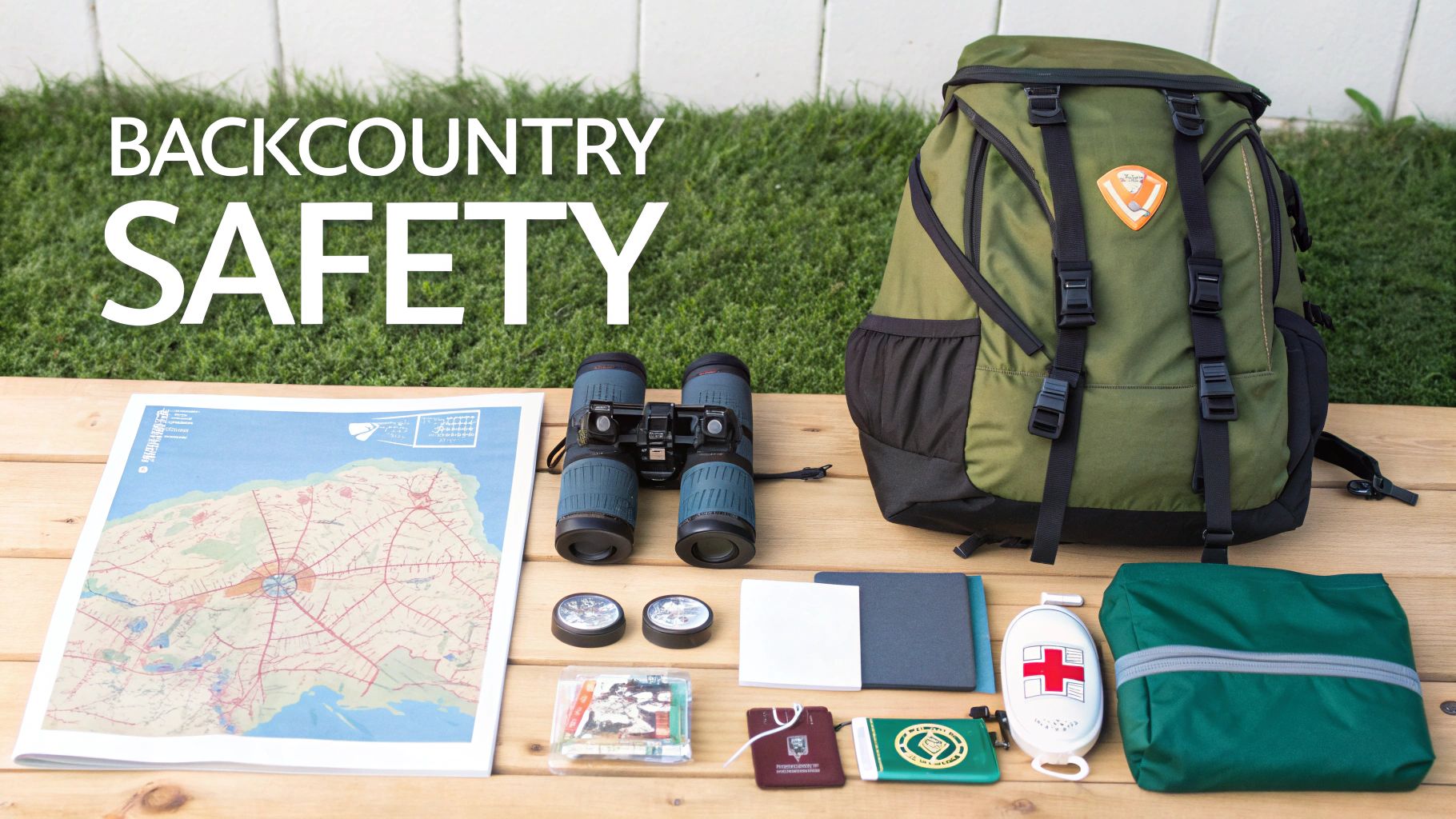
A good hunt on remote Ontario Crown lands has little to do with luck and everything to do with preparation. When you’re miles deep in the bush, with no cell service and the nearest road a distant memory, what’s in your pack and in your head is what truly counts.
Think of it this way: out here, you're your own first responder. It's a fundamental shift from a casual day hunt near the farm. This is an expedition, and self-reliance isn't just a virtue; it's a necessity. Your gear needs to get you through tricky navigation, bad weather, and any injuries that might crop up.
This isn’t about hauling a survival bunker on your back. It’s about being smart and packing for the most likely scenarios, giving you the peace of mind to focus on the hunt.
Navigating Without Service
Deep in the forests of Northern Ontario, that map app on your phone is about as useful as a screen door on a submarine. Getting turned around is a very real danger, which is why your navigation kit is your absolute number one priority.
This is where purpose-built tools for the backcountry shine. An app like HuntScout is a game-changer because of its offline mapping. Before you even leave home, you download detailed satellite and topographic maps of your entire hunting area. Once you're out there, the app uses your phone’s internal GPS to pinpoint your location right on those maps—no signal needed. You can track your route, mark waypoints, and find your way back to camp with confidence.
But technology can fail. Always have a backup. And a backup for your backup.
- Physical Map: Get a waterproof, tear-resistant topographic map of your specific hunting area. Don't leave home without it.
- Quality Compass: More importantly, know how to use it with your map. Batteries die, but a good compass always points north.
- GPS Unit: A dedicated handheld GPS is a tough, reliable piece of kit that offers another layer of security for your navigation.
Communication and First Aid Essentials
When you’re truly off-grid, you can't just call for help. This is where satellite messengers or a personal locator beacon (PLB) become your lifeline. Devices from brands like Garmin or SPOT let you send pre-set "I'm okay" messages or, in a true emergency, trigger an SOS that goes directly to search and rescue, completely bypassing the need for cell service.
Your first-aid kit also needs an upgrade from the basic one in your truck. A proper wilderness kit is built to handle more than scrapes and cuts. It should include a tourniquet, compression bandages, trauma shears, and serious blister care. Honestly, one of the best investments any backcountry hunter can make is a weekend wilderness first-aid course.
Your gear is your safety net. In the backcountry, you can’t afford to have any holes in it. Redundancy in navigation and a solid plan for emergency communication are the cornerstones of a safe and successful trip.
Bear Safety and Ethical Hunting
When you're on Ontario Crown lands, you're in bear country. Storing your food properly isn't just a good idea—it's essential for your safety and theirs. Use a bear-proof container or do a proper bear hang: get your food and any scented items at least four metres off the ground and three metres out from the tree trunk. Always cook and eat a good distance from where you sleep.
It's also wise to carry bear spray and know exactly how to use it. Keep it on your belt or a pack strap where you can grab it in a second, not buried at the bottom of your bag.
Finally, every trip should be guided by the principles of Leave No Trace. It’s a simple code: whatever you pack in, you pack out. That includes every spent shell casing. Treat the land with respect, minimize your impact, and leave the wild places you visit just as you found them. Your actions are a direct investment in the future of hunting for generations to come.
Before you head out, a solid checklist is your best friend to make sure nothing critical gets left behind.
Crown Land Hunting Trip Checklist
Here’s a look at the essentials you should consider for a multi-day hunt in a remote area.
| Category | Essential Items | Pro Tip |
|---|---|---|
| Navigation | Offline map app (e.g., HuntScout), compass, waterproof physical map, dedicated GPS unit, power bank. | Learn to use your map and compass together before you go. Practice in a local park. |
| Shelter & Sleep | Four-season tent or tarp system, appropriate sleeping bag, insulated sleeping pad, emergency bivy. | Your sleeping pad provides insulation from the cold ground, which is just as important as your bag's rating. |
| First Aid & Safety | Wilderness first-aid kit, satellite messenger/PLB, bear spray, headlamp with extra batteries. | Customize your first-aid kit with personal medications and plenty of blister treatment (moleskin). |
| Clothing | Layered system (base, mid, outer shell), waterproof rain gear, extra wool socks, sturdy broken-in boots. | Avoid cotton at all costs. It absorbs moisture and loses all insulating properties when wet. |
| Food & Water | High-calorie, non-perishable food, water filter/purifier, backup purification tablets, small cook stove/fuel. | Plan for one extra day's worth of food in case you're delayed by weather or other unforeseen events. |
| Hunting Gear | Firearm/bow, ammunition/arrows, knives, game bags, hunting licence & tags, rangefinder, binoculars. | A good pair of binoculars saves you miles of walking. "Let your glass do the walking." |
This checklist is a starting point. Always tailor your gear to the specific season, location, and length of your trip to stay safe and make the most of your time in the wild.
How HuntScout Pulls It All Together for Your Hunt
Having a good map and compass is one thing, but truly making the most of a hunt on Ontario Crown lands requires a whole lot more. You need a central hub—a mission control for your entire trip where you can plan, scout, navigate, and stay on the right side of the law.
That’s exactly the gap HuntScout was built to fill. It takes on the most common headaches hunters face by pulling all the critical tools into one place. Instead of bouncing between government websites, flipping through regulation booklets, and using a separate GPS app, you have everything you need in your pocket.
The goal is simple: less time tangled up in confusing research and more time actually hunting. It's about giving you the confidence that comes from having solid, reliable information so that every trip is safe, legal, and well-prepared.
More Than Just a Dot on a Map
Any decent app can show you where you are. The real value, though, comes from the quality and context of the information layered on top of that map. A basic GPS shows your location; a powerful hunting tool tells you what you need to know about your location.
HuntScout's map layers were designed from the ground up for Canadian hunters. It clearly marks the lines between different land types, so you know exactly where Crown land ends and private property begins. This feature alone is a game-changer for avoiding accidental trespassing—one of the biggest mistakes a hunter can make.
- WMU Boundaries: See the official Wildlife Management Unit boundaries drawn right over the satellite map. You’ll never have to guess which set of rules applies to where you’re standing.
- Land Use Designations: The app helps you see if you’re in a General Use Area or a more restricted zone, taking the guesswork out of tricky land-use policies.
- Your Real-Time Spot: Using your phone's built-in GPS, your live position is always on the map, giving you a constant reference point to make sure you're in a legal hunting area.
This level of detail turns your phone from a simple navigator into an intelligent guide that helps you make smarter, safer decisions in the field.
Keeping Track of Complex Rules
Ontario's hunting regulations are notoriously detailed, and they can change from one WMU to the next. The deer season dates might be completely different just a few kilometres down the road. Trying to memorize every opening and closing day for every species is a massive headache.
HuntScout solves this by building the regulations right into the app. You can instantly check the season status for any species in your specific WMU, ensuring you’re always hunting legally. No more fumbling with the official regulations summary out in the woods—you get a clear answer right when you need it.
Field-Ready Answers: Got a tricky question about bag limits or legal shooting hours? The AI Assistant gives you quick, straight answers based on Canadian hunting regulations. It’s like having an experienced mentor in your pocket.
Smart Scouting with Custom Waypoints
Every successful hunt is built on a foundation of good scouting. Finding promising sign—a fresh rub, a scrape line, a well-worn game trail—is the exciting part. But that discovery is worthless if you can't find your way back to that exact spot.
This is where custom waypoints become your strategic advantage. As you scout, whether you’re doing it digitally from your couch or with your boots on the ground, you can drop pins to mark every key location. Add notes, colour-code them, and build a personal, private map of your hunting spots.
Think about marking things like:
- A fresh scrape line you found along a hardwood ridge.
- A natural funnel between two swamps that deer are forced to use.
- The easiest and quietest access point from an old logging road.
- A potential tree stand location with a perfect shooting lane.
Season after season, you’ll build an invaluable personal map of your hunting grounds that lets you develop a smarter plan each year.
Offline Performance is Non-Negotiable
When it comes down to it, the single most critical feature for any tool used on remote Ontario Crown lands is offline capability. Cell service in the backcountry is a luxury, not a guarantee. Any app that needs an internet connection becomes a useless brick the moment you leave the main road.
HuntScout was built for the bush. Before you head out, you simply download the detailed maps for the area you plan to hunt. Once you’re in the field, the app uses your phone’s internal GPS signal—which works anywhere on the planet—to pinpoint your location on those saved maps.
This means you can navigate, check property lines, and access all your waypoints with total reliability, no matter how far off the grid you are.
Common Questions About Hunting on Ontario Crown Land
Even for seasoned hunters, heading out onto Ontario’s Crown lands can bring up a few questions. It's a massive system with its own set of rules, so it’s completely normal to want to double-check a few things. To make sure you’re heading into the bush with confidence, we’ve tackled some of the most common questions we hear from hunters.
Getting these details right isn't just about following the law—it’s about being a responsible steward of the land and a respectful member of the hunting community. It lets you keep your focus where it belongs: on a safe, ethical, and memorable hunt.
Can I Camp Anywhere on Ontario Crown Land?
This is a big one, and the short answer is "mostly, but with some important exceptions." If you're a Canadian resident, you can typically camp on one spot for up to 21 days in a calendar year, completely free of charge. After those 21 days are up, you have to move your campsite at least 100 metres away. This rule is in place to keep popular spots from becoming permanent settlements and ensure everyone gets a fair shot at a good site.
But—and this is a big but—you can't just pitch a tent anywhere. Certain areas are completely off-limits to camping, usually to protect sensitive environments. These no-go zones include:
- Provincially Significant Wetlands: These are critical habitats that can't be disturbed.
- Designated Conservation Reserves: These lands are set aside for their unique natural and cultural features, so camping is often restricted.
- Areas with Specific Land Use Policies: Some Crown land is leased for things like logging or mining, where public camping simply isn't allowed.
If you’re a non-resident of Canada, you'll need a permit to camp on Crown land in northern Ontario. The best move, no matter who you are, is to check the Crown Land Use Policy Atlas (CLUPA) or a modern mapping tool like HuntScout before you leave home. These tools will show you exactly what kind of land you’re looking at, so you know for sure you’re setting up in a legal spot.
Do I Need a Special Permit to Hunt on Crown Land?
Nope. There’s no such thing as a "Crown Land Hunting Permit" in Ontario. Your permission to hunt comes from the province-wide licensing system, not the specific piece of ground you're standing on. What you absolutely need are the standard documents outlined in the Ontario Hunting Regulations Summary.
This means having:
- A valid Outdoors Card.
- Your current-year hunting licence.
- The right tags for the species you’re after (like a deer, moose, or bear tag).
Think of your licence and tags as your ticket to the game, and Crown land as one of the venues. Your job is to make sure the specific piece of Ontario Crown land you want to hunt is actually open for hunting. This is where a reliable mapping tool isn't just a nice-to-have; it's essential.
How Do I Avoid Trespassing on Private Property?
This is probably one of the most critical responsibilities for any hunter. Pleading ignorance won't cut it if you get caught on private land. Relying on old fences or faded "No Trespassing" signs is a recipe for disaster—they can be misleading or gone altogether. The only surefire way to stay on the right side of the line is by using a modern GPS mapping app.
A tool like the HuntScout app takes all the guesswork out of the equation. It lays out crystal-clear, colour-coded property lines, showing you exactly where Crown land ends and private property begins. It’s like having a constantly updated plat book in the palm of your hand.
The offline map feature is what really makes it a game-changer in the backcountry. You can see your live GPS position on the map even without a shred of cell service. That means you always know precisely where you stand in relation to a property line, making it virtually impossible to accidentally wander where you shouldn’t.
Can I Build a Permanent Structure on Crown Land?
The answer to this is a hard no. You cannot build permanent cabins, shacks, or any other fixed structures on Crown land without getting specific authorization from the government, which is almost never given out for recreational hunting.
Temporary, portable structures are a different story. You can use tree stands and ground blinds, but there are strict rules you have to follow:
- Do No Harm: You can't damage the trees. That means no nails, screws, or bolts that pierce the bark. Stick to straps, chains, or cables that you can remove without leaving a mark.
- Pack It Out: Your stand or blind is for seasonal use. When the season’s over, you have to take it down and pack it out. Leaving it behind is considered littering and can get you fined.
Always check the latest Ontario Hunting Regulations Summary for the most up-to-date rules on hunting stands and blinds. Following these guidelines helps keep the land in great shape for everyone.
Ready to take the guesswork out of your next hunt on Ontario Crown lands? HuntScout combines detailed land ownership maps, WMU boundaries, and real-time season tracking into one easy-to-use app. Plan your hunt with confidence and navigate the backcountry like a pro. Download HuntScout today at https://huntscout.app and start your adventure.