A modern hunting camera isn't just another piece of gear to haul into the bush—it's one of the most powerful intelligence-gathering tools you can own. Whether it's a trail cam silently watching a game trail or an action cam capturing the thrill of the hunt, these devices change the entire game. They help you move from simply hoping for an encounter to strategically planning for one.
Your Eyes in the Field: Why Hunting Cameras Are a Game-Changer
Picture this: you know the exact travel corridor a mature buck is using, day in and day out, without ever leaving your truck. That's the edge a good hunting camera gives you. It's your tireless, 24/7 scout, gathering intel so you can hunt smarter, not harder. By revealing patterns, peak activity times, and the calibre of animals frequenting an area, a camera can save you from countless hours spent in the wrong stand.
This technology essentially lets you be in multiple places at once. You can simultaneously monitor a scrape line, a natural funnel, and a primary food source. The information you gather becomes the bedrock of a solid hunting strategy, replacing guesswork with a calculated, data-driven plan.
From Observer to Strategist
Putting a camera out fundamentally changes how you approach your hunt. Instead of just reacting to what you stumble upon, you start to anticipate animal behaviour based on the evidence you've collected. In the vast and often challenging Canadian wilderness, that shift is a powerful one.
Here’s how it really breaks down:
- Time Efficiency: You'll spend far less time tromping through the woods and more time analyzing hard data. This also means you're putting less pressure on your hunting spots.
- Increased Success Rates: By pinpointing the best locations and times to hunt based on confirmed animal activity, you dramatically stack the odds in your favour.
- Deeper Connection to the Land: There's something special about watching wildlife in its completely natural, undisturbed state. It gives you a much deeper appreciation for the ecosystem you're a part of.
A hunting camera is the ultimate force multiplier. It gives you the critical intelligence you need to make the right decisions, ensuring the limited time you have in the field is spent as effectively as possible.
The real magic happens when you pair this field intel with a modern hunting app like HuntScout. You can drop a pin for every camera location on your map, cross-reference sightings with WMU boundaries, and plan your entry and exit routes—all in one place. Integrating your digital scouting with advanced mapping tools gives you an incredible advantage before you even lace up your boots.
Choosing Your Optic: Trail Cams, Action Cams, and DSLRs
Picking the right camera for hunting is a lot like choosing the right tool from your toolbox. You wouldn't use a sledgehammer for a finishing nail, right? The same logic applies here. The best camera for you comes down to what you want to accomplish—are you gathering intel, capturing the thrill of the moment, or creating a piece of art?
The camera world for hunters really breaks down into three main categories. Each one is built for a specific job out in the bush, and knowing their strengths and weaknesses is the key to spending your money wisely and matching the gear to your style of hunting.
Let's dive into these types so you can figure out which one belongs in your pack.
The Silent Scout: Trail Cameras
Think of a trail camera as your full-time, round-the-clock scout. It's out there gathering intel while you're at work, at home, or scouting another spot. These motion-activated cameras are the backbone of modern hunting strategy, designed to do one thing exceptionally well: pattern game animals without you ever having to be there.
They’re built tough, made to handle everything Canadian weather can throw at them, from sideways autumn rain to a deep freeze in January. The biggest advantage is their "set it and forget it" nature. Once you have one watching a game trail, a scrape line, or a food source, it feeds you a constant stream of information about what’s moving through, when they're there, and which specific animals are in your zone. This is, without a doubt, the camera you need for reconnaissance and planning your hunt.
This simple guide can help you visualize which camera type fits your goals.
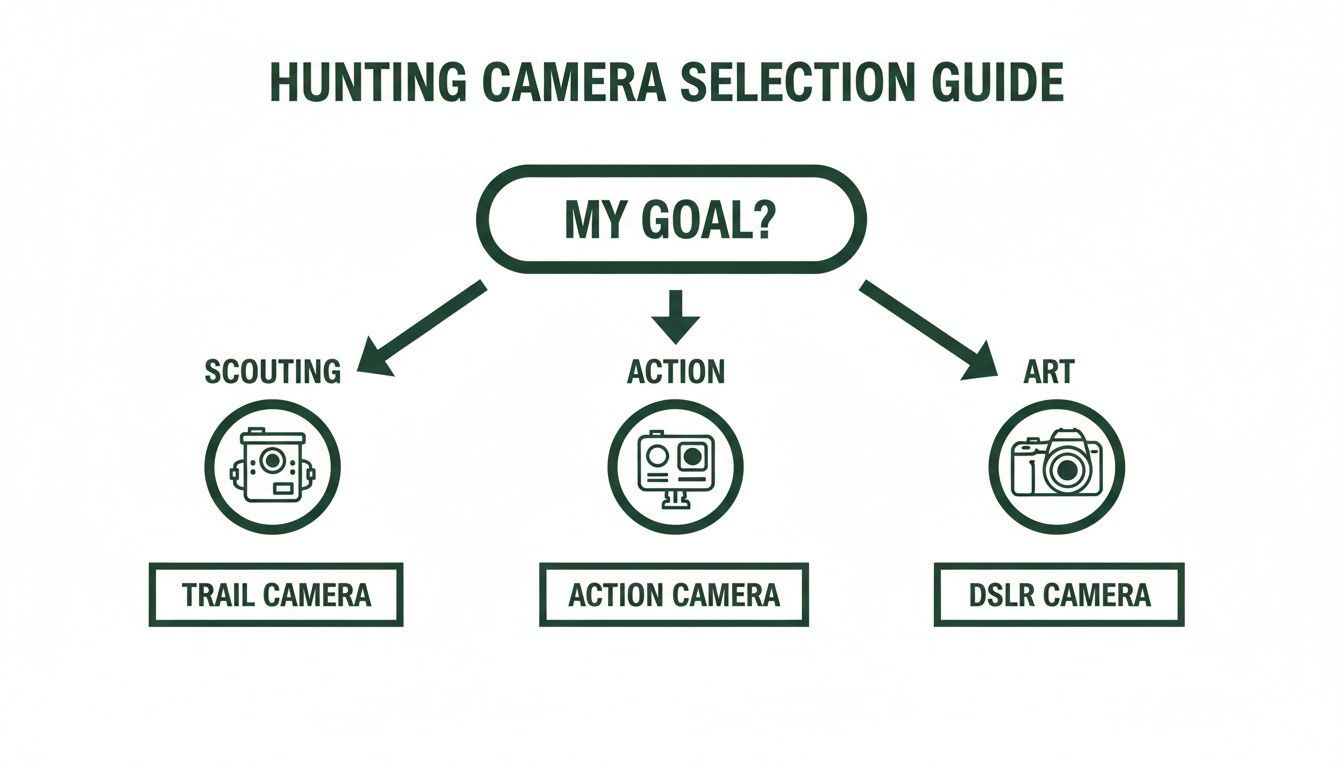
As you can see, what drives you—the need to scout, the desire to capture action, or the passion for art—points you directly to the perfect tool for the job.
The Field Reporter: Action Cameras
If trail cameras are the silent scouts, then action cameras are your embedded field reporters. These little, tough-as-nails cameras are all about capturing the hunt from your point of view, dropping anyone who watches the footage right into the middle of the action.
You can mount them on your bow, your scope, or even a head strap to record every heart-pounding moment. From the long, quiet wait in the stand to the adrenaline-soaked seconds when it all comes together, an action camera grabs that dynamic, wide-angle footage that makes you feel like you’re reliving the hunt.
But make no mistake, their job is documenting, not scouting. They have a short battery life and you have to turn them on and off yourself, so they’re no good for long-term surveillance. This is the camera for hunting you grab when you want to share your adventures and watch them over and over again.
The Artist: DSLRs and Mirrorless Cameras
For the hunter who sees the world through a photographer's eye, nothing comes close to the quality of a DSLR or mirrorless camera. These are the tools you use to create genuine art. With the ability to swap lenses and fine-tune every setting manually, they give you total creative control to produce breathtaking, high-resolution images that capture the raw beauty of the wild.
A high-quality photograph does more than document a memory; it preserves the emotion and atmosphere of a moment in the wild. This is where a DSLR truly shines.
The trade-off, however, is a big one. These cameras are bulky, far more fragile, and take real skill to use well, especially in the tough conditions we often hunt in. They just aren't practical for scouting or capturing that split-second shot unless photography is a central goal for your trip. When you pack a DSLR, you’re making a conscious choice to prioritize artistry, to bring home not just a memory, but a masterpiece.
To make things even clearer, here’s a quick-glance table comparing these three options.
Hunting Camera Type Comparison
| Camera Type | Primary Use | Key Advantages | Key Disadvantages |
|---|---|---|---|
| Trail Camera | Scouting & Game Patterning | Long battery life, autonomous, weatherproof, minimal disturbance | Fixed position, lower image/video quality |
| Action Camera | Documenting the Hunt (POV) | Compact, rugged, wide-angle view, easy to mount | Short battery life, requires manual operation, no zoom |
| DSLR / Mirrorless Camera | Artistic Photography & Videography | Superb image quality, creative control, interchangeable lenses | Bulky, fragile, expensive, requires skill to operate |
Ultimately, the best camera is the one that helps you achieve your specific goals for being out on the land. Whether you're a strategist, a storyteller, or an artist, there's an optic built just for you.
Decoding the Specs: Features That Matter in the Backcountry
Walking into the camera aisle can feel overwhelming. The boxes are plastered with terms like "trigger speed," "detection range," and "megapixels," and it’s easy to get bogged down in the technical jargon. Out in the bush, though, only a handful of those specs actually determine whether you get an empty SD card or a complete picture of what’s happening in your hunting spot.
Let's start with trigger speed. Think of it as the camera's reaction time—how long it takes from the moment the sensor picks up movement to when it snaps the picture. A slow trigger is like a lazy predator; by the time it reacts, that big buck is already halfway out of the frame, leaving you with a photo of its tail end. You want a camera with sharp reflexes, so look for a trigger speed under 0.5 seconds to get a clear, centred shot of the animal, not just its disappearing act.
Then there's image quality, which is measured in megapixels (MP). This isn't just about getting pretty pictures for the scrapbook. High-resolution photos are essential for identifying animals accurately. From a grainy, blurry image, can you be certain that's a legal bull moose and not a cow? Can you count the tines on a buck standing at the far end of a clearing? A camera with 12 MP or higher delivers the detail you need to zoom in and make the right call.
Powering Through the Canadian Cold
Even the most advanced camera is just a plastic box if the batteries are dead. Battery life is absolutely critical for any hunting camera, especially when you're dealing with the deep freeze of a Canadian winter. The type of battery you use can mean the difference between a full season of scouting and a single week of photos.
- Alkaline Batteries: These are the standard, affordable option you can find anywhere. The problem is their performance takes a nosedive as soon as the temperature drops. They’re fine for early-season scouting but won't cut it in the cold.
- Lithium Batteries: They cost more upfront, but lithium batteries are the undisputed champs of cold weather. They maintain their power in freezing conditions, last dramatically longer, and can often capture thousands of photos before they need to be swapped out.
For any serious Canadian hunter planning to run cameras through late fall and winter, lithium batteries are a non-negotiable investment. They give you the peace of mind you need when checking your camera involves a long hike or snowmobile ride into the bush.
Staying Connected and Concealed
How you get your photos is another huge factor. A standard camera forces you to physically visit the site to pull the SD card, which means you're leaving your scent and potentially spooking game every single time. A cellular trail camera, on the other hand, is a game-changer. It sends photos straight to your phone, giving you real-time information without ever disturbing your hunting spot. This is a massive advantage, especially for monitoring remote locations.
This is particularly true when you're hunting vast stretches of public land. A 2021 Hunter Access Survey in Alberta, for example, found that 85% of hunters contacted ten or fewer landowners a year for permission. This highlights how much we rely on public land, making remote scouting tools indispensable for keeping tabs on game across Crown land and within specific WMUs without constant trips. You can dig into more of those findings in the Alberta hunter access report.
Finally, never underestimate the camera's physical design. The best camera is one that the animals never know is there. Look for a model with a non-reflective, camouflaged casing that blends right into the trees. A tough, weatherproof housing is just as important—it needs to stand up to everything from blowing snow to a curious bear, ensuring your investment keeps working for you all season long.
Getting Your Camera Placement and Setup Just Right
Having a great camera is one thing, but knowing exactly where and how to put it is what really brings home the results. Get the placement right, and your camera goes from being just a piece of gear to your most valuable scouting partner. This all starts with a bit of prep work before you even head out.
First things first, always format your SD card in the camera you plan to use, not on your computer. This little step prevents corrupted files and lost photos by making sure the card is perfectly matched to that specific device. Next, pop in a fresh set of high-quality lithium batteries—they’re a must for handling Canada’s colder months. Double-check that the date and time are set correctly. Taking care of these basics now will save you a ton of headaches later.
Finding Those High-Traffic Hotspots
With your camera prepped and ready, it's time to find the best spots to catch animal activity. You're searching for those natural funnels and features that force game to travel through a specific area. Try to think like the animals do—they almost always take the path of least resistance.
Look for places like these:
- Game Trails: Find those well-worn paths that connect bedding areas with food and water. You’ll want to position your camera perpendicular to the trail to get a clear, broadside shot of whatever walks by.
- Watering Holes: Creeks, ponds, and hidden springs are absolute magnets for wildlife, especially when the weather is dry.
- Scrapes and Rub Lines: For deer hunters, these are pure gold. Setting up a camera over an active scrape just before the rut can give you an incredible look at the local buck population.
- Field Edges: That transition zone where thick cover meets an open food source is a classic spot to see deer, moose, and even bears.
Dialing in Your Placement
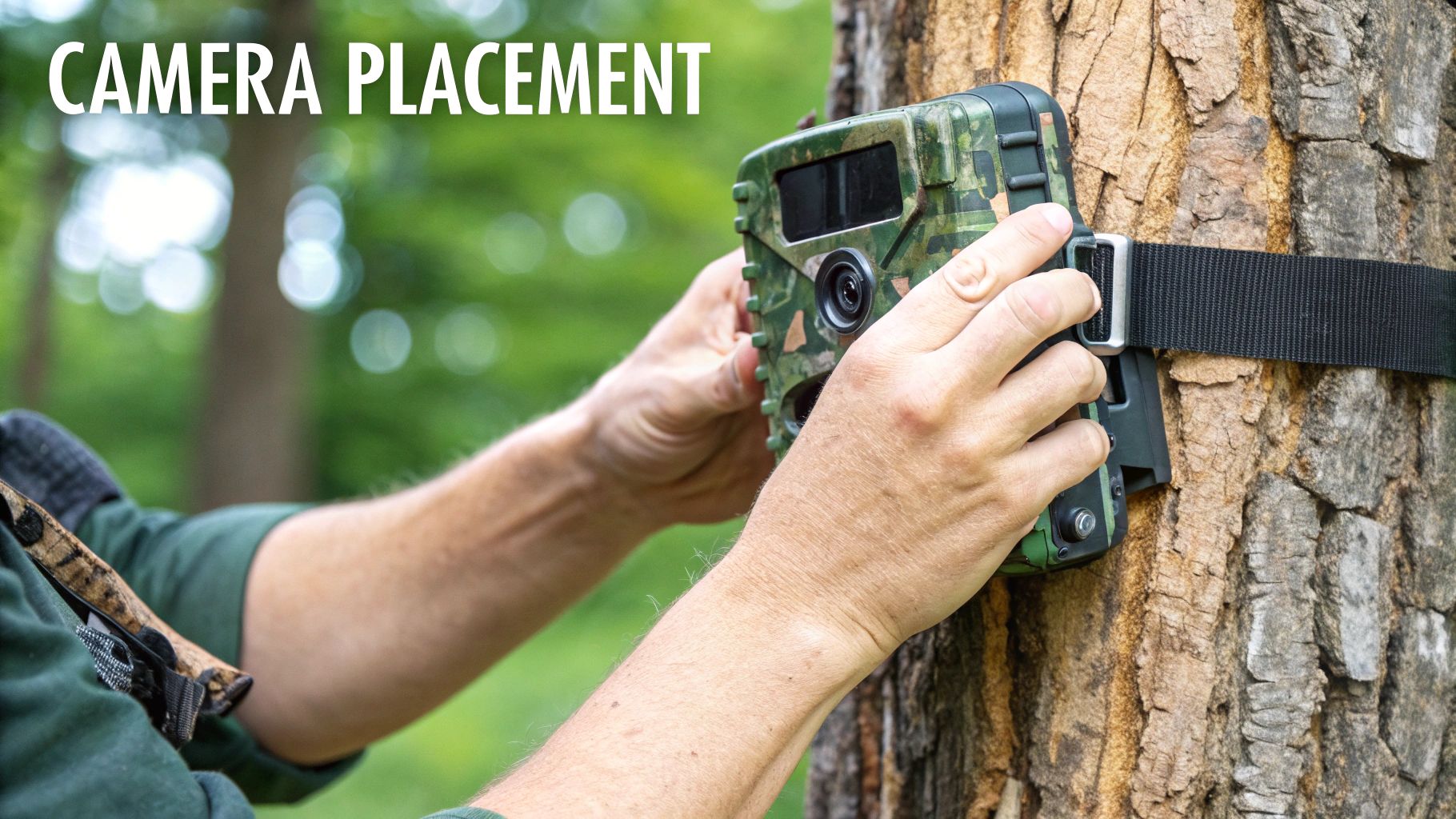
How you mount your camera is just as important as where you put it. A good rule of thumb is to set it up about three to four feet off the ground, which is roughly chest height for animals like deer. This angle gives you that crucial full-body view you need to properly identify and age them.
Make sure to angle the camera down just a little. This helps avoid false triggers caused by the rising or setting sun. On that note, try not to point your camera directly east or west, or you’ll end up with washed-out, unusable photos at dawn and dusk. Before you leave, clear away any dangling branches or tall grass right in front of the lens that could blow in the wind and set it off.
Here’s a pro tip: Scent control is everything. Always wear rubber boots and scent-free gloves when you’re setting up your cameras. Your goal is to get in, get it done, and get out without leaving any sign you were ever there.
Scouting remotely like this is a game-changer, especially across the vast landscapes we have in Canada. Think about it: 2021 data from Statistics Canada revealed that only 3% of Canadian households reported hunting near their homes. That stat really highlights how much we rely on effective long-range scouting in big country and on Crown land. You can dig into more of the numbers and see how Canadians are hunting on statcan.gc.ca.
Finally, make your life easier by using a tool like HuntScout to drop a waypoint for every camera you set. This builds a digital map of your entire scouting network, making it a breeze to find your cameras later and helping you piece together a solid hunting plan based on the intel you’ve gathered. If you're new to navigating these areas, our guide on what is Crown land in Canada is a great place to start.
Staying on the Right Side of the Law and Hunting Ethics
Using a camera for hunting in Canada is about more than just finding your next buck; it’s about being a responsible steward of the sport. Every province has its own rulebook for trail cameras, and these aren't just suggestions—they're the law. What’s considered fair game in one part of the country could land you in hot water in another, so doing your homework is non-negotiable.
These regulations are all about upholding the principle of fair chase. The goal is to make sure technology doesn't give anyone an unsporting advantage. For example, some provinces have put a stop to using live-action or cellular cameras during an active hunting season. This prevents hunters from getting real-time pings on an animal's exact location, which would take away from the true challenge and spirit of the hunt.
Understanding Land Access and Respect
Beyond the official regulations, there's the unwritten code of ethics that applies to land access and respecting property owners. Whether you're on Crown land or have permission to be on a private farm, how you act reflects on all of us in the hunting community. Always, always get explicit permission before setting up a camera on private land, and be upfront about how long you plan to leave it there.
When you're on public land, think about other people out there enjoying the wilderness. Tuck your camera away from busy hiking or ATV trails. This not only prevents it from getting stolen but also respects the privacy of others. The idea is to gather intel with the smallest footprint possible, leaving the woods exactly as you found them.
An ethical hunter sees technology as a tool for understanding animal behaviour, not as a guarantee for a harvest. By respecting the rules and the landowners, we ensure future generations can keep using these incredible tools.
Navigating Regulations with Confidence
The mix of rules across Canada can feel a bit overwhelming at times. Take Quebec, for instance. Between leased territories and specific Wildlife Management Units (WMUs), you have to plan your camera placement carefully. We know from historical data that big game harvests in Quebec, especially for deer which peaked at over 50,000 annually in the 2010s, have made effective scouting more important than ever. You can dive deeper into Quebec's harvest trends from the Urban Data Centre.
This is where a tool like HuntScout really shines. Its detailed maps clearly lay out WMU and property boundaries, taking the guesswork out of placing your hunting camera legally. Knowing exactly where you stand is a huge part of staying compliant, a subject we cover in our guide on why hunting licensing compliance matters. With modern mapping on your side, you can scout with complete confidence, knowing you’re upholding the laws and ethics that define what it means to be a responsible hunter in Canada.
Your Pre-Season Hunting Camera Checklist
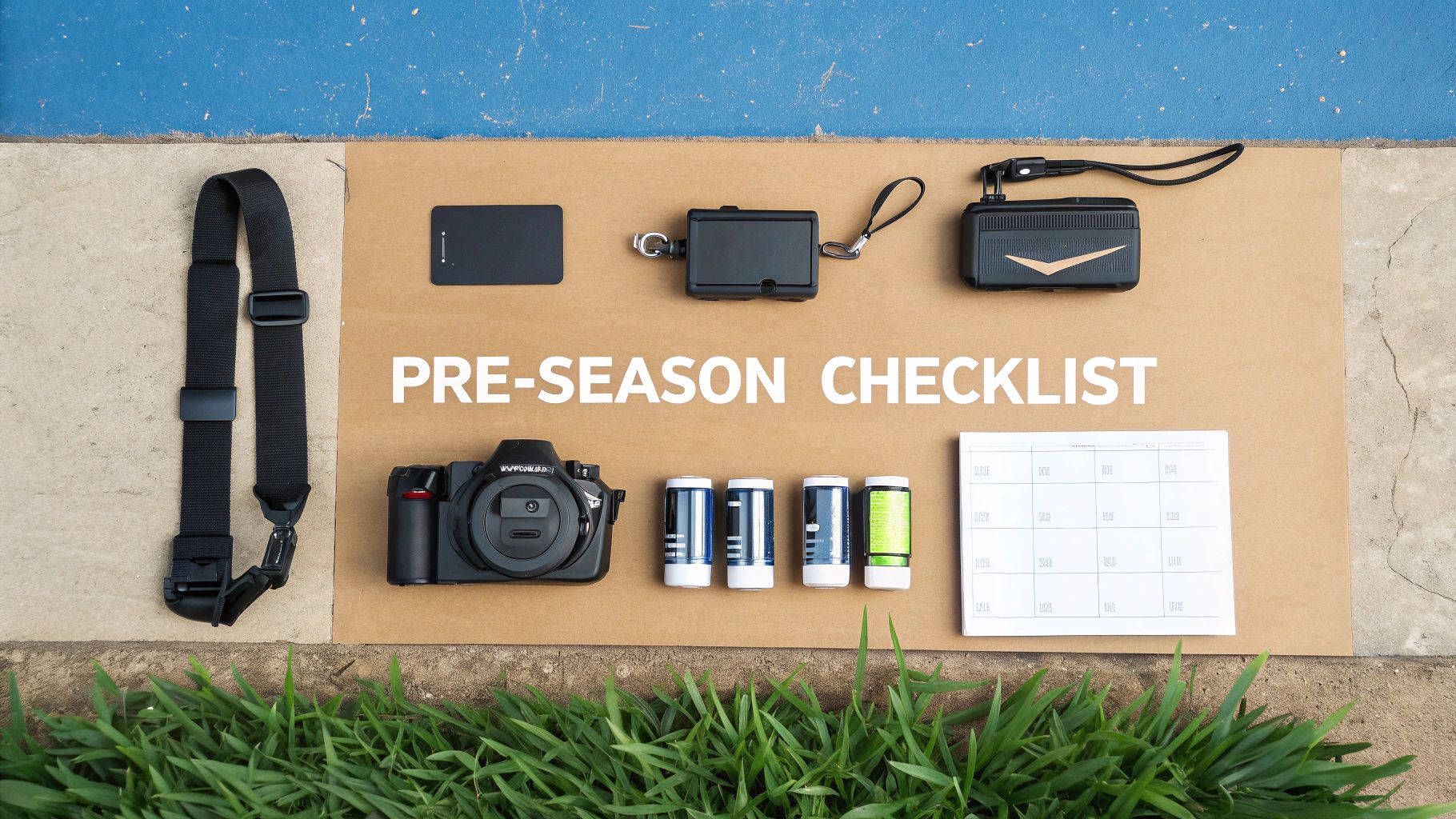
A good hunt doesn't start on opening day—it starts weeks, even months, before. Getting your cameras prepped and ready is one of the most critical parts of that prep work. Think of it as a pre-flight check for your hunt; a few minutes spent now will prevent major headaches when it really counts.
After all, there’s nothing worse than hiking out to a camera spot, full of anticipation, only to find a dead battery or a corrupted SD card. Your best scouting tool is just a piece of plastic strapped to a tree if it’s not working right.
Hardware and Firmware Prep
First things first, let's get the physical gear in order. This is the foundation for everything else, ensuring your equipment is reliable from the moment you hang it.
Battery Replacement: Don't even think about using last season's batteries. Start fresh with a new set of high-quality lithium batteries. They're your best bet for keeping the cameras running through a Canadian cold snap.
SD Card Management: Take each SD card, put it in the camera it's going to live in, and use the camera’s menu to format the card. This simple step is the best way to prevent file corruption and weird compatibility issues down the road.
Firmware Updates: Pop over to the manufacturer's website and see if there are any new firmware updates for your camera models. These updates often fix bugs and can improve performance, from trigger speed to battery life.
Settings and Deployment Strategy
With the hardware sorted, it's time to fine-tune the settings and think about where you’re putting these eyes in the woods. The choices you make here directly affect the quality of intel you’ll get back.
I've found a hybrid approach works wonders for most situations. Set your camera to snap a high-resolution photo first, immediately followed by a short 10-15 second video clip. This gives you the best of both worlds: a crisp, clear photo for quick identification and a video that reveals crucial animal behaviour. And for goodness sake, double-check that the date and time are set correctly—it’s essential for patterning your target animals.
Your pre-season work transforms a simple camera into a strategic asset. By meticulously preparing your gear, you’re not just placing a device; you’re deploying an intelligent scout that works for you 24/7.
Finally, pull it all together in the HuntScout app. Before you even leave the house, look at the waypoints you saved from last year and scout out some new potential honey holes on the map. As you hang each camera, drop a fresh pin, labelling it with the date and a camera name or number. This creates a powerful, visual map of your entire scouting network. To get even more organized, take a look at our guide on expert hunting season planning tips.
Got Questions? We’ve Got Answers.
Even the most seasoned hunters have questions when they're out in the bush. Let's tackle some of the common ones we hear from Canadian hunters about getting the most out of their cameras.
Camera Placement and Longevity
How high should I mount my trail camera?
A good rule of thumb is to mount your camera at chest height, roughly three to four feet off the ground. This gives you a great angle for capturing full-body shots of animals like deer and moose.
Of course, this isn't a hard-and-fast rule. Think about the terrain and your target species. If you're on a steep hillside or after smaller game, you'll need to adjust that height to get the perfect shot.
Can I leave my hunting camera out all year in Canada?
You bet, but only if your gear is up to the challenge of a Canadian winter. You'll need a tough, weatherproof camera built to handle everything from freezing rain to deep snow.
The real key here is power. Ditch the standard alkalines and invest in lithium batteries. They perform far better in the extreme cold and will keep your camera running when others would have died long ago. Also, be sure to check local regulations—some areas have rules about leaving equipment on public land for extended periods.
Technology and Security Questions
Do I really need a cellular trail camera?
Honestly, it depends. If your spot gets decent cell service and you want instant updates sent straight to your phone, a cellular camera is a game-changer. You get real-time intel without having to tromp in and disturb the area.
But if you’re heading deep into the backcountry where there's no signal, a traditional SD card camera is your reliable, budget-friendly workhorse. It comes down to weighing the convenience of immediate info against the reality of your hunting spot's connectivity.
How do I keep my camera from getting stolen?
The best defence is a good offence. Start by securing your camera in a heavy-duty steel lockbox and fastening it to a tree with a solid python cable lock. This will deter any casual thief.
Next, think like a hunter and use concealment. Place it away from obvious trails and use the surrounding foliage to break up its outline. Sometimes the best security is simply not being seen in the first place. A simple, smart step is to discretely mark your camera with your contact info, just in case.
Ready to pair your field intel with the best mapping tool in Canada? HuntScout helps you mark every camera location, understand WMU boundaries, and plan your hunt with confidence. Download it for free and start scouting smarter today at https://huntscout.app.