If you want to get closer to whitetails, you need to learn to speak their language. It's not just about making random noises in the woods; it’s a intricate system of sounds deer use for everything from checking in with each other to squaring off with a rival. Learning to interpret and replicate these sounds is one of the biggest steps you can take to become a more successful and engaged hunter.
Decoding the Language of Whitetail Deer
Think of it this way: instead of just being an outsider looking in, learning deer calls lets you join the conversation. When you understand what deer are actually saying, you can start to predict what they'll do next, pique their curiosity, and create shot opportunities that simply wouldn't happen otherwise.
This guide will walk you through the fundamentals. We'll cover the core sounds every hunter should know, starting with the basics and moving into more advanced, field-proven tactics that work across Canada's varied landscapes.
The Four Pillars of Deer Communication
At its core, the world of deer vocalizations is built on four main types of sounds. Each serves a specific purpose and works best at certain times of the year.
- Contact Calls: These are the day-to-day sounds deer make to stay in touch. A simple grunt, for instance, is often just a way of saying, "I'm over here, everything's cool."
- Maternal Calls: This group of sounds revolves around the powerful bond between a doe and her fawns. A fawn's distress bleat is a gut-wrenching sound that can bring does running in to protect what they think is a fawn in trouble.
- Mating Calls: When the rut kicks in, the woods are filled with the sounds of breeding. You'll hear the longing estrus bleats from does and the persistent tending grunts from bucks that are hot on their trail.
- Aggressive Calls: These are the sounds of a challenge. The explosive snort-wheeze and the unmistakable clash of rattling antlers are all about dominance, mimicking a fight between two bucks.
Before we get into the specifics of how to make these sounds, it's helpful to have a quick reference. Here’s a simple breakdown of the most common calls you'll hear and use.
Quick Guide to Common Deer Vocalizations
This table is your at-a-glance guide to the essential sounds in a deer's vocabulary. It covers what each call generally means and, just as importantly, when it's most effective to use it in the field.
| Sound Type | Primary Meaning | Best Season to Use |
|---|---|---|
| Grunt | "I'm here," contact, or challenging another buck | All Season (especially Pre-Rut & Rut) |
| Doe Bleat | Social contact, loneliness, or a doe ready to breed (estrus) | All Season (especially Rut) |
| Fawn Bleat | Distress or a lost fawn looking for its mother | Early Season & Post-Rut |
| Snort-Wheeze | Aggressive challenge to a dominant buck | Pre-Rut & Peak Rut |
| Rattling | The sound of two bucks fighting over territory or a doe | Pre-Rut & Peak Rut |
Think of these sounds as the building blocks for the stories you'll tell in the woods. Learning to use them correctly is about more than just making noise; it’s about communicating with a purpose.
By learning to replicate these sounds with the right timing and emotion, you can tell a believable story that deer will investigate. It's about painting a picture with sound.
As we dive deeper, we'll show you how tools like the HuntScout app can help you pinpoint the perfect time and place to start these conversations, using its detailed maps of Canadian Wildlife Management Units (WMUs) and seasonal data to inform your strategy.
The Core Vocabulary of Whitetail Deer
If you want to get good at calling deer, you first have to understand what they're actually saying to each other. It’s less about memorizing sounds and more about learning their language—where the same sound can mean wildly different things depending on the context, timing, and tone. A simple grunt might just be a casual "I'm over here," but add some aggression and rhythm, and it suddenly becomes a challenge to a fight.
Think of it this way: every call you make is telling a story. By knowing what each sound means to a deer, you can paint a picture that draws them in, whether it’s because they're curious, feeling protective, or ready to defend their turf. Let's break down the essential sounds that make up the whitetail language.
This diagram lays out the main categories of deer sounds, helping you see how they fit into a deer's daily life. You'll notice that while we hunters tend to focus on rutting calls, the contact and maternal sounds are just as important for communication.
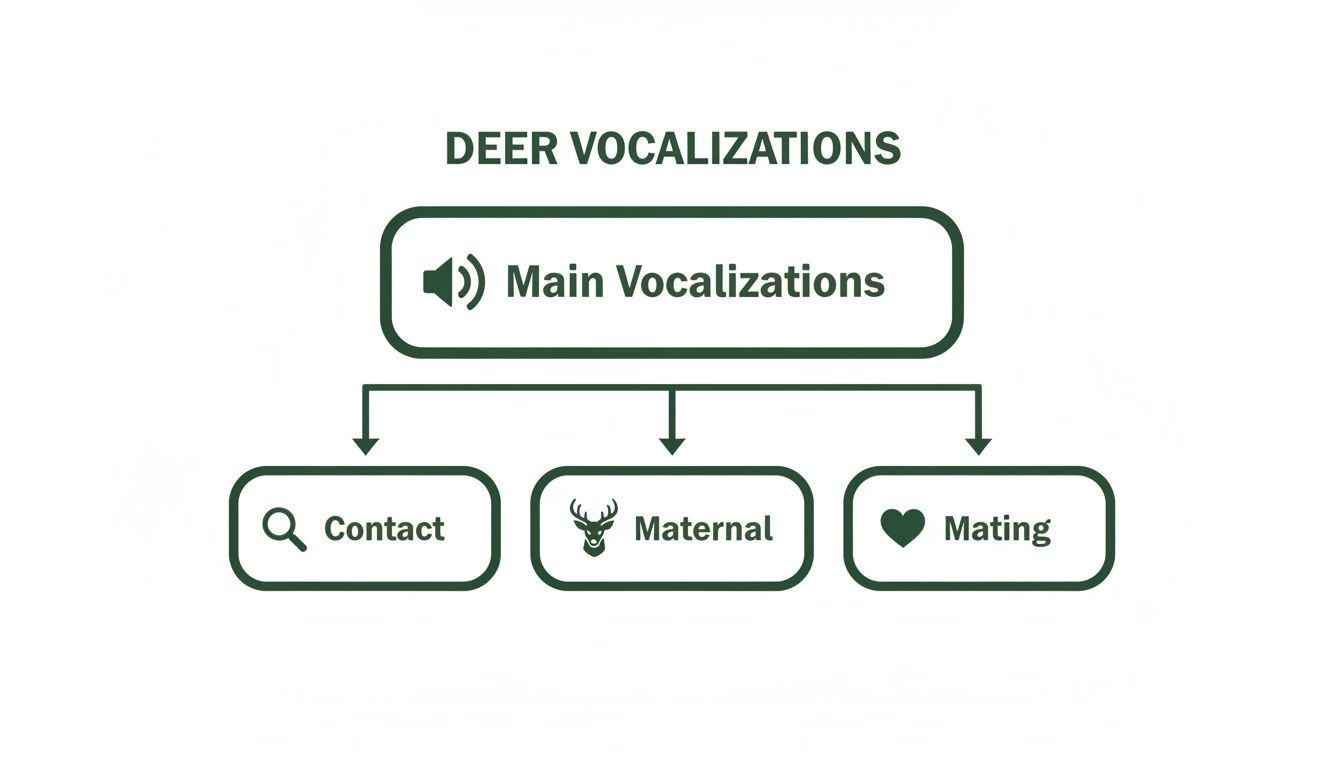
The chart really drives home that mating calls are only one piece of the puzzle. Sounds related to social contact and maternal instincts are powerful tools that too many hunters leave in their pack.
The Grunt: The All-Purpose Sound
The grunt is the absolute workhorse of the whitetail world. It's the Swiss Army knife of their vocabulary, something you can use in almost any season or situation if you get the delivery right.
A soft, short grunt is often just a contact call. It’s a low-key way for deer to keep tabs on one another in thick woods, basically saying, "Hey, I'm over here, where are you?"
Come the rut, that same grunt takes on a whole new meaning. A buck hot on a doe's trail will let out a series of rhythmic tending grunts. This isn't just him talking to himself; it’s a clear signal of his intentions and a warning for any smaller bucks to back off.
Then you have the aggressive challenger grunt. This one is deeper, more guttural, and it’s what a dominant buck uses to lay down the law. It’s an unmistakable message: "This is my house."
The Bleat: From Nurturing to Needing
Bleats are higher-pitched sounds you’ll hear mostly from does and fawns. They can signal anything from simple loneliness to outright panic, which makes them incredibly effective at triggering a deer's social or protective side.
- Doe Bleat: This is a social call a doe uses to talk to her fawns or other deer. It’s a calm, reassuring sound that says everything is okay.
- Estrus Bleat: When a doe is ready to breed, she'll make a longer, more pleading bleat. This is the sound that can make a mature buck throw caution to the wind and come charging in.
- Fawn Distress Bleat: This might be the most powerful call you can make. It’s the frantic, terrified cry of a fawn in danger, and it will pull on the heartstrings of any doe within earshot. It's not uncommon for a big buck to show up too, wanting to see what all the commotion is about.
The fawn distress bleat taps into a deer's powerful maternal instinct. It's not just does that respond; the sound of a potential predator attacking a fawn can draw in bucks looking to see what's happening.
Knowing when to use which call is everything. For example, research from California's varied hunting areas shows how population density changes a call's effectiveness. In regions with fewer deer, where bucks are naturally more cautious, soft doe-in-estrus bleats can boost success rates by 15-20% compared to aggressive rattling. Another study that captured over 10,000 deer vocalizations found that 57% of buck responses to fawn distress calls happened within 200 yards in high-pressure hunting zones. This just proves how critical it is to match your sound to your environment—a principle Canadian hunters can put into practice using the WMU mapping features in HuntScout. You can learn more about how deer population data influences hunting strategies from the California Department of Fish and Wildlife.
The Snort-Wheeze: A Declaration of War
The snort-wheeze is the sound of pure aggression. It's a sharp, explosive, two-part sound—a quick "hiss" followed by a wheezing exhale. A dominant buck makes this sound when he feels challenged and is ready to throw down.
This is a high-risk, high-reward call. Use it at the right moment during the pre-rut or the peak of the rut, and you might just pull a dominant buck in on a string, ready to confront the intruder. But be warned: use it on a younger, subordinate buck, and you'll probably just send him running for the next county.
Rattling: The Sound of a Fight
Finally, there's rattling. It’s not a vocalization, but it mimics one of the most compelling sounds in the deer woods: two bucks locked in combat. The sound of antlers crashing together means a fight is on for dominance, territory, or a receptive doe.
Rattling works best during the pre-rut and rut when bucks are testosterone-fueled and competitive. The trick is to make it sound real. Start with some light ticking and grinding to sound like a sparring match, then build up to loud, clashing cracks. Mix in some grunts and even stomp the ground to sell the illusion. To any buck listening, it signals that a fight is happening, and he might have a chance to sneak in and steal the doe while the other two are busy.
Choosing the Right Call for the Job
Walking into a hunting store to pick out a deer call can feel a lot like trying to choose a single tool from a packed workshop. You’ve got dozens of options, and each one is designed for a very specific job. Your mission is to build a small, effective toolkit that lets you tell a convincing story out in the woods.
The right choice really boils down to your personal hunting style, how much practice you're willing to put in, and the kind of terrain you'll be in. A simple call is easy to master and deadly in the right situation, while a more complex one gives you a wider vocabulary but takes time to learn. Let's break down the main types so you can build a solid calling arsenal for your next hunt.
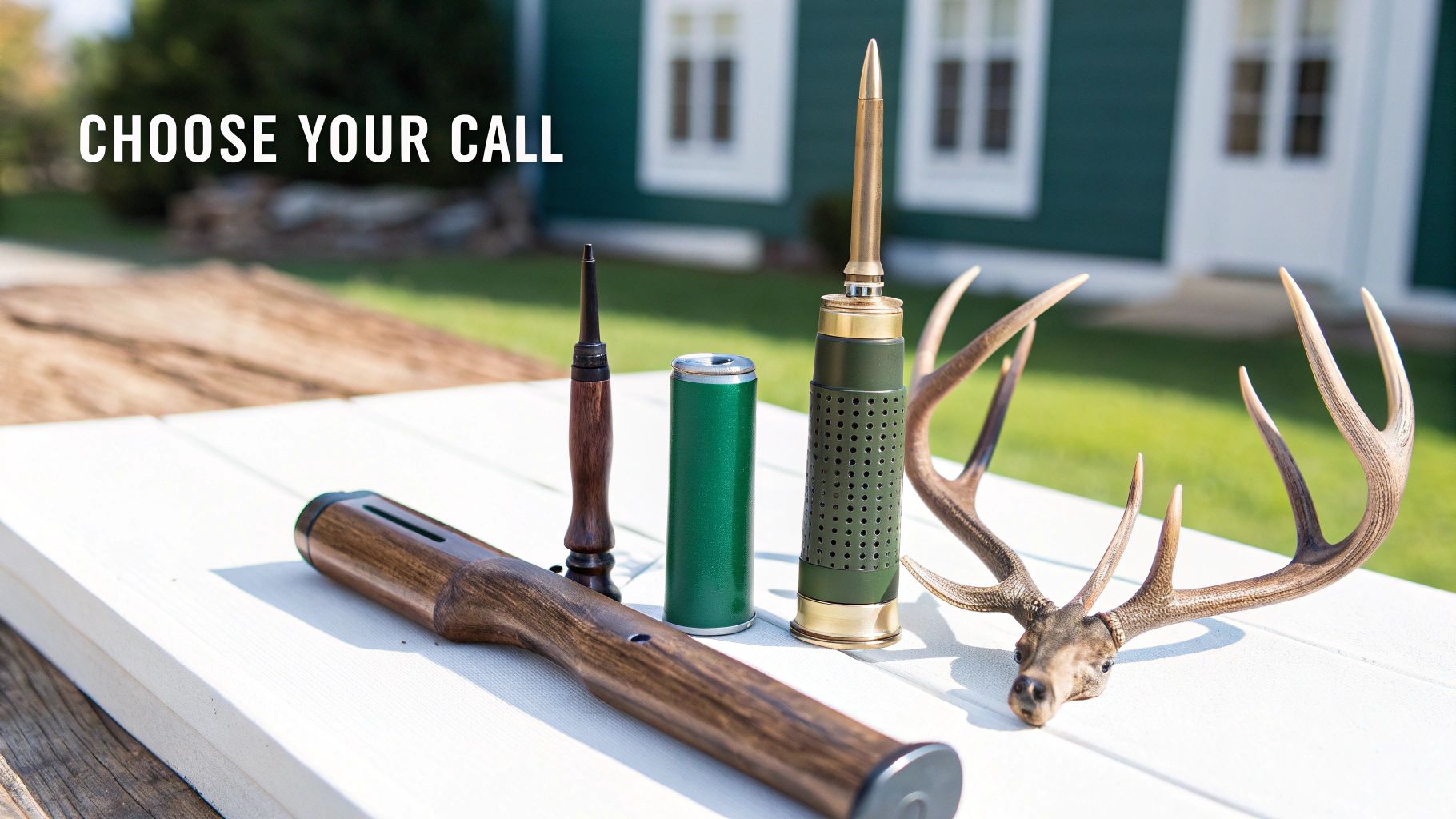
The Versatile Grunt Tube
If there's one call that deserves a permanent spot in your pack, it's the grunt tube. This is the undisputed workhorse of deer calling. It’s incredibly versatile, letting you produce everything from the soft, contented grunts of a young buck to the deep, throaty growls of a dominant stag spoiling for a fight.
Most grunt tubes today are adjustable, usually with a simple rubber O-ring on the reed. Sliding it up or down changes the pitch, which is a fantastic feature. It lets you sound like a smaller, subordinate buck, a tactic that can draw in a mature giant without intimidating him.
- Pros: Can make multiple sounds (grunts, growls, snort-wheezes), making it extremely adaptable. Adjustable models offer incredible realism.
- Cons: Takes some practice to get the different tones and cadences just right. Cheaper models can freeze solid in a cold Canadian November.
- Best For: Everyone. From the first-timer to the seasoned pro, this is the one call you shouldn’t leave home without.
The real magic of a grunt tube is in the details. A soft, perfectly timed grunt to stop a cruising buck for a clean shot is almost always better than a loud, aggressive roar that just makes him nervous.
The Foolproof Bleat Can
Think of the bleat can as the complete opposite of the grunt tube. It’s dead simple and almost impossible to mess up. You just tip it over, and it lets out a perfect doe or fawn bleat. Every single time. This makes it a brilliant choice for beginners.
These calls are perfect for creating a sense of calm and safety in your area. The gentle sound of a doe bleat can settle the nerves of nearby deer or spark the curiosity of a buck that’s out looking for a mate during the rut.
- Pros: No learning curve whatsoever. Produces a consistent, realistic bleat. It's also small, light, and easy to carry quietly.
- Cons: It only makes one sound. It also doesn't have the volume you need for windy days or for reaching deer a long way off.
- Best For: New hunters, bowhunters getting in close, or anyone wanting a simple, reliable call for short-range situations. It's also fantastic for stopping a moving deer in its shooting lane. You can learn more about finding the right spots for these tactics in our guide on where to hunt in Ontario.
Rattling Systems and Bags
Rattling isn't a vocalization—it's the sound of a fight. It’s pure theatre, and it can be one of the most exciting ways to bring in a buck by playing directly on his competitive and aggressive nature.
You have two main choices for making the racket:
- Real Antlers: Nothing sounds more authentic. The sharp, cracking sound of real bone-on-bone carries incredibly well. The downside? They’re bulky, heavy, and can be noisy to carry through the bush.
- Rattling Bags: These are basically small pouches filled with wooden or plastic pieces cut to mimic the sound of antlers clashing. They are way more compact, lighter, and much quieter to carry, striking a great balance between realism and convenience.
Which one is better is really up to you. A rattling bag is often the smarter, more practical pick for hunters who have to sneak through thick cover. Real antlers, on the other hand, have unparalleled sound quality for hunting wide-open country where you need that volume to cut through the wind.
Matching Your Calling Strategy to the Calendar
Using the right deer call at the wrong time is a bit like telling a great joke with bad timing—it just won’t land. A whitetail's world revolves around the calendar, shifting from the lazy, predictable patterns of early season to the absolute chaos of the rut, and then back to survival mode. If you want your calls to work, they have to sync up with these seasonal moods.
Think about it: a sequence of aggressive grunts and rattling that might bring a buck charging in November could send that same deer running for the next county in September. Matching your sounds to the deer’s biological clock is everything. It’s the difference between creating a believable scene and sounding a loud, unnatural alarm in the woods.
Let's break down the Canadian hunting season and see how your calling should change right along with it.
Early Season: Keep it Calm, Spark Curiosity
The early season, which for most of us in Canada means September and early October, is all about relaxed, social vibes. Deer are still locked into their summer routines, hitting farm fields and acorn flats. Bucks are often still hanging out in bachelor groups, and their testosterone levels are way down.
This is the time for subtlety. Aggressive calling is completely out of place and will do more harm than good. Your goal here isn't to challenge a buck, but to gently spark his curiosity without setting off alarm bells.
- Social Grunts: A few soft, single grunts are perfect. All you're saying is, "Hey, another relaxed deer is over here, and everything's cool." It's a low-key confirmation of safety.
- Fawn Bleats: The occasional, gentle fawn bleat can still be surprisingly effective. Does still have that maternal instinct kicking and might just wander in to see what's going on.
- Light Sparring: Forget the all-out war of rattling. Instead, just lightly tickle your rattling antlers or a rattle bag together. You want to sound like a couple of young bucks playfully pushing each other around, not two heavyweights fighting to the death.
At this stage, you're not trying to lure a monster buck out of the woodwork. You're trying to locate deer and create a sense of calm and normalcy in your hunting area.
Pre-Rut: Time to Escalate
As October wears on, you can feel the change in the woods. Those bachelor groups start breaking up, bucks begin working scrapes, and there's a new tension in the air. This is the pre-rut, and it’s when bucks get intensely curious and competitive. Now's the time to start dialling up the intensity of your calls.
You can begin introducing more assertive sounds to play on a buck's growing ego. They're actively searching for the first hot doe and sizing up the local competition, which makes them prime targets for the right call.
The pre-rut is arguably one of the best times to use a deer call. Bucks are busy establishing the pecking order, and the sound of a potential rival or a receptive doe is often too much for them to resist.
Try putting together a sequence. A few demanding grunts followed by a snort-wheeze tells the story of an intruder in a dominant buck's territory. This is also the perfect time to get more serious with your rattling, simulating two real rivals fighting over breeding rights.
The Peak Rut: All-Out Frenzy
When the peak rut finally hits, you can throw most of the rules of subtlety right out the window. Bucks are running on pure instinct, focused on one thing and one thing only: breeding. They’ll often throw caution to the wind, chasing and tending does with a reckless abandon. Your calling should reflect that chaotic energy.
This is when you can deploy your entire arsenal of mating calls. Your job is to create the illusion of a hot doe being pestered by another buck—a scenario that any dominant buck in the area will find irresistible.
- Estrus Bleats: A loud, pleading doe estrus bleat is the sound that says a doe is ready to breed right now.
- Tending Grunts: Immediately follow up that estrus bleat with a series of short, rhythmic tending grunts. This creates the sound of a buck right on her tail, refusing to let her get away.
- Aggressive Rattling: The sound of a real fight can pull in any nearby bucks. They'll often sneak in, hoping to steal the doe while the other two are busy battling it out.
To really sell the scene, add some extra noise. Stomp in the leaves and snap a few twigs to sound like a chase is happening. If you want to dig deeper into getting your timing just right, check out our expert hunting season planning tips for Canadian hunters.
Late Season: Back to Basics and Survival
After the madness of the rut, the late season is all about recovery and survival. The deer are run down, extremely wary, and laser-focused on finding high-energy food to get through the tough Canadian winter. Calling now means going back to those quiet, subtle sounds you used in September.
Loud, aggressive calls are a major red flag at this point. Instead, stick to soft social calls that signal safety and food. A few gentle grunts or doe bleats near a good food source can reassure other deer that it’s safe to come out and feed. The key is to sound like a content, undisturbed deer, not a threat.
Understanding these seasonal shifts is what separates successful callers from those just making noise in the woods. Research from wildlife management agencies backs this up. Studies have shown that during the rut, vocalizations like grunts and snorts can trigger aggressive responses from bucks an incredible 92% of the time. In one management area, tending grunts were found to draw in 65% more bucks than rattling did, showing just how specific you need to be.
You can learn more about how vocalizations inform deer management from this comprehensive rangewide study. Better yet, you can put this knowledge to work by using the HuntScout app to track rut phases and season dates in your specific WMU, making sure your calling strategy is always perfectly timed for success.
Advanced Calling Techniques and Common Mistakes
Knowing the basic deer sounds is one thing, but making them work for you in the field is a whole different game. Getting good at calling isn't just about making noise; it's about learning to tell a story with sound—one that's convincing enough to fool a wary old buck.
It's all in the details: the rhythm, the volume, and how you string different calls together. While a single, well-timed grunt can sometimes do the trick, weaving multiple sounds into a believable scene is what really brings them in. This takes practice and a good feel for the situation, but it can be the difference between a quiet sit and a heart-pounding encounter.
Creating Believable Scenarios with Call Sequencing
Great calling is about painting a picture. You’re trying to create an illusion that a nearby buck just can't resist investigating. Think of it like setting a stage in the woods.
One of the deadliest sequences, especially during the rut, is the classic “hot doe” scenario. The idea is to mimic a doe in heat being pestered by a buck.
- The Opening Act: Kick things off with a loud, pleading estrus bleat. This is your attention-getter, announcing that a receptive doe is in the area.
- Add a Pursuer: Right after the bleat, follow up with a series of short, choppy tending grunts. This makes it sound like a buck is right on her tail, creating a sense of urgency.
- Sell the Scene: Don't just rely on your call. Add some realism by kicking leaves, snapping a few twigs, or even scraping your boot against a tree. The more layers of sound you can create, the more real the whole scene feels.
This little drama plays right into a buck’s instincts. A dominant buck might charge in to chase off the competition, while a younger buck might try to sneak in to steal the doe away.
Adjusting Volume for Conditions
A common question I get is, "How loud should I be?" The honest answer? It depends. Controlling your volume is a crucial skill, and it comes down to reading the woods around you.
- Calm, Still Mornings: On those dead-quiet mornings, sound carries like you wouldn't believe. Keep your calls soft and don't overdo it. A loud, booming grunt will sound completely out of place and spook every deer in the county.
- Windy or Rainy Days: When the wind is whipping or it's pouring rain, you have to ramp things up to cut through the noise. This is the time to get aggressive with loud rattling and forceful grunts to make sure you’re being heard.
- Thick Bush vs. Open Country: In the dense Canadian bush, sound gets muffled fast, so you can call a bit louder and more often. Out in an open field, however, those same sounds travel a long way. It's best to start quiet and only get louder if you don't get a response.
Here’s a pro tip that’s often missed: use a quiet grunt or bleat to stop a deer in its tracks. If a buck is walking through your shooting lane, a quick, soft "mehp" will almost always make him pause for a second, giving you that perfect, ethical shot opportunity.
The Most Common Mistakes to Avoid
Knowing what not to do is just as important as knowing what to do. I’ve seen countless hunts spoiled by a few simple, easy-to-avoid mistakes.
The single biggest error is over-calling. In the deer woods, less is almost always more. Calling every five minutes because you’re getting antsy sounds totally unnatural and will just make deer suspicious. A good rule is to run a calling sequence for a minute or so, then just be quiet and listen for at least 20-30 minutes. Patience pays off.
Another classic mistake is having an unnatural cadence. Real deer don’t sound like a metronome. They pause, their pitch changes, and the intensity varies. Try to mix up the timing and tone of your calls to sound more like the real thing.
Finally, and this one is huge, always be ready for an immediate response. A buck can show up out of nowhere, silent as a ghost, the second you put your call down. Too many hunters get caught fumbling for their rifle or bow when it’s go-time. The moment you finish calling, get your gear up and be ready.
Using HuntScout to Supercharge Your Calling Game
Knowing how to call deer is one thing, but knowing where and when to do it is what really puts a buck on the ground. This is where your fieldcraft meets modern tech. Think of the HuntScout app not just as a map, but as the command centre for your entire calling strategy across Canada.
Instead of just wandering into the woods and hoping for the best, you can use the app's detailed Crown and private land maps to find the perfect spots before you even pull on your boots. Look for terrain features that naturally carry sound or funnel deer right past your stand.
Pinpoint Calling Hotspots with Waypoints
A good call only works if a deer can hear it. The first step is picking the right stage for your performance. Deer are slaves to routine, and they stick to the same types of terrain for bedding, feeding, and travelling. HuntScout's satellite imagery is your eye in the sky to find these spots and drop a waypoint for your next setup.
- Funnels and Pinch Points: Look for those narrow necks of timber connecting two bigger woodlots or a thin strip of cover between a lake and a field. Deer get squeezed through these areas, dramatically increasing the odds that a buck will walk right into your calls.
- Bedding Area Edges: Find the downwind side of a nasty-thick bedding area. A few soft grunts or a simple doe bleat around midday can be the perfect subtle trick to pull a mature buck out of his safe space.
- Staging Areas: Bucks rarely just step out into an open field. They'll often hang back in a small clearing or patch of trees just off the main food source, waiting for dark. This is a killer spot to try a rattling sequence and catch them before they expose themselves.
Stay Legal, Stay Ethical
This is a big one. The rules for calling, especially when it comes to electronic calls, can change from province to province, or even from one Wildlife Management Unit (WMU) to the next. Getting this wrong isn't an option.
HuntScout makes staying on the right side of the law easy. It overlays the WMU boundaries right onto your map. A quick tap shows you exactly which unit you're standing in and lets you pull up the specific regulations, so you know your tactics are always 100% legal and ethical.
Learn from the Local Pros
Every corner of Canada has its own rhythm. What works for calling whitetails in the Ontario hardwoods might not work for muleys in the Alberta foothills. The best way to shorten that learning curve is to tap into the local knowledge base.
The forums inside the HuntScout app are a goldmine for this. It’s a place where you can connect with other hunters, see what calling sequences are working in your specific WMU, and learn from the successes—and failures—of a community that lives and breathes Canadian hunting. It transforms your app from a simple tool into a full-circle system for planning your hunt, executing it, and learning for the next one.
Answering Your Questions About Deer Calls
It's one thing to read about deer sounds, but it's another to be out in the woods, call in hand, wondering what to do next. Let's tackle some of the most common questions that pop up when you're actually trying to put this all into practice.
How Loud Should I Be When Using a Deer Call?
This is a classic "it depends" scenario, and what it depends on is the weather. The key is to sound natural, not like you're shouting through a megaphone in a quiet library.
On a dead-calm morning, sound carries an incredible distance. Start soft. A loud, aggressive grunt can sound completely out of place and spook every deer within earshot. But if the wind is howling or rain is coming down, you've got to crank up the volume just to be heard over the racket. Think of it as matching your voice to the room—be loud enough to get your point across, but not so loud it's alarming.
Can I Use Deer Calls Outside of the Rut?
Absolutely. Thinking deer calls are only for the rut is a huge mistake. While November is the peak for rattling and aggressive grunting, deer are "talking" to each other all year long.
- Early Season: A few soft, social grunts can signal that everything is calm and safe. Fawn bleats can also work wonders to trigger a doe's maternal instinct or just pique the curiosity of other deer.
- Late Season: When deer are exhausted and focused solely on finding food, a simple contact grunt can be the reassurance they need to step out into a field, letting them know another "deer" is already there and it's safe.
Don't hang your calls up after the rut. A well-timed social grunt in September can be just as effective as a snort-wheeze in the middle of November.
What Is the Single Most Effective Deer Call for a Beginner?
If you're just getting started, you can't go wrong with the bleat can. It’s as close to foolproof as it gets. You just turn it over, and it makes a perfect doe bleat. That's it. No complicated breathing techniques, no reeds to master.
Its simplicity is its greatest strength. A new hunter can immediately make a realistic sound that calms other deer, stops a buck for a shot, or just makes a curious deer come in for a closer look. It’s a massive confidence-builder right from your very first outing.
Mastering HuntScout can turn your calling from a guessing game into a calculated strategy. Use the detailed Crown Land maps to pinpoint the perfect calling setup, double-check your local WMU regulations on the fly, and swap stories with a whole community of Canadian hunters. Download it for free and start planning a smarter hunt at https://huntscout.app.