Saskatchewan is a hunter's paradise, but its vast landscape is managed through a system of specific regions called Wildlife Management Zones, or WMZs. Getting a handle on these Saskatchewan hunting zones is arguably the most critical skill you can develop. It’s the foundation for a safe, legal, and successful hunt, dictating everything from season dates to the specific animals you can legally harvest.
Getting a Handle on Saskatchewan Hunting Zones
Think of a hunting map of Saskatchewan like a giant, complex puzzle. At first, all the lines, numbers, and colours can feel a little overwhelming, like a jumble of random pieces. The WMZ system is what brings order to it all, turning that chaos into a clear framework every hunter can follow.
Understanding these zones is more than just a matter of compliance—it gives you a real strategic edge. Each WMZ is a distinct area where wildlife populations are managed with very specific goals. That's why the regulations for white-tailed deer in one zone might be completely different from the rules in the one right next door.
Why WMZs Are a Hunter's Best Friend
Nailing down the zone system is central to your entire hunting experience. Every single decision you make in the field, from where you park your truck to when you can hunt, is tied to it.
Here’s what we’ll break down for you:
- Reading the Map: We’ll show you how to interpret the official maps and use modern tools to find your exact location, so you never have to guess which zone you're in.
- Figuring Out Land Access: You'll learn the crucial differences between Crown land, private property, and other restricted areas that exist within every single WMZ.
- Connecting Zones to Seasons & Licences: We’ll explore how season dates, bag limits, and even the type of firearm you can use are all tied directly to the specific WMZ you’re hunting.
- Hunting with Confidence: Our goal is to take you from feeling uncertain to being confident that your hunt is well-planned, ethical, and fully compliant with the law.
By the time you finish this guide, you won't just see a map of Saskatchewan hunting zones; you'll see a clear roadmap for your next adventure. This knowledge turns regulations from a hurdle into a tool for smarter, more successful hunting.
We’ve designed this guide to be your go-to resource, breaking down each concept piece by piece. We'll get into how you can use technology to your advantage, avoid common mistakes like accidental trespassing, and make sure every trip you take is built on a solid foundation of know-how. Let’s dive in.
Getting to Know Saskatchewan's Wildlife Management Zones
If you want to hunt in Saskatchewan, the first thing you need to wrap your head around is the province's system of Wildlife Management Zones, or WMZs. The best way to think about it is like this: imagine the entire province is a giant patchwork quilt. Each patch is a unique WMZ. Just like every patch on a quilt has a different pattern and colour, each WMZ has its own specific set of rules based on the local landscape and wildlife populations.
These Saskatchewan hunting zones aren't just random lines drawn on a map. They’re carefully thought-out areas that bundle together similar habitats—whether it's the thick northern forests, the rolling parklands, or the wide-open southern prairies. This design gives the government a super-precise way to manage wildlife.
Why These Zones Are So Important for Conservation
This zone-based system is the absolute cornerstone of sustainable hunting in Saskatchewan. It lets biologists manage wildlife on a local level, creating strategies that fit the specific needs of an area. For example, if the moose population in WMZ 50 is doing really well, officials might increase the number of licences available there. On the flip side, if a tough winter hits the deer herds hard in WMZ 12, they might shorten the season or reduce bag limits to give that population a chance to bounce back.
This targeted approach ensures hunting pressure is spread out evenly across the province, stopping any one spot from getting overhunted. It’s a flexible system that works to keep wildlife populations healthy while making sure hunters have fair and sustainable opportunities.
The comeback of mule deer in the province is a perfect real-world example of this system working. Back in the late 1960s, their numbers were dropping, so the government used specific WMZs in the southwest to put strict controls in place. In 1968, mule deer were added to the Big Game Draw with a tiny quota of just 426 licences. Because of that targeted management within those zones, the population made a huge recovery. Between 2002 and 2008, the average number of draw licences offered had jumped to 6,117. You can dig deeper into these historical conservation efforts and see how they’ve shaped the hunting we enjoy today.
How WMZs Affect Your Hunt on the Ground
So, what does all this mean for you when you're actually out in the field? Pretty much everything. The WMZ you're standing in dictates every key part of your hunt.
- Licences and Draws: Getting a tag for high-demand animals like moose, elk, or mule deer is all handled through the Big Game Draw system, which is organized completely by WMZ.
- Season Dates: The start and end dates for rifle, archery, or muzzleloader seasons can be wildly different from one zone to the next, even for zones that are right next to each other.
- Bag Limits: The number of animals you're legally allowed to take is set specifically for each WMZ.
- Species Availability: You can't hunt every species in every zone. The rules reflect where different animals naturally live across Saskatchewan.
Knowing your WMZ isn't just about avoiding a ticket—it's about understanding the delicate ecological balance that the regulations are there to protect. It shifts your perspective from just following rules to playing an active part in conservation.
Once you get that each WMZ is its own carefully managed ecosystem, you've built a solid foundation. This is the mindset you need before we get into the nitty-gritty of reading maps and figuring out boundaries, because it helps you see that every rule is part of a bigger, and very successful, conservation story.
How to Read and Identify Your Hunting Zone
Knowing which of the many Saskatchewan hunting zones you’re in at any given moment isn't just a good idea—it’s non-negotiable. Getting the answer to, "Which zone am I in?" wrong is the quickest way to turn a great hunt into a costly, illegal mistake. Thankfully, whether you prefer old-school paper maps or powerful new apps, there are foolproof ways to always know exactly where you stand.
The classic approach has always started with the official Saskatchewan Hunters and Trappers Guide. For decades, hunters have spread these physical maps across the hood of a truck, tracing boundary lines along familiar landmarks like roads, rivers, and railway tracks to pinpoint their location. It’s a tried-and-true method, but it definitely requires a sharp eye and a good sense of direction.
Traditional Tools for Zone Identification
Building on that foundation, the Government of Saskatchewan offers some great online resources. Their official website has an interactive map that lets you zoom in and explore WMZ boundaries right across the province. It's a fantastic tool for planning your hunt from home, letting you scout areas and see clearly where one zone ends and another begins.
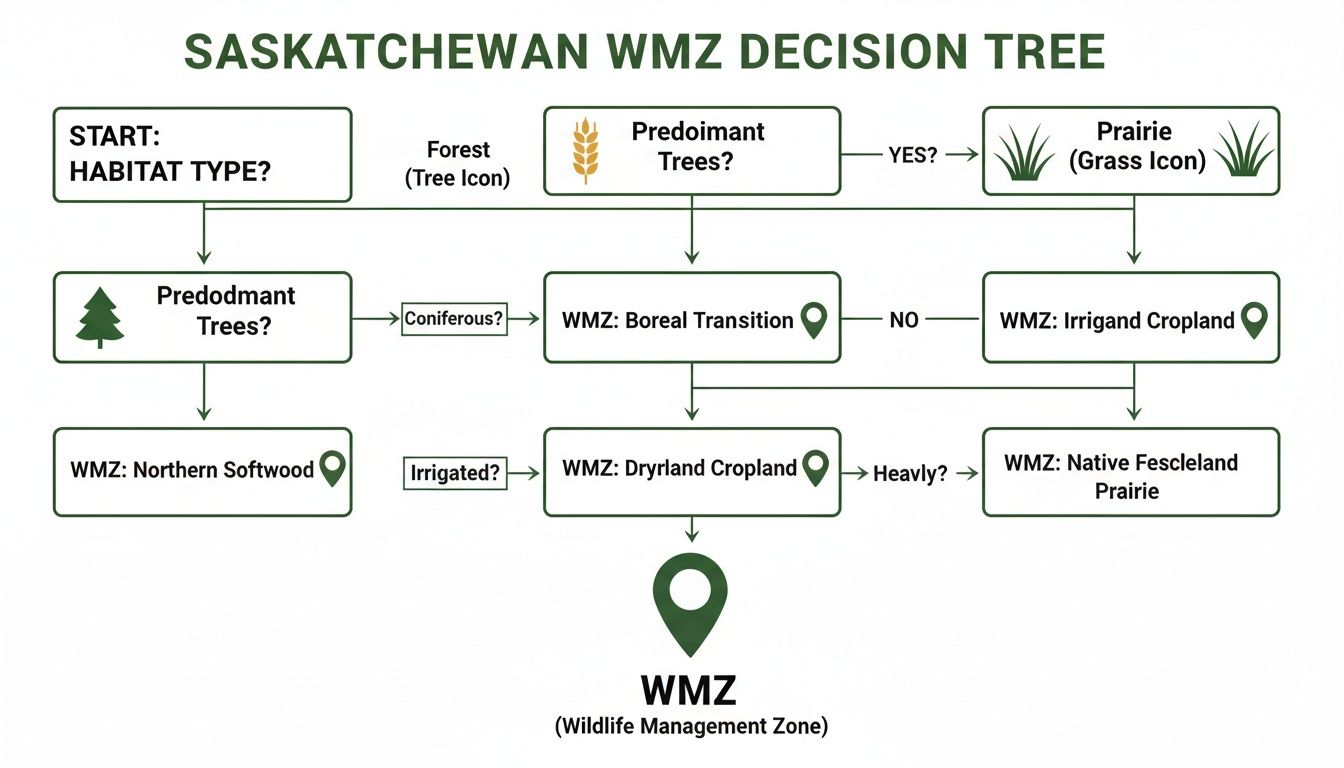
This kind of big-picture view helps you see the logic behind the zones, which are often grouped by major habitat types like forest, parkland, or prairie.
The big catch with these government tools, however, is what happens when you’re actually out in the field. Lose cell service—a common reality in Saskatchewan's best hunting country—and those online maps are gone. You’re left with whatever you printed out or memorized beforehand.
Modern Digital Solutions for Hunters
This is where modern hunting apps completely change the game. Tools like HuntScout are built from the ground up for in-the-field use, layering crystal-clear WMZ boundaries over high-resolution satellite maps. Forget trying to guess if you’re on the right side of a creek; you can see your exact GPS dot on a detailed photo of the terrain with the zone line clearly marked.
With just a tap, the app can tell you exactly which WMZ you're standing in, often pulling up the relevant season dates and regulations for that specific spot. It takes all the guesswork out of the equation.
The real game-changer is offline functionality. Before you even leave the house, you can download the maps for your entire hunting area. Once you’re out there with zero bars of service, your phone’s built-in GPS still works, showing your precise location on the map you saved. You’ll always know which side of a boundary you're on.
For hunters who want dedicated hardware, a standalone GPS unit is another rock-solid option. Many modern GPS devices let you load WMZ boundary files directly onto them, giving you a tough, reliable navigation system that doesn’t depend on your phone’s battery. The interface might not be as slick as an app, but their rugged build and long battery life are huge pluses for multi-day backcountry trips.
Many serious hunters run both—an app on their phone for quick reference and a dedicated GPS as a bulletproof backup. This kind of redundant system gives you total confidence in your location, no matter what. And if you ever find yourself hunting in other parts of the country, you can check out our guide on the Ontario hunting WMU map system to see how the concepts and tools compare.
Navigating Crown and Private Land Within a Zone
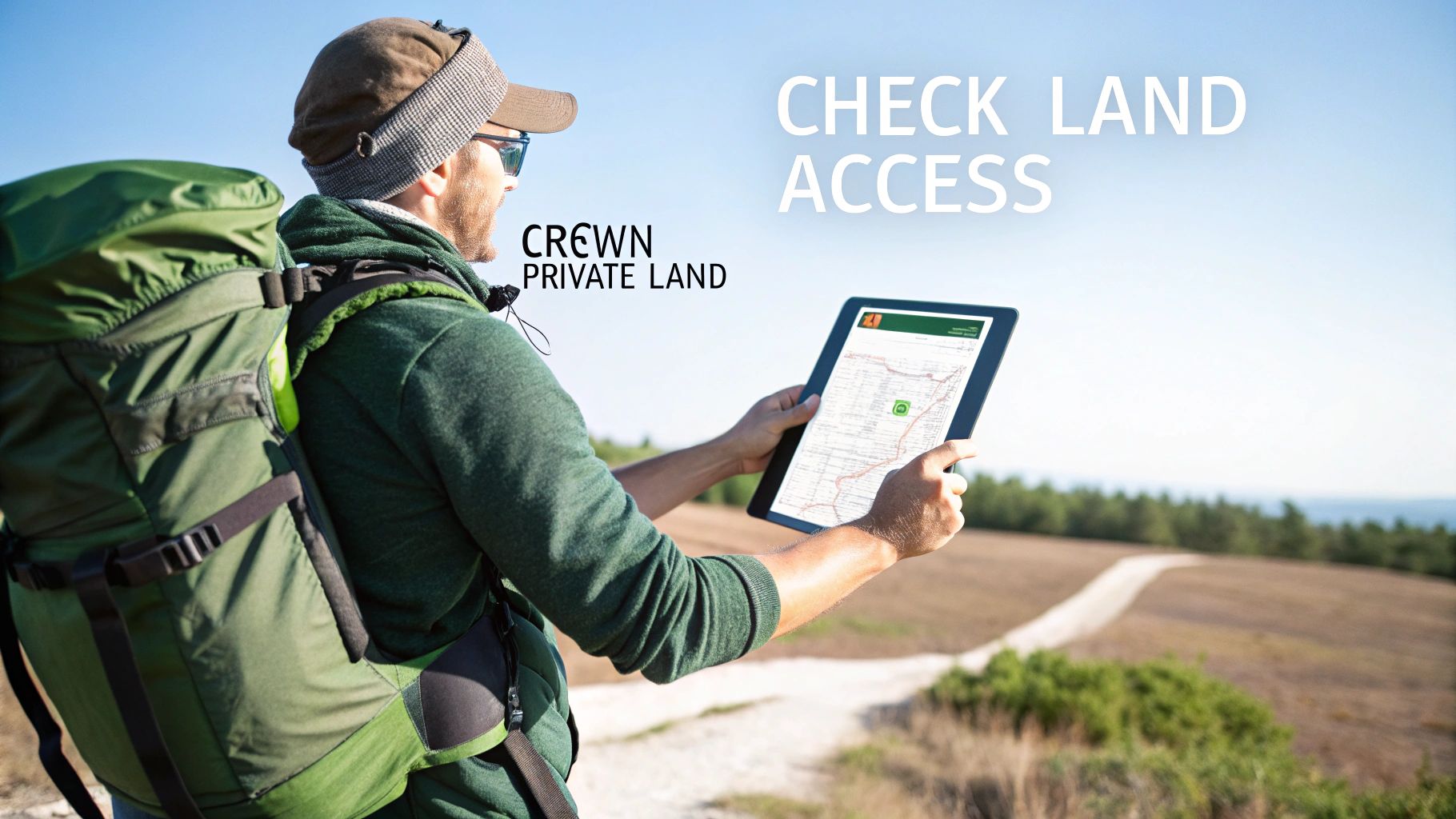
Okay, so you've figured out your Saskatchewan hunting zones. That's a great first step, but the real work starts now. The next challenge—and it’s a big one—is understanding the patchwork of different land types that exist within those zone boundaries. A costly mistake I see hunters make is assuming that just because they’re in the right WMZ, every field and bluff is fair game.
Think of a WMZ like a big rural municipality. Being inside the town limits doesn’t mean you can just wander into anyone's backyard. It's the exact same principle out in the field. Each zone is a complex quilt of publicly accessible Crown land, privately owned farms and ranches, and other restricted areas.
Learning to tell them apart isn’t just good practice; it's essential for a legal, ethical, and successful hunt. It keeps you out of trouble and lets you focus your energy on ground you can actually hunt.
The Crown Land Advantage
For many of us, Crown land is the heart of public hunting opportunity in Saskatchewan. These are public lands managed by the province, and for the most part, they are open for us to use. But here’s the catch: not all Crown land is created equal. The rules can change quite a bit depending on how a specific parcel is designated.
You’ve got your standard General Use Crown Land, which is typically wide open for hunting. But you’ll also run into other types:
- Wildlife Habitat Protection Act (WHPA) Lands: These spots are managed specifically to protect wildlife and habitat. They’re almost always open to hunting unless a sign tells you otherwise.
- Fish and Wildlife Development Fund (FWDF) Lands: This land was bought using money from our hunting and fishing licences, so it’s managed for wildlife and our access.
- Community Pastures: These are huge areas that can offer incredible hunting, but you often need to follow specific rules. It usually means contacting the pasture manager to get the details on access and any local restrictions.
The golden rule is to never assume. Always double-check the specific rules for any piece of Crown land you plan to hunt. While the regulations differ, our guide on finding Crown land in Manitoba covers some great principles that apply right across the prairies.
Respecting Private Property Lines
While Crown land is fantastic, a huge chunk of southern and central Saskatchewan is privately owned. And when it comes to private land, the rule is simple, direct, and non-negotiable: you must have permission from the landowner to access their property. That includes just walking across it, let alone hunting.
The law in Saskatchewan puts the responsibility squarely on our shoulders as hunters. It's up to us to know whose land we're on and to get permission before we set foot on it. A simple mistake can lead to serious fines, the loss of your hunting licence, and a bad name for all hunters in the community.
Building a good relationship with landowners is one of the most valuable assets a hunter can have. Approaching them respectfully, well before the season starts, can open up access to incredible hunting spots that public land hunters will never see.
Saskatchewan Land Access Quick Guide
Understanding the basic land access rules is crucial before heading out. This table breaks down the most common types of land you'll encounter within a Saskatchewan hunting zone.
| Land Type | General Access Rule | Key Consideration |
|---|---|---|
| General Crown Land | Open to public access | Always confirm there are no specific activity or vehicle restrictions. |
| WHPA & FWDF Lands | Generally open to hunting | Managed for wildlife; access may be restricted to foot-only in some cases. |
| Private Land | Permission Required | Hunter must get explicit consent from the landowner before any entry. |
| Community Pastures | Varies; permission often needed | Contact the local pasture manager for specific access rules and dates. |
| First Nations Reserve Land | Restricted access | Non-band members require permission from the specific First Nation's council. |
| Provincial/National Parks | Highly restricted or prohibited | Hunting is typically not allowed, except in very specific, designated areas. |
This is just a starting point, of course. The key takeaway is to do your homework on every single parcel you plan to visit to ensure you're always on the right side of the law.
Using Modern Tools to Avoid Trespassing
This is where technology has completely changed the game for us. Trying to sort out property lines with old paper maps or by looking for fences is a recipe for a headache and potential legal trouble. Modern hunting apps are the answer.
These tools layer detailed land ownership information right onto satellite maps on your phone. With a quick tap on the screen, you can see property boundaries and, in many cases, who owns that piece of land. This makes your planning so much easier:
- Clearly see Crown land: Instantly spot the huntable public parcels and how they border private property.
- Identify landowners: Get the information you need to respectfully contact owners and ask for permission.
- Avoid restricted areas: Easily see parks, conservation areas, or First Nations reserve lands where special rules apply.
By using these digital maps, you take all the guesswork out of the equation. You can plan your hunt with total confidence, knowing exactly where you can and can’t be. It saves a ton of time on pre-scouting and prevents you from making that one accidental step across a line you shouldn't.
How Zones Influence Seasons and Regulations
Knowing where the boundaries of Saskatchewan’s hunting zones are is step one. But the real game-changer is understanding how those lines on the map dictate the actual rules of your hunt. A Wildlife Management Zone (WMZ) isn't just a chunk of land; it's a self-contained world of regulations where everything from season dates to legal gear is spelled out in black and white. This is where high-level wildlife management strategy becomes your personal, on-the-ground reality.
Think of it like driving through a town. On the highway, you can do 110 km/h. Once you hit the town limits, it drops to 50 km/h, and then to a crawl at 30 km/h in a school zone. The road is the same, but the rules change based on exactly where you are. WMZs are the hunting equivalent.
This approach gives biologists an incredible amount of precision. They can fine-tune the rules to match the needs of local animal populations, keeping them healthy and sustainable. For you, the hunter, it means the regulations can change dramatically just by crossing a gravel road or a small creek that happens to be a WMZ boundary.
The Impact on Season Dates and Timings
Season dates are probably the biggest thing that trips hunters up. It's a classic mistake to assume the white-tailed deer rifle season starts on the same day everywhere in the province. That's almost never the case.
For example, the rifle season for whitetails might be wide open for two weeks in WMZ 35, while the zone right next door, WMZ 36, is archery-only for that same stretch. You might also find a special antlerless season in one zone to help manage the local population, while just a few kilometres away, it’s bucks-only.
Here are a few common ways the rules can differ:
- Staggered Openings: Zones that see a lot of hunting pressure might have later or shorter seasons to give the animals a break.
- Method-Specific Seasons: One zone might allow muzzleloaders, bows, and rifles, while its neighbour is restricted to primitive weapons only.
- Species-Specific Windows: A moose season in the northern forest will have completely different dates from an elk season down in the southern parklands.
This is exactly why you have to check the regulations for your specific WMZ before you head out. It’s not just a good idea—it’s absolutely essential for staying legal and ethical.
The bottom line is simple: Your licence is only valid for a specific species, in a specific WMZ, during a specific season, using a specific type of equipment. All four of those things have to line up perfectly for your hunt to be legal.
How Bag Limits and Tag Requirements Change by Zone
It's not just about when you can hunt; the WMZ you're in also determines what and how many animals you can legally take. Bag limits are set at the zone level based on the health and numbers of local wildlife. In a zone with a thriving deer population, you might get a tag for an antlered deer and another for an antlerless one. But in a neighbouring zone where the herd is still recovering, the limit might be just one antlered buck.
This all ties directly into the Big Game Draw. When you put in for a draw species like elk, moose, or mule deer, you aren't just applying for a tag—you’re applying for a tag in a specific WMZ. Your odds of getting drawn can swing wildly from one zone to the next, depending entirely on how many tags are available and how many other hunters applied for that same spot.
This zone-based system is how the province manages hunting opportunities fairly. It's also a key tool for spreading out the economic and recreational benefits of hunting, which are massive. With over 70,000 resident hunters after big game, WMZs are what make the whole thing sustainable. In fact, a 2016 survey found that over 80% of hunters used firearms exclusively, which shows just how important zones are for managing pressure from the most popular hunting methods. You can learn more about the economic and management role of hunting to see the bigger picture.
By getting to know the land within these zones, you can also plan your hunts much better. A great place to start is our guide on what Crown land is in Canada, which will help you find public-access lands in your target WMZ. At the end of the day, this hyper-local approach to regulations drives home one point: knowing your zone isn’t just a tip, it’s the foundation of every single decision you make in the field.
Putting It All Together: A Modern Saskatchewan Hunt
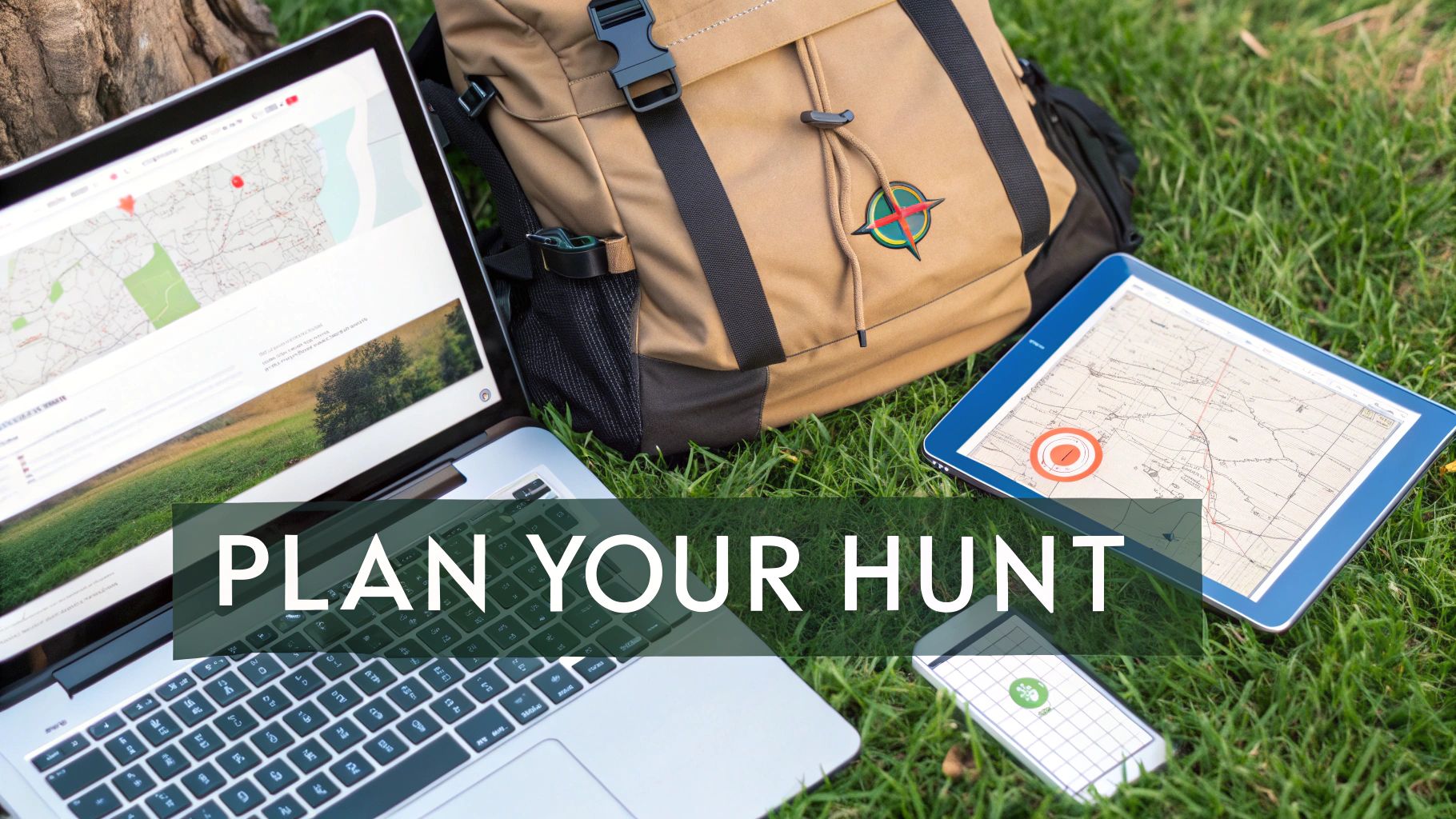
Knowing the maps, land types, and rules is one thing. The real magic happens when you tie it all together. Let’s walk through how a smart, modern hunt actually comes to life, moving from homework on the screen to boots on the ground. This is how understanding Saskatchewan hunting zones gives you a serious edge.
Let's say a white-tailed deer hunt is on your mind. The old way was to just pick a spot and hope for the best. The new way is to start with some smart research. You’ll dig into the Big Game Draw statistics from past seasons, looking for a few WMZs that hit that sweet spot: healthy deer numbers and decent draw odds. Right away, you’ve filtered out the noise and are focusing only on high-potential zones.
Once you’ve got a target WMZ picked out, it's time for some e-scouting.
From Digital Maps to Field-Ready Plans
This is where a tool like HuntScout really shines. You pull up your chosen WMZ and switch on the satellite view. Your first move is to flip on the Crown land layer, which instantly paints all the public-access land in a different colour. Now you can easily trace logging roads and old trails, looking for those perfect funnels, feeding spots, and thick bedding cover that are tucked away from easy access.
As you find promising areas, you start dropping digital waypoints. Maybe you'll pin a little clearing that screams "morning ambush spot," a beaver pond that acts as a water source, or a hidden meadow deep in the woods. Each pin you drop becomes part of a custom-built strategy, all before you’ve spent a dime on gas.
This completely changes the game. Hunt planning shifts from hopeful guesswork to a calculated, strategic mission. You're not just crossing your fingers and hoping to stumble onto a good area; you're building a detailed plan based on solid data and a bird's-eye view.
With your waypoints locked in, the final check is to confirm the specific regulations for that exact WMZ. A quick look verifies the season dates, legal shooting hours, and any other unique rules for that zone. Your plan is now 100% compliant. Before heading out, you download the maps for offline use, ensuring your phone’s GPS can guide you to every single spot, even when you're miles from the nearest cell tower.
Hunting with Confidence
All this prep work pays off big time once you're out there. You aren't burning precious daylight trying to figure out if you're on public land or about to trespass. You can move with purpose, navigating directly to the spots you've already scouted so carefully from your couch.
This entire workflow is built on the foundation laid by Saskatchewan's Wildlife Management Zones, which are essential for conserving our wildlife and producing incredible big game. In fact, it's this very system that helped manage the habitat that grew the world-record typical whitetail—the legendary Hanson Buck—back in 1993. Modern tools like HuntScout are indispensable, putting Crown land maps, WMZ boundaries, and offline GPS right in the palm of your hand.
You can learn more about the incredible animals that have come from these well-managed lands by checking out Saskatchewan's impressive big game records.
Your Questions Answered: Navigating Saskatchewan's Hunting Zones
When you're poring over maps and planning your next hunt, it’s natural for questions about Saskatchewan’s hunting zones to pop up. Let's tackle some of the most common ones that hunters ask, whether they're in the planning stage or already out in the bush.
Can I Hunt in Multiple WMZs with One Licence?
For the most part, the answer is no. Think of your big game licence—especially for draw species like moose, elk, and mule deer—as being tied to a single, specific WMZ. This is a cornerstone of how the province manages wildlife populations, making sure hunting pressure is spread out properly.
Always double-check the fine print on your licence. Some tags, like those for an antlered white-tailed deer, might be valid across several adjacent zones. But that's more of an exception. If you have a draw tag, you can bet you’re locked into the single zone you successfully applied for.
What Is the Easiest Way to Find Out Who Owns a Piece of Land?
These days, the most straightforward method is to use a modern hunting app with land ownership layers. Gone are the days of wrestling with old plat maps. Tools like HuntScout overlay property lines right onto a satellite map on your phone, often including the landowner's name.
This takes all the guesswork out of it. You can clearly see Crown land, pinpoint private parcels, and get the information you need to respectfully ask for permission before you even think about stepping onto someone’s property.
Using an app like this saves a massive amount of time and, more importantly, keeps you on the right side of the law by helping you avoid accidental trespassing.
What Happens If I Accidentally Cross a WMZ Boundary?
This is something you have to take seriously. Stepping across a WMZ boundary from the one your tag is valid for—even by a few metres—can land you in hot water. If you shoot an animal in a zone where your licence isn't valid, that's considered poaching. The consequences can be severe: hefty fines, losing your licence, and having your firearm and the animal confiscated.
This is exactly why having a reliable GPS with a WMZ boundary layer is non-negotiable. It’s your proof of where you are. "I didn't know" won't hold up as an excuse, so the responsibility is 100% on you to know your location at all times.
Are There Any Special Rules for Using Trail Cameras in Saskatchewan?
Yes, there are. While trail cameras are legal, you need to be mindful of the rules. For instance, wireless or cellular cameras that send you real-time images are permitted for keeping an eye on wildlife.
The key thing to remember is that you can’t place them where they might harass wildlife, and you absolutely need the landowner's explicit permission to put them on private property. Regulations can and do change, so it's always smart to give the latest Hunters and Trappers Guide a quick review before you head out.
Planning your next hunt shouldn't feel like a chore. With HuntScout, you can instantly see WMZ boundaries, tell Crown and private land apart, and look up regulations right on your phone. Download HuntScout today and spend less time guessing and more time hunting.