When it comes to putting a whitetail down quickly and humanely, it all comes down to where you place your shot. The goal is always to target the vital organs—specifically the heart and lungs. This area, what old-timers call the "boiler room," sits right behind the front shoulder. It's not just the biggest target; it's the most reliable one for a clean, ethical harvest that honours the animal.
Understanding Whitetail Anatomy for a Clean Harvest
Every seasoned hunter knows the old advice: “aim behind the shoulder.” But to get really good, you need to go deeper than that. You have to develop a three-dimensional mental map of what's going on inside that deer. It's this ability to truly visualize the vitals that separates a lucky shot from one made with skill and confidence.
The chest cavity is your primary target area. It’s where the most critical organs for a quick harvest are located: the heart and the lungs. Focusing on this zone gives you the best margin for error, which is something you have to account for in the real world, where a perfect, textbook shot is a rare gift.
The Boiler Room: The Heart and Lungs
There’s a good reason hunters call the heart and lung area the "boiler room." A well-placed shot here causes massive internal bleeding and a rapid drop in blood pressure, resulting in a quick and humane end. The lungs are a huge target, taking up most of the chest cavity.
Even if a deer runs on a shot of adrenaline, a projectile that passes through both lungs will create a devastating wound. It's almost always a fatal hit, and the animal usually goes down within a minute. The heart is a smaller target, tucked down low between the lungs, just above the brisket. A direct heart shot will drop a deer on the spot, but it’s a much tougher shot to make.
Here's the key takeaway: Aiming for the lungs gives you a much bigger kill zone. If you're a bit low, you might hit the heart. If you're a little high or back, you’re still likely to take out lung tissue. This built-in forgiveness makes it the most responsible shot you can take.
Try to picture the boiler room not as a flat bullseye, but as a three-dimensional space. Think of a basketball tucked inside the deer's chest, right in that pocket created by the back of the front leg and shoulder. No matter what angle the deer gives you, your job is to drive your bullet or arrow straight through the centre of that basketball.
High-Risk Targets: The Spine and Brain
Sure, a shot to the brain or spine will drop a deer instantly, but most ethical hunters consider these to be extremely high-risk, low-percentage shots. Why? Because the targets are incredibly small and leave zero room for error.
- Brain Shots: A whitetail's brain is about the size of a tennis ball, and it’s protected by a thick skull. Miss by just a few centimetres, and you could inflict a horrible, non-lethal wound to the jaw or face. The deer might escape, only to die a slow death from infection or starvation.
- Spine Shots: The spinal column is another very narrow target. A direct hit will paralyze the animal, but a near-miss can result in a wounded deer that gets away, likely to suffer for a long time.
With these shots, there's just no margin for error. A sudden gust of wind, a deer flinching at the sound, or a slight twitch from the hunter can turn what looked like a perfect shot into a tragic mistake. This is why experienced hunters always choose the reliable heart-lung area. The goal isn't just to kill the animal; it's to do it as quickly and humanely as possible. Targeting the boiler room is the surest way to achieve that, and understanding this anatomy is the foundation of ethical shot placement whitetail deer hunters can count on.
Reading the Angles: Making the Shot Count in the Field
Knowing where a whitetail’s vitals are is one thing, but that knowledge is useless if you can't apply it to a living, breathing deer that’s rarely standing perfectly still. In the real world, deer are constantly moving, and success comes down to your ability to read the animal's angle in an instant.
You have to visualize the path your bullet or arrow will take, adjust your aim accordingly, and ensure that path leads directly through the vital organs. This is where textbook anatomy meets practical, in-the-moment hunting skill. The most common scenarios you'll face each come with their own challenges, and mastering them means knowing not only where to aim but, more importantly, when to hold your fire.
The Ideal Broadside Shot
This is the shot we all dream of. The deer stands perpendicular to you, offering the largest possible target area for its heart and lungs. It’s the highest percentage shot because there’s very little heavy bone to get in the way of a clean pass-through.
Your aiming point should be right in the "pocket," that little crease just behind the shoulder. A good rule of thumb is to trace an imaginary vertical line up the front leg and aim about one-third of the way up the deer's chest. A well-placed shot here will almost always take out both lungs and often clips the top of the heart, leading to a quick, ethical harvest.
For many hunters, especially with a bow, the broadside shot is the only one they’ll take. It offers the highest probability of a clean kill and the lowest risk of a poor hit, making it the gold standard for shot placement on whitetail deer.
The Quartering-Away Shot
This is often considered the next-best opportunity. The deer is angled away from you, which still gives you great access to the vitals, but your aiming point has to change. If you aim for the classic spot right behind the shoulder, you'll likely only hit one lung or catch the liver—not ideal.
Instead, you have to think in three dimensions. Visualize your bullet or arrow entering the deer and exiting through the offside shoulder. To make that happen, you need to shift your aim farther back on the ribcage. The sharper the angle, the farther back you aim. This trajectory drives the projectile forward through the chest cavity, ensuring it destroys the lungs and possibly the heart.
The decision tree below is a fantastic mental checklist for these crucial in-the-field moments.
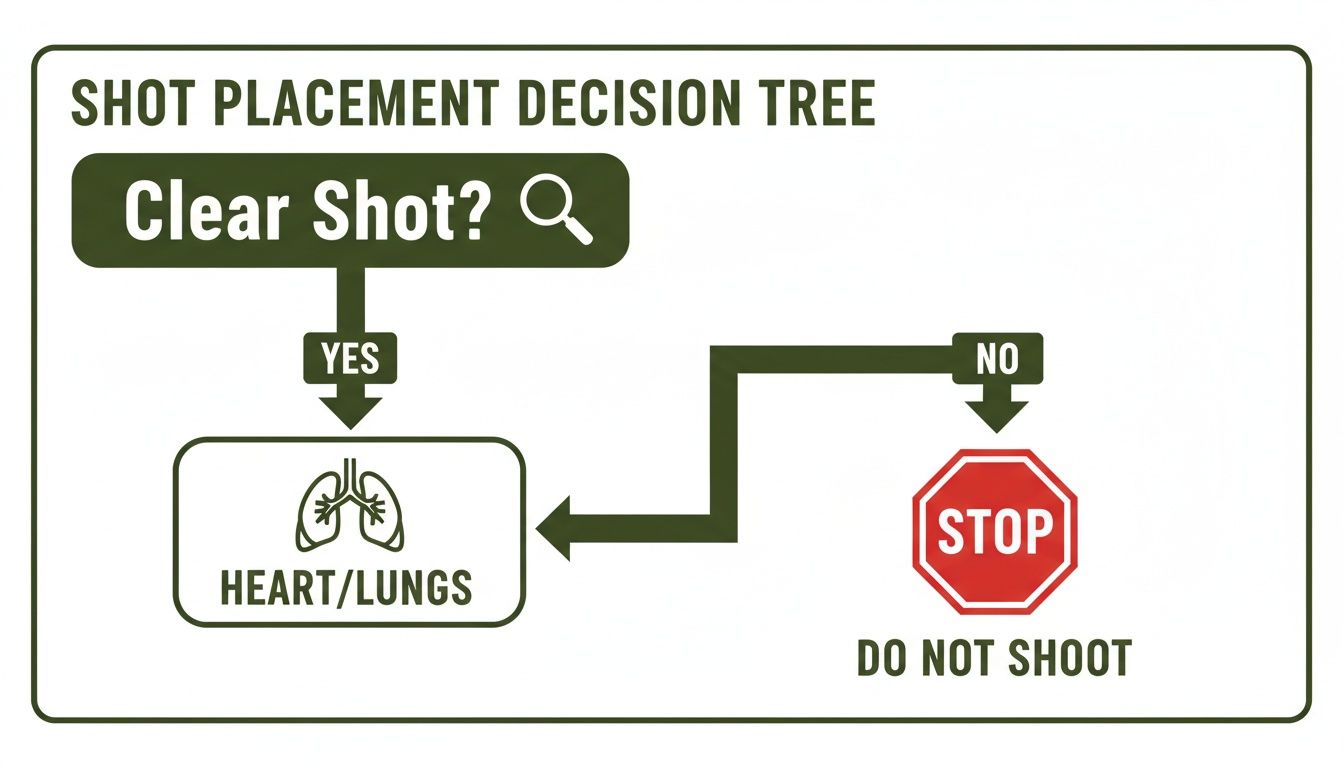
This visual guide hammers home the most important rule of ethical hunting: if you don’t have a clear, high-percentage shot at the vitals, you don’t shoot. Period.
High-Risk and Unethical Angles
Patience is a hunter's most valuable tool, and that’s never truer than when a deer presents a poor angle. Some shots are simply too risky, and the only responsible choice is to pass and wait for a better opportunity to come along.
Here’s a quick-reference table to help visualize the decision-making process for the most common angles you'll encounter.
Shot Angle Quick Reference
| Shot Angle | Aim Point Guidance | Ethical Viability (Rifle) | Ethical Viability (Bow) |
|---|---|---|---|
| Broadside | Behind the shoulder, 1/3 up the body. | High | High |
| Quartering-Away | Aim farther back to exit through the opposite shoulder. | High | High |
| Quartering-To | Shoulder bone heavily obstructs vitals. | Very Low / Unethical | Unethical |
| Straight-On | A tiny target on the chest; no room for error. | Very Low / Unethical | Unethical |
| Straight-Away | Projectile must pass through paunch and intestines first. | Unethical | Unethical |
As the table shows, anything other than a broadside or quartering-away shot dramatically increases the risk of a wounded and lost animal.
- Quartering-To: With the deer angled toward you, the heavy shoulder bone and leg act as a shield, covering the vitals. A high-powered rifle might break through, but an arrow will almost certainly deflect, resulting in a superficial wound. It's a gamble not worth taking.
- Straight-On (Frontal): The vital area here is incredibly small, basically a tiny window at the front of the chest. Miss by just a few inches in any direction, and you've wounded the animal without a clean harvest.
- Straight-Away (Rear-Facing): This is considered the most unethical shot in the book. You’re trying to send a projectile through the entire digestive system to reach the vitals. The chances of a quick, clean kill are practically zero, while the chances of a slow, painful death for the deer are extremely high.
Always pay attention to a deer’s body language. Sometimes, understanding different deer calls and sounds can help you predict if it's about to turn, potentially giving you that perfect shot. Your number one responsibility is to the animal. That means only taking shots you are 100% confident will result in a quick, humane harvest. Anything less demands the discipline to let the deer walk away.
How Your Weapon Choice Changes Everything
The gear you carry into the woods—whether it's a rifle, bow, or muzzleloader—does more than just launch a projectile. It dictates your entire game plan for taking a clean, ethical shot on a whitetail. The energy, trajectory, and what happens on impact are worlds apart between these tools. Honestly, failing to respect these differences is one of the biggest mistakes I see hunters make, and it can easily lead to a wounded animal and a long, difficult tracking job.
Think about it this way: a high-powered rifle bullet and a hunting arrow are designed to do the same job, but they get there in completely different ways. A modern bullet is all about creating massive internal trauma through hydrostatic shock and rapid expansion. An arrow, though, is a cutting tool. Its job is to slice a wide wound channel that leads to rapid, fatal blood loss.
This fundamental difference is why a rifle hunter might confidently take a high shoulder shot, breaking heavy bone to drop a deer on the spot. If a bowhunter tried that same shot, it would be a disaster. The heavy shoulder blade would likely stop the arrow dead in its tracks, preventing it from ever reaching the vitals.
Rifle Hunting: It’s All About the Bullet
When you're hunting with a rifle, effective shot placement is about matching your bullet's design to your calibre and the typical ranges you'll be shooting. It’s not just about raw power; it’s about controlled performance when the bullet hits the animal. A fragile bullet from a high-velocity magnum might just explode on the surface, while an overly tough bullet might not expand at all on a longer shot, just punching through like a field point.
What you're looking for is that sweet spot between penetration and expansion. You need the bullet to drive deep enough to scramble the vitals from most angles, but also expand reliably to create a devastating wound channel once it gets there.
- Tougher Bullets (Bonded/Monolithic): For close-range shots in the thick Canadian bush or when you're after big-bodied northern bucks, a tough bonded-core or monolithic copper bullet is a fantastic choice. They hold together, resist breaking up, and ensure deep penetration, even if you hit bone.
- Rapid Expansion Bullets: Out in open country where your shots might stretch out a bit, a bullet designed for faster expansion can be a better bet. These make sure you get maximum energy transfer and shock, even when the bullet's velocity has started to drop off.
The real takeaway for rifle hunters is to look past the ballistics printed on the box and get to know your specific load. Practice at different distances to confirm your zero and learn your holdovers, sure, but also take the time to research how your chosen bullet is actually designed to perform on game.
Bowhunting: The Game of Precision
Bowhunting is a discipline of inches, not foot-pounds of energy. Your whole approach to shot placement has to be about avoiding heavy bone and slipping a razor-sharp broadhead through the ribs and into the lungs. As a bowhunter, you have to be far more patient and selective, often passing on shots that a rifle hunter wouldn't hesitate to take.
For archers, that heavy shoulder blade is public enemy number one. A perfect broadside or slightly quartering-away angle is absolutely critical because it opens up the rib cage, giving you a clean window into the "boiler room." This is why so many seasoned bowhunters I know will practice out to 20-30 yards beyond their maximum hunting distance. If you can consistently stack arrows at 60 yards on the range, a 30-yard shot in the woods feels like a chip shot.
Muzzleloaders and Shotguns: Mind the Drop
Hunting with a muzzleloader or a shotgun slug brings another major factor into play: a seriously curved trajectory. Unlike a flat-shooting centre-fire rifle, these projectiles start to drop like a rock after about 100-125 yards. This makes judging range one of the most critical skills you can have.
What looks like a dead-on hold at 75 yards could result in a hit that's several inches low at 150 yards—the difference between a perfect double-lung shot and a gut shot. For anyone using these firearms, spending serious time at the range is non-negotiable. You have to shoot at multiple, known distances to learn exactly how much your projectile drops.
Knowing your weapon isn't just about hitting a paper target. It’s about truly understanding its limits, knowing how your projectile acts when it hits an animal, and tailoring your entire shot placement strategy around that knowledge. That deep, practical understanding of your equipment is the final piece of the ethical hunting puzzle.
Factoring in Distance and Ballistics
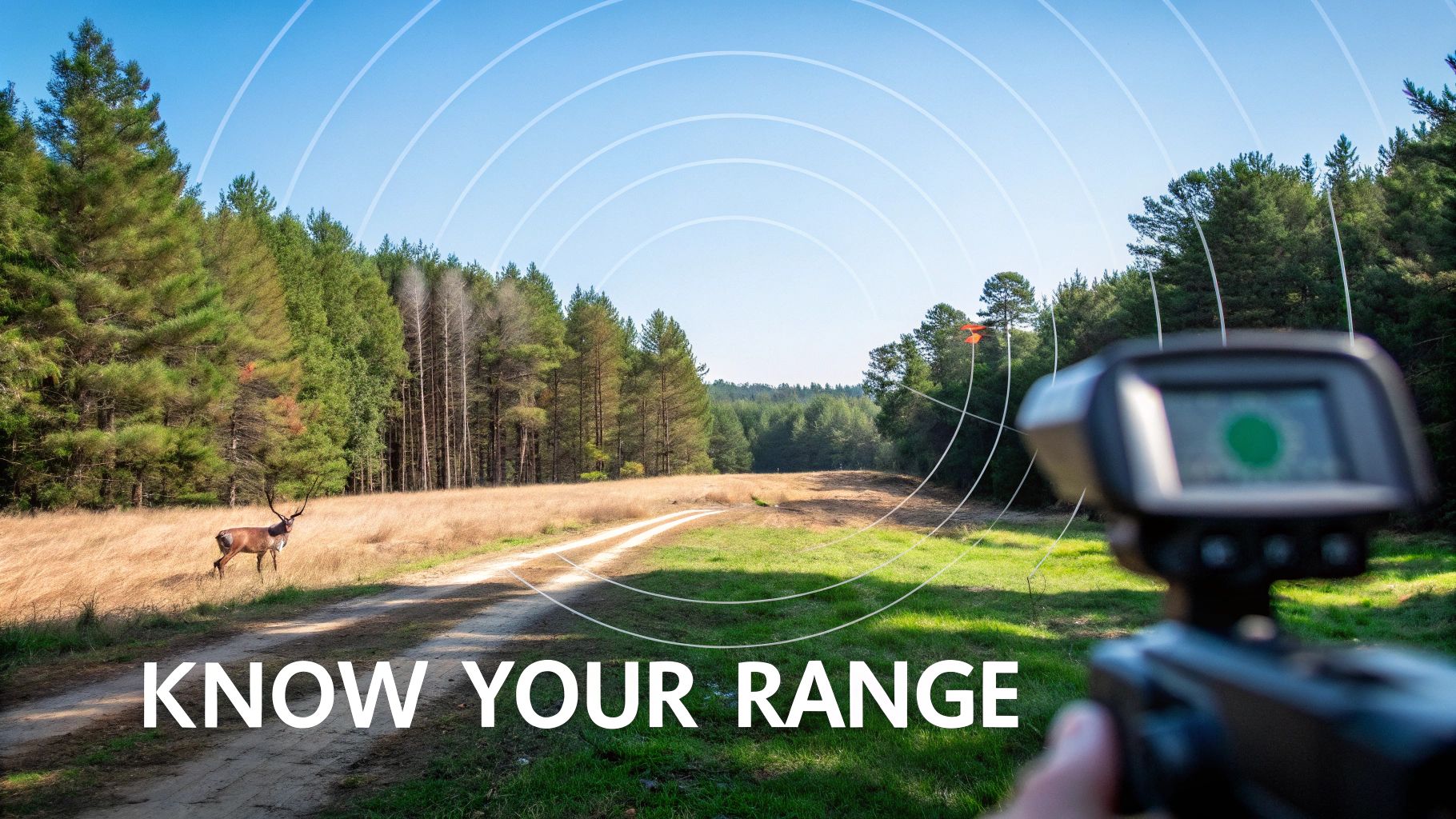
An ethical shot is so much more than just a steady hand; it's a quick but critical calculation. From the instant you decide to shoot, gravity and wind get to work on your bullet or arrow. Knowing how to account for distance, drop, and drift is what separates a hopeful prayer from a confident, clean harvest.
In the varied landscapes across Canada, from the thick bush of the East to the open prairies of the West, judging distance by eye is a skill that can fail even the most seasoned hunter. What looks like a 150-metre shot across a stubble field can easily be over 200. This is precisely why a good laser rangefinder has become one of the most essential tools in a modern hunter's kit.
Knowing the exact distance to your target isn't just helpful—it's the first and most critical piece of the ballistic puzzle. Without it, everything that follows is just a guess.
Knowing Your Zero and Effective Range
Your rifle’s “zero” is the bedrock of your accuracy. Let's say you’ve sighted your rifle to be dead-on at 100 metres; that’s your baseline. But a bullet doesn’t fly in a perfectly straight line. As it travels downrange, it immediately starts to drop.
This is where practice becomes completely non-negotiable. You have to know, without a doubt, how much your specific ammunition drops at different distances. For a common deer cartridge like a .308 Winchester, a 200-metre shot might only require you to hold a few inches high. But stretch that out to 300 metres, and the drop could easily be more than a foot.
Your maximum effective range isn't the farthest your rifle can physically shoot. It's the maximum distance at which you can consistently and confidently place a shot in a deer's vital zone—under real-world field conditions, not just from a perfect benchrest at the range. Be brutally honest with yourself about this limit.
This means putting in quality time at the shooting range. Don't just confirm your 100-metre zero and pack up. You need to actively practice at longer ranges, learning your holdover points—how high to aim to compensate for bullet drop at 200, 250, and 300 metres. This is the knowledge that builds the real-world confidence needed for precise shot placement on whitetail deer when the moment of truth finally arrives.
Archery Considerations: Pin Gaps and Angles
For those of us who hunt with a bow, the principles are the same, but the margins for error are incredibly tight. An arrow flies in a much more pronounced arc than a bullet, which makes precise range estimation absolutely vital.
- Pin Gaps: Your sight pins are set for specific yardages (e.g., 20, 30, 40 metres). If a deer is standing at 35 metres, you have to "gap shoot" by aiming perfectly between your 30 and 40-metre pins. It's a skill that takes a ton of practice to get right.
- Shot Angle: Shooting down from an elevated treestand significantly changes where your arrow will hit. Gravity has less time to act on the arrow during its flight, causing it to impact high. The old rule of thumb is a good one: aim for the horizontal distance to the deer (the distance from the base of your tree), not the direct line-of-sight distance your rangefinder shows you.
Many serious bowhunters practice well beyond their intended hunting range. If you can consistently group arrows at 60 metres, a 30-metre shot in the woods feels like a chip shot. This kind of long-range practice builds unshakable mental confidence and quickly reveals any flaws in your form.
Ultimately, mastering ballistics comes down to discipline. It's the discipline to invest in a rangefinder and learn to use it properly. It's the discipline to spend those hours at the range learning the trajectory of your equipment. Most importantly, it's the discipline to know your absolute limit and have the integrity to pass on any shot that falls outside of it.
Planning Your Hunt With Modern Mapping Tools
An ethical shot doesn't just happen. It’s the result of careful planning that starts long before you ever see a deer, and these days, that planning is powered by some incredible mapping tools. It's not just about finding a good spot anymore; it’s about building a solid, strategic plan that puts the odds in your favour while making sure you're safe, legal, and ready for what comes next.
Using an app like HuntScout really changes the game. Before I even think about putting boots on the ground, I can pull up my hunting area and verify the exact Wildlife Management Unit (WMU) boundaries. This takes all the guesswork out of staying compliant. Knowing you're in the right place, following the right rules, gives you a ton of confidence.
Digital Scouting and Waypoint Strategy
I do most of my initial scouting from my computer or phone now. It's amazing what you can learn by analyzing terrain, picking out potential deer funnels, and flagging promising locations without ever leaving home. I'll drop waypoints on anything that looks interesting—a thick bedding area, a natural pinch point, or what looks like the perfect tree for a stand.
This screenshot from HuntScout gives you an idea of the detail we're talking about.
Look at those clear property lines and topo contours. That's gold for planning your entry and exit routes. You can map out a path that keeps the wind in your favour and your scent away from where you expect the deer to be. That kind of prep is what separates a lucky hunt from a successful one.
But here’s where this tech becomes absolutely critical. The moment you take a shot, you need to do two things immediately:
- Mark Your Position: Drop a waypoint right where you are standing or sitting.
- Mark the Deer’s Last Known Spot: Drop another waypoint on the exact spot the deer was when you shot.
This simple two-waypoint system creates an ironclad starting point for your tracking job. Even if blood is sparse at first, you have a data-backed, confident reference to begin your search.
Trust me, having those two points saved is a lifesaver. It cuts through the adrenaline and potential panic that can creep in after a shot. Instead of second-guessing yourself, you have a calm, methodical starting line. Knowing exactly where to begin is half the battle in any recovery.
The Power of Offline Maps
Let's face it, most of Canada's prime deer country has spotty cell service at best. This is where offline maps aren't just a nice feature; they're essential. Before heading out, I download all the maps for my area, which includes my waypoints, property boundaries, and WMU layers, right onto my phone.
This guarantees all my critical info is there when I need it, signal or no signal. It's a safety net and a strategic tool all in one, letting you navigate and make smart decisions deep in the woods. Good planning is the foundation of ethical hunting, and it directly leads to confident shot placement on whitetail deer because it helps put you in the right place at the right time.
To get a better handle on this, you can check out this detailed guide on how to use a WMU map for hunting in Ontario and really dial in your pre-hunt prep.
The Critical Steps After You Take the Shot
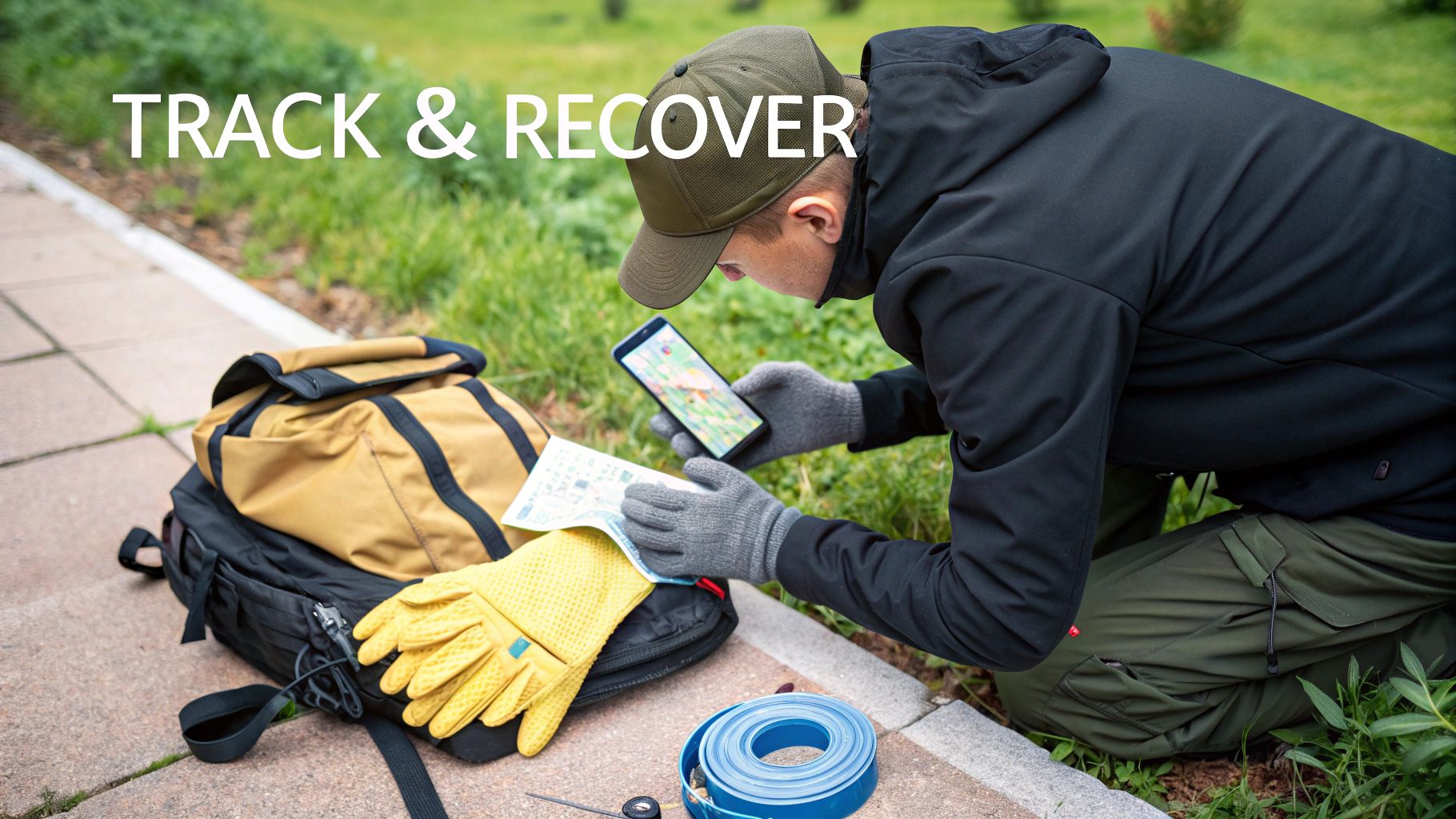
Pulling the trigger is really just the halfway point of the hunt. What you do in the moments right after the shot often makes the difference between a quick recovery and a long, frustrating search. The absolute best thing you can do is take a deep breath, stay calm, and become an expert observer.
As soon as the rifle cracks or your arrow releases, burn the deer’s exact location and its immediate reaction into your memory. Did it hunch up? That often suggests a liver or gut shot. Did it kick its back legs like a mule? That’s a classic sign of a solid heart shot. Maybe it dropped and then staggered back up, which could point to a non-lethal muscle or leg injury.
Listen carefully. You want to hear the distinct "whack" of impact, which tells you the hit was solid. Note the exact direction it ran, and keep listening for the sound of it crashing through the brush and, with any luck, falling for good.
When to Begin Tracking
Patience is your best friend now. The urge to jump out of your stand and immediately start looking is powerful, but it’s one of the biggest mistakes a hunter can make. Pushing a wounded deer too soon can force it to run much farther than it ever would have on its own, turning a 100-metre recovery into a multi-kilometre nightmare.
Here’s a good rule of thumb for how long you should wait:
- Heart/Lung Shot: Even if you’re confident in your shot placement on the whitetail deer and saw it go down, give it at least 30 minutes. Adrenaline is a powerful thing and can keep a mortally wounded deer on its feet longer than you’d think.
- Liver/Gut Shot: If you suspect a hit farther back, you need to wait much longer. Give the animal a minimum of four to six hours, sometimes more. This allows the deer to find a place to bed down and expire without being pressured.
The waiting period is all about honouring the animal. Giving it that time is the most ethical step you can take toward a clean recovery. Use this time wisely—replay the shot in your head, mark your location, and drop a waypoint on your HuntScout app where you last saw the deer.
Interpreting the Blood Trail
Once you finally start tracking, the blood itself will tell you a story. Go to where the deer was standing when you shot and look for the very first sign of blood. From there, move slowly, marking each drop or spatter with flagging tape so you can see the direction of travel.
- Bright, Pink, Bubbly Blood: This is the sign every hunter hopes for. It means a lung shot, which is almost always fatal and typically leaves a short, heavy blood trail.
- Dark Red Blood: This can point to a heart or liver hit. The trail might start out a bit inconsistent but should become steady.
- Watery, Greenish-Brown Blood: This is the telltale sign of a gut shot. The trail will likely be sparse, and this is exactly why that extended waiting time is so crucial.
A proper recovery is a methodical process, just like ensuring your licences and tags are in order before you even step into the woods. To brush up on that critical part of the hunt, you can read our guide on why hunting licensing compliance in Canada is so important. By respecting the animal from shot to recovery, you complete the hunt ethically.
Got Questions? Whitetail Shot Placement Q&A
Even the most seasoned hunters have questions that pop up now and then. Let's tackle a few of the most common ones I hear about where to aim on a whitetail.
What's the Best Spot to Aim with a Bow?
When you’ve got a bow in your hand, there’s one shot that reigns supreme: the double-lung. You're aiming for that sweet spot right in the middle of the vitals, tucked just behind the shoulder crease and about a third of the way up the deer’s body.
Why there? It gives you the biggest target and the most room for error. More importantly, it keeps your broadhead away from that thick shoulder bone that can stop an arrow in its tracks. A double-lung shot leads to massive hemorrhaging and the quickest, most ethical harvest you can ask for in archery.
Is the High Shoulder Shot a Good Idea?
With a powerful rifle, a high shoulder shot can drop a deer right where it stands. The hydrostatic shock and bone-shattering impact can anchor it instantly. But—and this is a big but—it’s an incredibly high-risk shot. Your margin for error is tiny.
If you miss by just a couple of inches, you could wound the deer without a clean recovery. For almost everyone, and especially if you're using a bow or a lighter calibre rifle, the classic heart-lung area is a much smarter and more ethical choice. It’s a bigger target and gives you a far better chance of a clean kill.
My Two Cents: I’ve seen the high shoulder shot work, but I’ve also seen it go wrong. For consistency and peace of mind, I tell every hunter to stick to the "boiler room." It's the most reliable path to an ethical harvest.
How Far Can a Heart-Shot Deer Really Go?
It’s always surprising, but even a deer shot directly through the heart can cover a lot of ground on pure adrenaline. Expect them to run anywhere from 30 to 100 metres, sometimes even a bit more. For the first few seconds, they often have no idea they've been fatally hit.
Your job isn't over when you pull the trigger. Keep your eyes glued on that deer for as long as you can see it, and listen carefully for the sound of it crashing down. That information is pure gold when you start your tracking job.
From planning your scout to tracking your harvest, make HuntScout your go-to tool. Get ahead of the game with our detailed mapping, WMU layers, and season trackers to hunt safely and confidently in the Canadian wild. See how it works and download the app at https://huntscout.app.