Welcome to the accessible and thrilling world of small game hunting in Ontario. Whether you're just starting out or have years of experience under your belt, this guide is built to be your go-to resource. We'll cover everything from decoding local regulations to the practical skills needed for a successful day chasing ruffed grouse or snowshoe hare. Think of this as your roadmap, taking you from the kitchen table planning session right into the heart of the action.
Your Adventure into Ontario Small Game Hunting
There's something special about small game hunting. It’s an incredible way to get out and explore Ontario's wild places without the intense, long-term planning that often comes with big game. A small game hunt can be a spur-of-the-moment weekend trip, packed with action and challenge. It’s the perfect field to sharpen your core hunting skills, from tracking to marksmanship, and a deeply rewarding tradition in its own right.
This isn't just a hobby; it's a huge part of the province's culture and a real economic driver. Thousands of hunters head out each year in pursuit of ruffed grouse, spruce grouse, snowshoe hares, and cottontail rabbits across Ontario's vast Crown lands and Wildlife Management Units (WMUs). In fact, Ministry of Natural Resources and Forestry (MNRF) data shows that over 50,000 participants annually pump more than $100 million into local economies through licences, gear, and travel. You can dig into the economic impact of these recreational activities yourself on the Open Government of Canada portal.
Understanding the Landscape
Before you even think about lacing up your boots, there are two key concepts you need to get straight: Wildlife Management Units (WMUs) and Crown Land.
Think of WMUs as different hunting 'neighbourhoods.' Each one has its own specific set of rules, season dates, and bag limits. Crown Land, on the other hand, is simply public land owned by the provincial government. The good news? A huge portion of it is open for hunting and other outdoor activities.
Getting these boundaries and regulations right is non-negotiable for every hunter. Your primary source for all this information is the official Ontario government website for hunting. Make it your first stop for regulations, licences, and any last-minute updates.
This government portal is where you'll find the official season dates, licensing details, and the all-important annual Hunting Regulations Summary.
Why Modern Tools Are a Game-Changer
While the spirit of the hunt is as old as time, our tools have definitely gotten an upgrade. Modern apps like HuntScout have become absolutely essential for planning a successful and legal hunt. These aren't just maps; they're powerful tools that layer WMU boundaries, Crown Land access points, and private property lines all in one place.
Key Takeaway: A successful hunt doesn’t start when you step into the woods. It begins at home with thoughtful planning, a firm grasp of the rules, and using the right tools to find those promising spots.
With features like offline maps, you can navigate with confidence even when you're deep in the bush with no cell signal. Throughout this guide, we'll show you how to blend that timeless fieldcraft with powerful modern resources to make your small game hunting Ontario trips safer, more ethical, and a whole lot more successful.
Making Sense of Ontario's Hunting Rules and Boundaries
Stepping into the world of Ontario's hunting regulations can feel a little overwhelming at first. Don't worry, it's a lot more straightforward than it looks. The whole system is built around your licence and the specific geographic area you're hunting in, all designed to keep wildlife populations healthy for generations to come. Getting this part right is the absolute foundation of a legal, ethical, and successful hunt.
Your starting point is getting the two key pieces of the puzzle. First up is the Ontario Outdoors Card, which is basically your official ID for all things hunting and fishing in the province. Then you'll need a Small Game Licence tag to go with it—this is what gives you the green light to hunt species like grouse, rabbits, and squirrels. You absolutely must have both on you at all times when you're out in the field.
Understanding Wildlife Management Units
Imagine Ontario is a giant quilt, and each square patch is a Wildlife Management Unit, or WMU. This is the single most important concept to grasp. Because Ontario is so massive and its ecosystems so varied, having one set of rules for the entire province just wouldn't work. So, it's divided into nearly 100 of these WMUs.
Each WMU has its own unique rulebook, covering things like:
- Open and Closed Seasons: The exact dates you're allowed to hunt a certain animal can be completely different from one WMU to the next.
- Bag Limits: This is the maximum number of a species you can legally harvest in a single day.
- Possession Limits: This is the total number of a species you're allowed to have, which includes what's in your pack and what’s in the freezer back home.
For instance, the Ruffed Grouse season in a southern WMU might open and close weeks apart from a season way up north. This is precisely why you can't just know the general rules; you have to know the rules for the exact WMU you're standing in. To get a better sense of how these zones are laid out, check out our detailed guide to the Ontario hunting WMU map.
Pinpointing Your Location and the Rules That Apply
So, how do you know which WMU you're in and what the specific regulations are? In the old days, this meant wrestling with giant paper maps and flipping through thick, confusing regulation books. Thankfully, modern tools have completely taken the guesswork out of the equation.
An app like HuntScout makes this dead simple. It uses your phone’s GPS to show your precise location on a map with all the WMU boundaries layered right on top. Just tap the area you plan to hunt, and it will instantly tell you which WMU you're in. This simple step prevents you from accidentally wandering across an invisible line into a different unit with different rules—a common mistake that can lead to some pretty serious fines.
Crucial Insight: Your location dictates the rules. Being a few hundred metres on the wrong side of a WMU boundary can be the difference between a legal hunt and a costly violation. Always confirm your WMU before you head out.
Finding a Place to Hunt: Navigating Crown Land
Once you’ve got your WMU sorted out, the next question is, "Where can I actually go?" Ontario is incredibly fortunate to have a massive amount of Crown Land—public land that is, for the most part, open to hunting. This is a game-changer for hunters, opening up millions of acres of wild, accessible country.
But "Crown Land" isn't a total free-for-all. Some areas have specific access restrictions or land-use rules you need to be aware of. It's on you to make sure you're on what's called General Use Area Crown Land, which is where hunting is typically permitted. Once again, a good mapping tool is your best friend. The HuntScout app clearly shows Crown Land boundaries, helping you easily tell the difference between public land, private property, and other restricted areas so you can hunt legally and with confidence.
Meet Ontario's Most Popular Small Game Animals
Alright, you've got the rules down. Now for the fun part—meeting the animals you'll be pursuing. Being a successful small game hunter in Ontario means getting to know your quarry inside and out. It’s not just about what they look like; it's about understanding how they live, where they hide, and what they do when they sense you're near.
This is the knowledge that turns a simple walk in the woods into a real hunt. Knowing why a grouse loves a certain kind of forest or how a hare uses a fresh snowfall to its advantage is what will fill your game bag. Let's break down the most common species you'll encounter.
The Ruffed Grouse: King of the Uplands
For a lot of Ontario hunters, the Ruffed Grouse is the classic prize. They're famous for their heart-stopping, explosive flush that can make even the most experienced hunter jump. These birds are absolute masters of camouflage, melting right into the leaves on the forest floor.
Grouse thrive in young, thick forests, what folks often call "early successional habitat." Think of places logged about 5 to 15 years ago. These areas are packed with the aspen, birch, and poplar that grouse love to eat.
- Where to Look: Hunt the edges of old logging roads, along creek bottoms, and through dense stands of young aspen. Come fall, they'll be keying in on food sources like wild berries, clover patches, and hawthorn apples.
- Key Behaviour: In the spring, males make a unique "drumming" sound with their wings—a low, thumping beat that carries through the woods. You won't hear it during the fall hunting season, but if you hear it while scouting, you know you're in prime grouse country.
The Snowshoe Hare: A Master of Disguise
The Snowshoe Hare is another icon of Ontario small game hunting. They get their name from their massive hind feet, which work just like snowshoes, letting them stay on top of deep snow. But their most amazing trick is their coat.
They’re a mottled brown in the summer and turn a stark, brilliant white in the winter, giving them incredible camouflage against the snow. This constant change-up makes them a challenging and rewarding animal to hunt all season long.
Hunter's Edge: One of the best times to go after hares is right after a light, fresh snowfall. Their tracks are incredibly easy to spot, leading you right to their hiding spots in dense thickets of spruce, balsam fir, or cedar.
Hares are creatures of habit. They stick to the same "runways" or paths through the brush, packing them down with use. If you find these well-worn trails, you can be sure hares are around.
Cottontail Rabbit: The Edge Dweller
Though people often mix them up with hares, Cottontail Rabbits are their own species, found mostly in Southern Ontario. They're smaller, don't have those giant back feet, and their fur stays brown all year—except for that bright white "cotton ball" tail they're named after.
Cottontails are all about "edge" habitat. They love the tangled, brushy zones where fields meet forests, along old fence rows, or in overgrown orchards. Their entire survival strategy is based on diving into dense cover, so they almost never stray far from a briar patch or thicket.
Before we dive deeper, let's look at a quick-reference guide to help you get a feel for the variety of small game out there.
Ontario Small Game Species at a Glance
This table gives you a snapshot of some of the most sought-after small game in the province, highlighting where they live, when you can hunt them, and what the typical limits are. Always remember to check the official regulations for your specific WMU, as dates and limits can vary significantly.
| Species | Preferred Habitat | Typical Open Season (Varies by WMU) | General Daily Bag Limit (Varies by WMU) |
|---|---|---|---|
| Ruffed Grouse | Young, dense mixed-wood forests; aspen stands | Late September to December/January | 5 |
| Snowshoe Hare | Coniferous forests, cedar/spruce swamps | Late September to February | 5 |
| Cottontail Rabbit | Brushy field edges, fence rows, farmland | Late September to February | 5 |
| Gray (Black) Squirrel | Hardwood forests with oak, maple, hickory | Late September to December/January | 5 |
| Ring-necked Pheasant | Farmland, grassy fields, marsh edges | Late September to December (specific WMUs) | 3 |
| Mourning Dove | Farmland, grain fields, open country | Early September to mid-November | 15 |
This is just a starting point, of course. The real learning happens when you get your boots on the ground and start matching this information to the terrain in front of you.
Speaking of getting out there, this image is a perfect reminder of the absolute must-haves for every single trip.
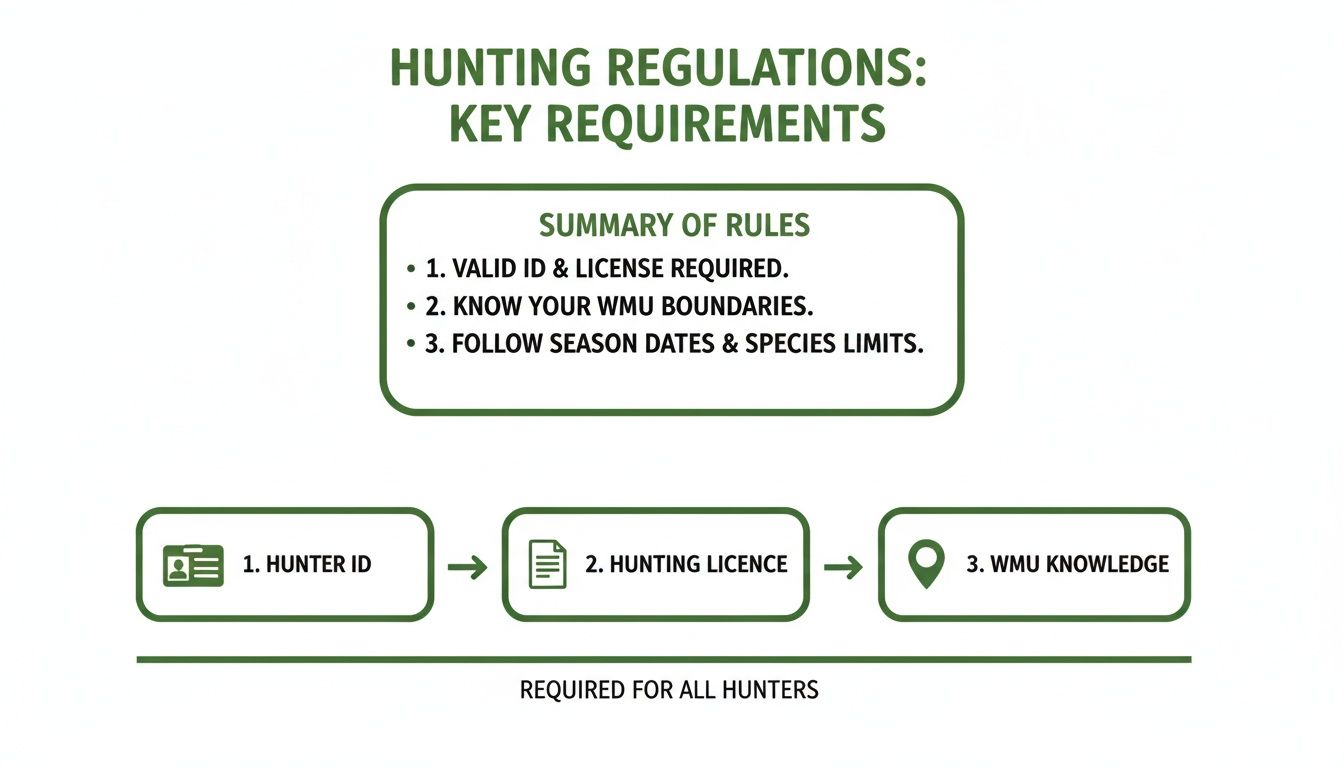
Think of it this way: your Outdoors Card, your small game licence, and knowing your exact WMU boundaries are the three pillars of a legal and stress-free hunt.
Understanding the Hare Cycle
Here's something every Ontario hunter should know: Snowshoe hare populations run on a dramatic 8-11 year cycle. In peak years, there can be more than 1,000 hares per square kilometre. But when the population crashes, numbers can plummet to under 50 per km². This natural boom-and-bust causes hunter harvests to swing by as much as 80% and often pushes hunters to focus on other species like grouse.
You can see the full breakdown in the official 2020 survey of small game hunting in Ontario.
Why does this matter to you? If you head out and aren't seeing any hares, it might not be your fault—you could just be in a low cycle year. Being aware of this rhythm helps you set realistic expectations and adapt your strategy. Instead of getting frustrated looking for hares, you might have a much better day switching gears to hunt for grouse.
Field-Proven Techniques for Small Game Success
Knowing a grouse lives in that aspen stand is one thing; knowing how to get a shot at it is something else entirely. This is where real fieldcraft takes over. The most effective ways to hunt small game in Ontario aren't complicated or high-tech—they're simple, time-tested methods built on patience, keen observation, and a solid understanding of how these critters think.
Success out here isn't about covering the most ground. It’s about covering the right ground in the right way. It’s about learning to slow down, to really use your eyes and ears, and to put yourself in the mindset of the game you’re after. Let's get practical and talk strategy for Ontario's most popular species.
The Art of the Grouse Walk
The classic way to hunt ruffed grouse is the "walk-up," sometimes called a "still-hunt." On paper, it's simple: you walk through the woods until a bird flushes. But there’s a real art to doing it well. The whole game is about moving with purpose and using the landscape to your advantage.
The single biggest mistake I see hunters make is walking way too fast. You need to adopt a "stop-and-go" rhythm. Walk for maybe 20-30 metres, then stop dead silent for a full minute. This unsteady cadence does two things: first, it makes you sound less like a human predator and more like another critter just meandering through the woods. Second, that sudden silence often rattles a hidden grouse, making it lose its nerve and flush.
- Hunt the Edges: Don't just wander aimlessly. Focus your efforts along habitat edges—where a thick young aspen stand crashes into a mature hardwood forest, or along the shoulders of an old, overgrown logging trail. These transition zones are prime real estate for grouse.
- Zigzag Through Cover: When you get into a promising patch of thick cover, fight the urge to walk a straight line. By slowly zigzagging, you cover the area far more thoroughly and give yourself different angles to spot a bird that would otherwise go unnoticed.
Tactics for Rabbits and Hares
Hunting cottontails and snowshoe hares calls for a different approach. Grouse often sit tight, but a rabbit is built for one thing: speed. They rely on diving into the thickest, nastiest cover they can find to escape. Your job is to convince them to leave it.
For the solo hunter, a slow, methodical push through a briar patch or a tangle of dogwood is your best bet. Just like with grouse, the stop-and-go technique is golden. A rabbit will often hunker down, hoping you'll walk right on by. But when you stop, the silence gets to them, and they'll often explode from their hiding spot.
Hunter's Tip: There is no better advantage than a fresh blanket of snow. A set of fresh hare tracks is a roadmap. Follow them, and they’ll lead you straight to their favourite feeding areas and daytime hiding spots, which are usually tucked under the low-hanging boughs of a dense spruce or balsam fir.
Working with a partner or a small group can be incredibly effective. One or two hunters can act as "beaters," moving slowly through a patch of cover to push rabbits toward a "poster" who is waiting quietly and ready at the far end. Just remember, safety and crystal-clear communication are non-negotiable for this method.
Bringing in the Dogs
For centuries, hunters have worked alongside dogs, and for very good reason. A well-trained hunting dog can be a total game-changer, dramatically boosting your odds for both birds and rabbits.
- Flushing Dogs (e.g., Spaniels): These dogs are pure energy, working close to you and diving headfirst into the thick stuff to "flush" birds into the air for a shot.
- Pointing Dogs (e.g., Setters, Pointers): Perfect for more open country, these dogs will lock up and "point" when they scent a bird, freezing in place to show you exactly where it's hiding.
- Hounds (e.g., Beagles): When it comes to rabbits and hares, nothing beats the music of a beagle hot on a track. They use their incredible noses to find a scent and will chase the rabbit, often running it in a big circle right back to you.
Marking Your Success for Future Hunts
Finding a honey hole full of game is a fantastic feeling, but being able to find it again next year is even better. This is where a little modern tech comes in handy. When you flush a covey of grouse or kick up three rabbits from one thicket, don't just bank it to memory.
Pull out your phone and use an app like HuntScout to drop a waypoint right on your map. You can give it a quick label like "Grouse Covey" or "Rabbit Thicket" and add a note about the date or weather. Over a few seasons, you’ll build an invaluable personal map of proven spots, turning a lucky day into a reliable go-to for years to come. Every trip becomes an investment in your future success.
Gearing Up for Your Ontario Small Game Hunt
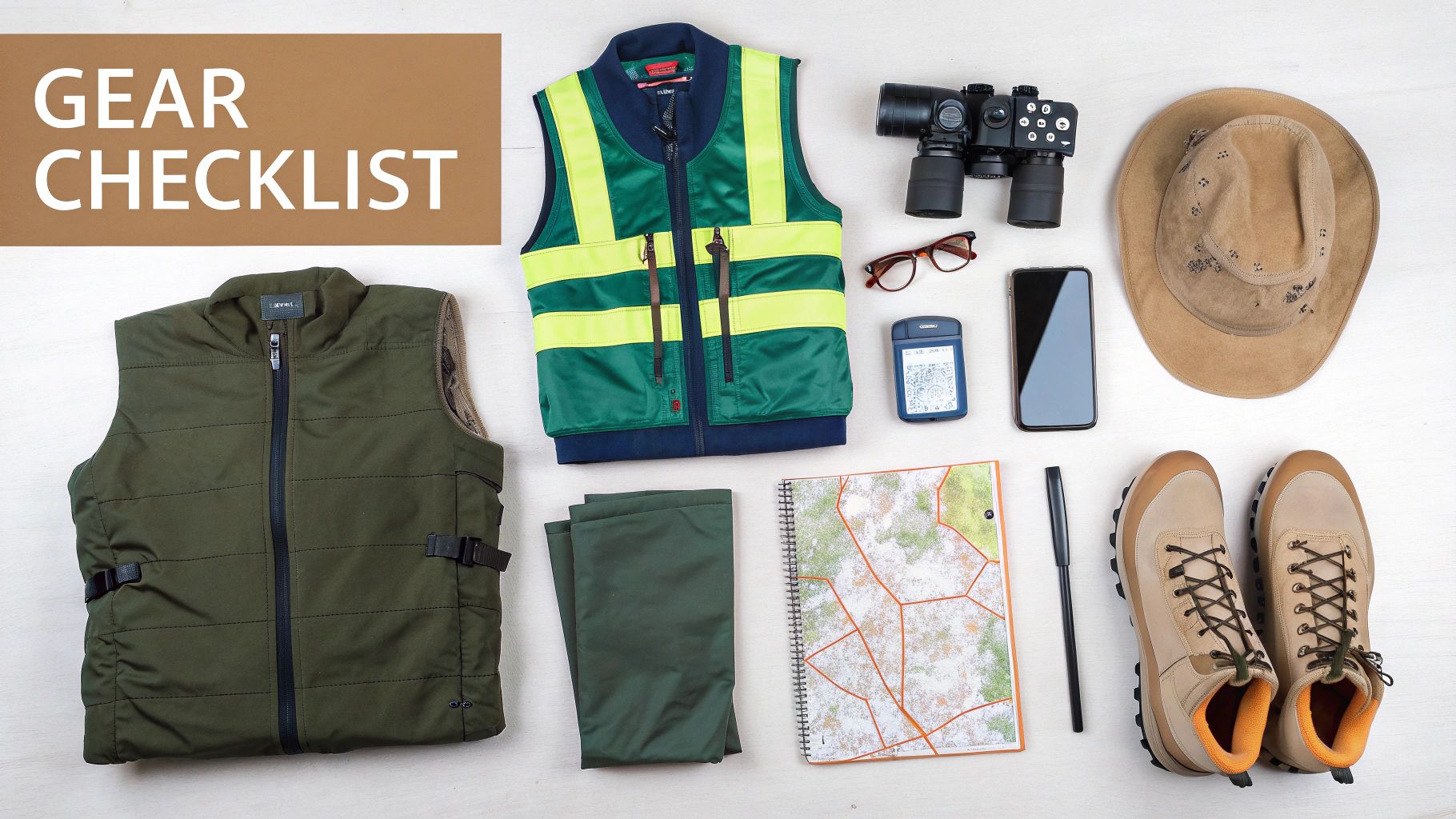
Any seasoned hunter will tell you that success often comes down to what you pack. It’s not about having the latest and greatest gadgets, but about being prepared. Think of your gear as your support system—the tools that keep you safe, comfortable, and ready when an opportunity arises.
A good day in the Ontario bush starts long before you step out of the truck. It begins with a well-thought-out kit. Let's break down the absolute must-haves, from your firearm to the boots on your feet, so you can focus less on your pack and more on the hunt itself.
Your Firearm: The Core of Your Kit
When it comes to small game in Ontario, you really only need to choose between two main types of firearms. The right one for you simply depends on what you're chasing—fast-flushing grouse or ground-hugging rabbits.
For moving targets, a versatile shotgun is almost always the best bet.
- 12-Gauge Shotgun: This is the undisputed workhorse for a reason. With a massive range of available loads, it's just as effective on grouse in heavy cover as it is on pheasants breaking from a field edge.
- 20-Gauge Shotgun: A fantastic alternative. It’s lighter, making those long walks much easier, and the reduced recoil is a welcome feature for many hunters. It still packs more than enough punch for any small game you'll encounter.
If you’re after stationary game, a rimfire rifle offers surgical precision.
- .22LR Rifle: For squirrel or rabbit hunting, the classic .22 Long Rifle is tough to beat. It’s quiet, incredibly accurate, and the ammunition is cheap and easy to find. It’s the perfect tool for making a clean, ethical shot.
Safety First: It doesn’t matter what you carry; safety is non-negotiable. Always treat every firearm as if it's loaded, maintain muzzle control, and be 100% certain of your target and what lies beyond it.
Dressing for the Ontario Wilderness
Ontario’s weather is notoriously fickle, especially in the fall. One minute it’s crisp and sunny, the next you’re dealing with a cold wind or a sudden squall. Dressing in layers isn't just a good idea—it's essential for staying safe and comfortable.
A proper layering system lets you adapt on the fly, shedding a layer during a strenuous hike and adding one back on when you stop to sit.
- Base Layer: This is what’s next to your skin. You want something that wicks sweat away, like merino wool or a quality synthetic fabric. Steer clear of cotton—it traps moisture and will leave you chilled to the bone.
- Mid Layer: This is your insulation. A fleece jacket or a light puffy vest is perfect for trapping your body heat and keeping you warm.
- Outer Layer: This is your shield against the elements. A good waterproof and windproof jacket and pants are must-haves for blocking wind, rain, and snow.
And here’s the most important piece of clothing you’ll wear: blaze orange. For most seasons, Ontario law requires you to wear a solid blaze orange hat and vest, visible from all directions. This isn't a suggestion; it's a critical piece of safety gear that helps other hunters see you.
Essential Accessories for the Field
With your firearm and clothing sorted, a few more items will make your hunt much more enjoyable and safe. These are the things that turn a simple walk in the woods into a well-prepared outing.
Your navigation tools are your lifeline. A map and compass are classic, but modern apps offer a huge advantage. The HuntScout app is particularly useful because its offline maps and WMU boundaries work perfectly even when you have zero cell service—a common reality in Ontario’s best hunting spots.
Here are a few other must-haves for your pack:
- Reliable Hunting Knife: For quickly and cleanly field dressing your harvest.
- First-Aid Kit: A small, lightweight kit can be a lifesaver for minor cuts and scrapes.
- Game Bag or Vest: A hunter’s vest with a built-in game pouch is the most convenient way to carry your game.
- Water and Snacks: Staying hydrated and energized is key to staying sharp.
- Headlamp or Flashlight: Don’t get caught in the dark. A good light source is crucial if you’re hiking out at dusk.
Thinking of bringing a four-legged partner along? A good dog can transform a hunt. Check out our guide on the best hunting dog breeds to find the right companion for your style.
Planning Your Hunt with Modern Technology
The best hunts are rarely a matter of luck; they’re won or lost long before you lace up your boots. These days, solid planning with the right tech is just as crucial as your marksmanship. Digital tools have completely changed the game for preparing a small game hunting ontario trip, making the whole process safer and way more effective.
We've moved on from creased paper maps to powerful apps that let you scout, plan, and navigate with a precision our grandfathers could only dream of. It’s all about working smarter, not just harder.
Digital Scouting From Home
Let's say you’ve got your eye on hunting grouse in WMU 76B, but you have no idea where to even start. With an app like HuntScout, you can pull up a high-resolution satellite map of the entire unit without leaving your couch. You can digitally "walk" the landscape, scanning for those tell-tale signs of prime habitat—like the young, dense aspen stands bordering mature forests or those overgrown logging roads that grouse absolutely love.
This screenshot from the HuntScout app shows how Crown Land and WMU boundaries are laid out crystal clear over a satellite map.
This kind of visual intel is a game-changer. It helps you pinpoint promising areas and figure out access points before you’ve spent a single dollar on fuel.
Once you’ve found a few spots that look good, you can drop digital waypoints right on them. Add some notes for yourself, like "Thick aspen, looks like good grouse cover" or "Potential rabbit thicket near the creek." You're essentially building your own personal database of hotspots, turning what used to be hours of guesswork into a focused, efficient game plan. This e-scouting gives you a massive head start, so you show up on hunt day with a clear strategy.
Pro Tip: Keep an eye out for "edge" habitat on the satellite map. These are the places where different types of terrain meet up—think a farmer's field butting up against a dense woodlot, or a swampy patch connecting to high ground. These transition zones are absolute magnets for all kinds of small game.
Offline Maps Are Non-Negotiable
This is a big one, and it's all about safety. Most of Ontario’s prime hunting territory has zero cell service. If you’re relying on a live internet connection for your maps, you're not just taking a risk—you're practically asking to get turned around. This is exactly why offline maps are a must-have for any serious hunter.
Before you even head out the door, you can download all the map layers you'll need for your WMU straight to your phone. This should include:
- Topographic maps so you can see the lay of the land and any changes in elevation.
- Satellite imagery to get a real look at the ground cover.
- Crown Land and WMU boundaries to make absolutely sure you're hunting where you're legally allowed to be.
With these maps saved on your device, your phone’s built-in GPS will still pinpoint your exact location on the map, even when you're completely off-grid. This means you can navigate unfamiliar woods with confidence, find your way back to those spots you marked, and, most importantly, get back to your vehicle safely at the end of the day. For a deeper dive, check out our guide on finding and using Ontario Crown Land maps for hunting.
Answering Your Top Questions About Small Game Hunting in Ontario
Getting into small game hunting in Ontario is exciting, but it's natural to have a few questions bubble up, especially when you're just starting out. Let's tackle some of the most common ones so you can head out with confidence.
Do I Need a Different Licence for Every Animal I Hunt?
Thankfully, no. For most of the classic small game critters—think grouse, rabbits, and squirrels—your standard Small Game Licence and Outdoors Card are all you need.
But, and this is a big but, some species are special cases. If you're hoping to hunt wild turkey or migratory birds like ducks and geese, you'll need separate licences, tags, and even a federal permit for the waterfowl. The best habit to get into is checking the official Ontario Hunting Regulations Summary before every season.
Can I Hunt on Any Crown Land I Find?
This is a common misconception that can get a hunter into hot water. While Ontario has a massive amount of Crown Land, you can't just hunt on all of it.
Some areas are designated as provincial parks where hunting is a no-go, while other parcels have specific land use rules that restrict it. The bottom line is, it's always your responsibility to know exactly where you are and if you're allowed to be there.
Pro Tip: Never assume a piece of land is fair game. Modern mapping tools are a lifesaver here. An app like HuntScout will show you precise Crown Land boundaries, taking all the guesswork out of staying legal.
When’s the Best Time of Year to Go?
The "best" time really comes down to what you're chasing. Autumn, from September through November, is prime time for most species. The leaves are off the trees, which makes spotting a ruffed grouse a whole lot easier.
However, if you're after snowshoe hare, the game changes. Winter becomes your best friend. A fresh blanket of snow makes their tracks pop, turning the hunt into an exciting pursuit. Just remember that all season dates are tied to your specific Wildlife Management Unit (WMU), so what's open in one area might be closed in another.
Planning your next hunt is easier than ever with the right tools. HuntScout provides detailed Crown Land maps, WMU boundaries, and offline navigation to keep you safe and legal. Download it for free at https://huntscout.app.