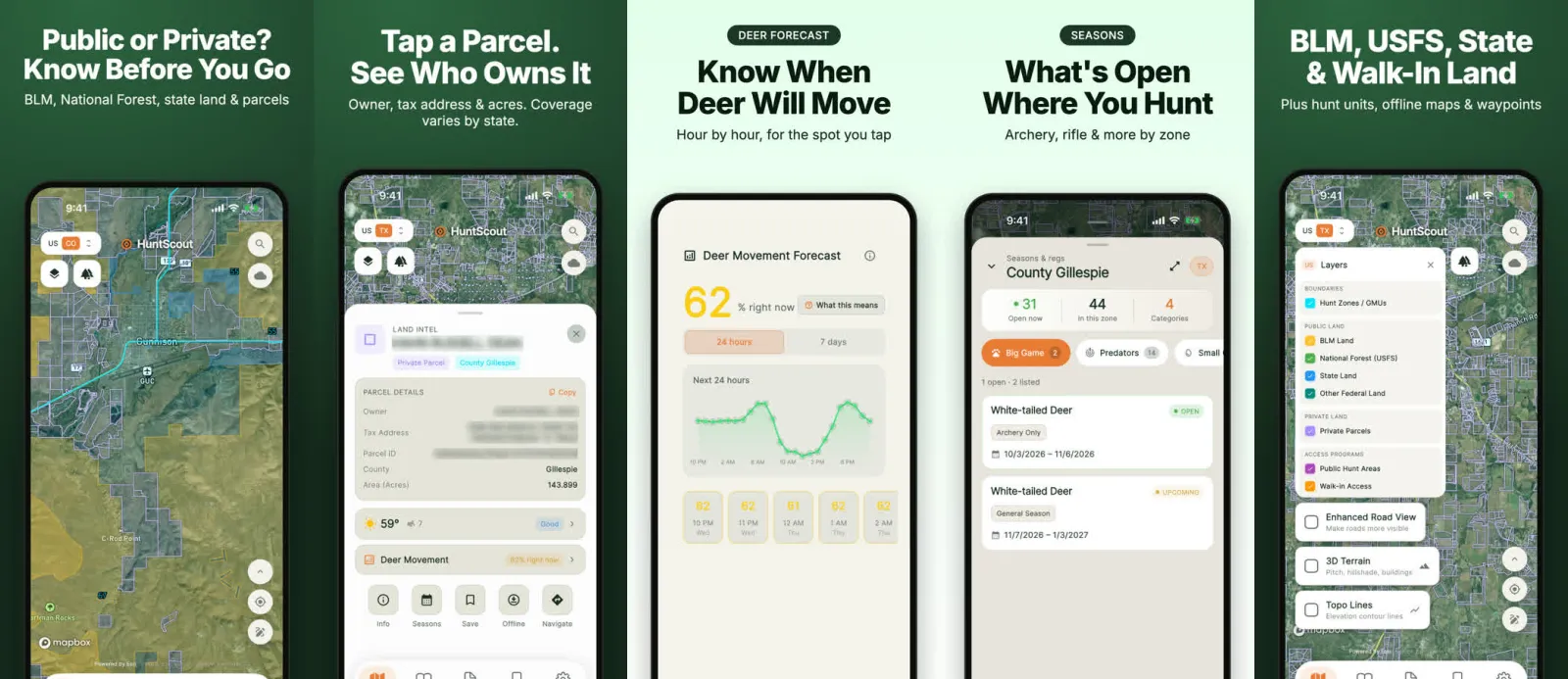
Quick answer: The reliable way to tell public from private land in the field is a GPS map app that shows land ownership. Open HuntScout, and your blue dot sits on the map with BLM, national forest and state land shaded (free); HuntScout Pro adds private parcel lines with the owner's name, mailing address and acreage in most US states, plus offline maps for places with no signal. Signs and fences help, but they are often missing, and in many states unmarked private land is still off limits. When in doubt, check the county parcel record or ask the owner before you go in.
Disclosure: HuntScout publishes this blog. Trespass rules differ by state; always check your state's hunting regulations.
1. Check a land map with your GPS position
Paper maps and the "it looked like public land" guess are the main ways hunters end up on the wrong side of a line. A phone map that shows land ownership solves that:
- Before the hunt, open the map, turn on public land and (if you have it) private parcels, and look at the edges of the piece you plan to hunt. Public land often has private in-holdings and corners.
- Save waypoints at the access point and along the boundary you care about.
- In the field, check your blue dot against the boundary before you shoot or follow a wounded animal across a line.
- Download the area offline if there is no cell service where you hunt.
In HuntScout, tapping a spot shows what it is: BLM, national forest, state land or a private parcel, with owner details on private parcels in HuntScout Pro (coverage varies by state).
2. Read the signs on the ground
- Posted signs. "No hunting" or "No trespassing" signs mark private land, but many owners never post.
- Paint marks. A number of states, including Texas and Missouri, treat purple paint on trees or posts as a legal no-trespassing notice. Other states use orange paint. Check what your state recognizes.
- Fences and gates. A fence is not always the property line, and an open gate is not permission.
- Public land signs. BLM and Forest Service land is often marked with brown boundary signs or carsonite posts at corners, but not everywhere.
The safe rule: no sign does not mean public. In many states you need permission to hunt private land whether or not it is posted.
3. Confirm with official records
- BLM and national forest: the BLM and Forest Service publish their own land status maps; they are the official source for closures and road access.
- State land: your state wildlife agency's hunting atlas shows wildlife areas and any special rules.
- Private land: the county assessor or GIS parcel viewer lists the owner of record. HuntScout Pro shows the same owner information across counties on one map.
4. Get permission for private land
Once you know who owns a parcel, ask before the season: a polite letter, a knock on the door, or a call. Offer to help with chores, tell them when you will be there, and follow their rules on vehicles and guests. Written permission is worth carrying; some states require it.
5. If you end up on the wrong side
Stop, check the map, and leave the way you came. If a wounded animal crosses onto private land, rules on retrieval differ by state; contact the landowner or a game warden instead of following it in.
Frequently asked questions
What app shows if land is public or private?
HuntScout shows BLM, national forest and state land free, and HuntScout Pro adds private parcels with owner names in most US states, so you can see which side of a boundary you are on from your GPS position. onX Hunt and HuntStand also show land ownership.
Is unposted land open to hunting?
Not necessarily. In many states you need the owner’s permission to hunt private land whether or not it is posted. Check your state’s hunting regulations.
What does purple paint on a tree mean?
In states with a purple paint law, such as Texas and Missouri, purple paint marks on trees or posts mean no trespassing, the same as a posted sign.
How do I find out who owns land so I can ask permission to hunt?
Look up the parcel in the county assessor or GIS parcel viewer, or tap the parcel in HuntScout Pro to see the owner name, mailing address and acreage in most US states.