Quick answer: To hunt on public conservation land in New Zealand you need a hunting permit from the Department of Conservation (DOC). The standard open hunting permit is free, lasts 12 months and is issued online (apply here). You need an email address, and you can show the permit on your phone. Every hunting area has a status: open areas follow the standard permit conditions, restricted areas have their own conditions (ask the nearest DOC office), and prohibited areas are closed to hunting. Before you go, read the DOC page for the block you plan to hunt for its dates, dog rules and access over private land.
New Zealand has some of the most generous public hunting in the world: no closed season on red, fallow and sika deer or chamois, and no bag limits on them. The trade-off is that the rules live at the block level. This guide explains how the permit system works and how to read a block before you commit to a trip.
What is a DOC hunting permit?
A DOC hunting permit is your authority to hunt on public conservation land: national parks, forest parks, conservation areas and other land DOC manages. DOC's rules for hunting on public conservation land put it simply: to hunt on public conservation land you must get a hunting permit from DOC.
The permit is not a firearms licence. If you hunt with a firearm you also need a current New Zealand firearms licence, and game birds need a Fish & Game licence on top (see below).
Types of permit
| Permit | Covers | How to get it |
|---|
| Open hunting permit | Open hunting areas, under the standard conditions plus any special conditions for the area | Online, free, valid 12 months |
| Restricted area permit | Areas with their own conditions (for example limited numbers, set dates or block bookings) | Contact the DOC office nearest the area |
| Roar block and ballot permits | Balloted or booked blocks during the roar | Through the ballot or booking system for that area |
| Dog and game bird permits | Hunting with dogs where they're allowed, and game birds on conservation land | See DOC's permits page or your local office |
How to get a DOC hunting permit online
- Go to DOC's online hunting permit system.
- Pick all regions or just the area you want to hunt.
- Create an account (useful for renewals) or continue as a guest. Either way you verify your email address.
- The permit is emailed to you. You don't need to print it: DOC accepts an electronic copy on your phone.
If you don't have an email address, call DOC and they will issue a permit another way. Details are on DOC's open hunting permit page.
Because the permit lasts 12 months, the simplest habit is to renew it once a year before the roar.
Open, restricted and prohibited hunting areas
DOC publishes its hunting areas as a national dataset: about 1,900 areas (DOC data, October 2026), each with a status.
- Permitted (open): Hunt under the standard permit conditions. Some open areas add special conditions, such as no-hunting zones near a road end or a limit on dogs.
- Restricted: Area-specific conditions apply. DOC's advice is to contact the nearest DOC office for details.
- Prohibited: No recreational hunting. These are often around towns, high-use tracks or sensitive sites.
There are also Recreational Hunting Areas, where DOC manages the herd for recreational hunters rather than for commercial recovery. You still need a permit to hunt them.
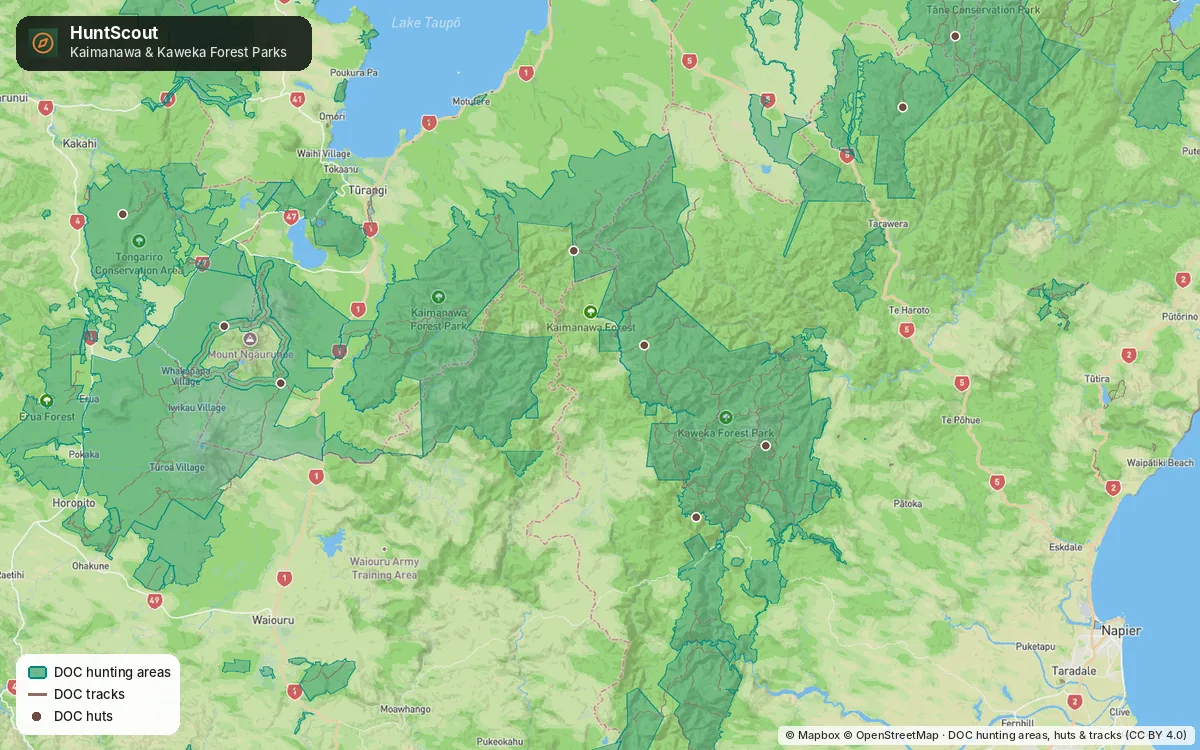 Kaimanawa and Kaweka Forest Parks in HuntScout: DOC hunting areas, huts and tracks. Sika deer are found here.
How to read a DOC hunting block page
Every hunting area has a page on the DOC website. Before you commit to a trip, read four things on it:
- Permit type. Open permit, restricted permit, or a block booking or ballot.
- Date conditions. Most open areas have no closed season, but some close for the roar, for research, for aerial operations or for a ballot period.
- Dog conditions. Dogs are banned in many areas (national parks especially), allowed under a dog permit in others, and limited in number in some. Never assume.
- Access conditions. Many blocks have no legal public access and can only be reached across private land. DOC is clear that you need the landowner's permission to cross private property to reach public conservation land if there's no public access.
DOC also lists special conditions, such as firearm restrictions near particular huts or tracks, and closed zones within an open block.
Standard conditions that apply everywhere
From DOC's rules for hunting on public conservation land:
- No hunting in darkness, from 30 minutes after sunset to 30 minutes before sunrise. Spotlights are not allowed for hunting at night.
- No shooting near people. Don't discharge a firearm near tracks, huts, campsites, road ends or other public places, or within 500 m of Great Walks huts and tracks.
- Store firearms safely in camp, with the bolt and ammunition kept separate from the firearm.
The full list is in the standard permit conditions attached to your permit. Read them once a year.
The roar: ballots and booked blocks for 2027
During the roar (roughly March to April) some popular red deer areas switch to a block system, so one party has a block for a set period. Dates for the 2027 roar, from DOC:
| Ballot | Blocks and dates | Applications |
|---|
| Haast | 65 restricted red deer blocks, one party per block for 7 days, 21 March to 17 April 2027 | Closed 28 September 2026. Results were sent by 12 October; confirmation forms close 26 October 2026. $40 per application. |
| Wānaka | 50 blocks, one party per block per 7-day period, 21 March to 17 April 2027 | Close Saturday 31 October 2026. Results by email by the end of November, a second-chance draw in December, then first come, first served in January 2027. No fee. |
| Molesworth | 20 blocks, 10 March to 13 April 2027 | Open 1 October to 30 November 2026, through the DOC hunting permit system. Draw 6 December; confirm by 13 December 2026. |
| Fiordland wapiti | The Wapiti Area in Fiordland National Park is balloted for the rut, 1 March to 30 April | See DOC and the Fiordland Wapiti Foundation. Outside the rut you need a specific permit. |
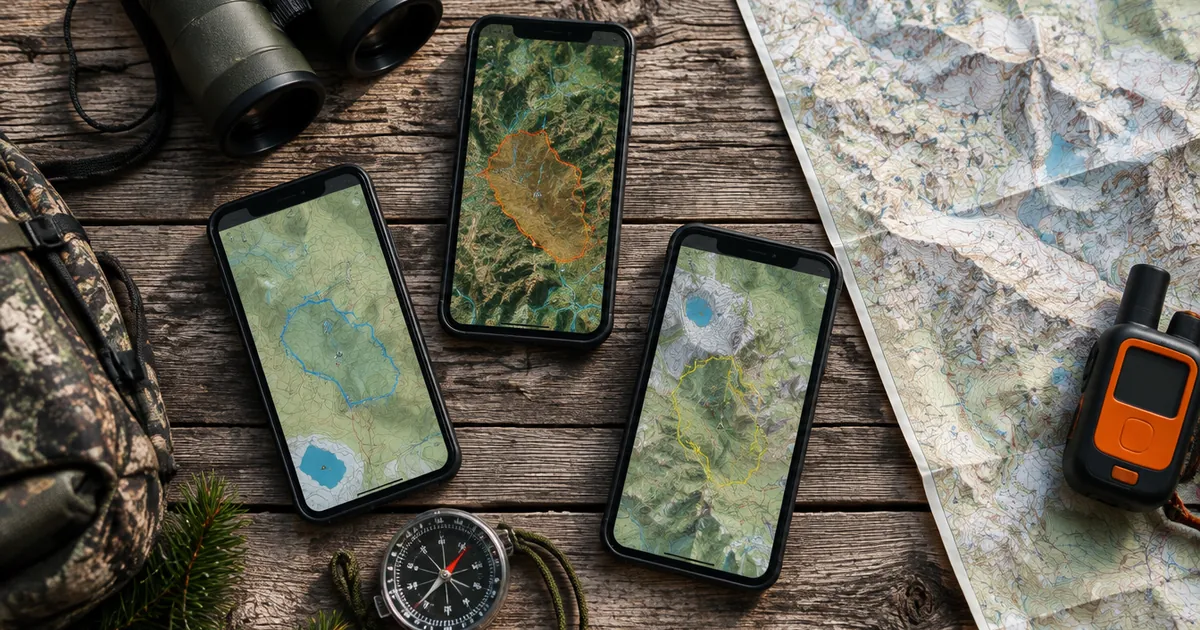
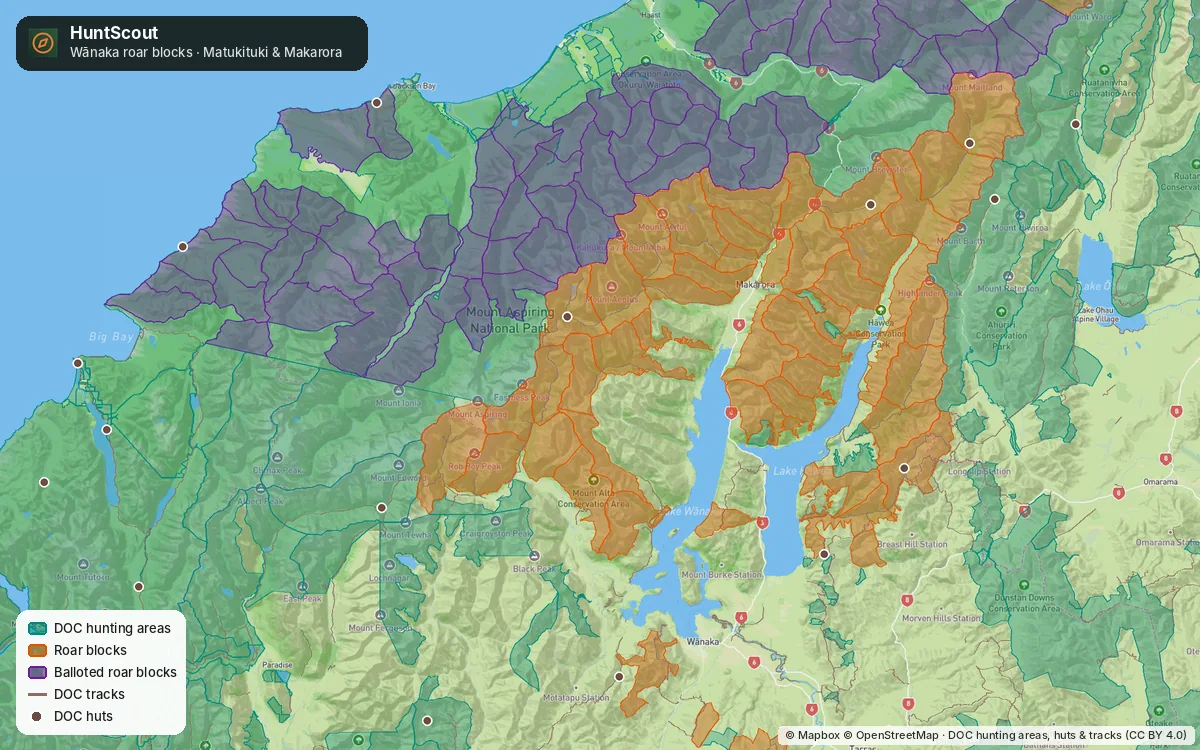 Roar blocks (orange) and balloted roar blocks (purple) around Wānaka and Makarora in HuntScout. A block on the map is not a ballot win.
Viewing DOC permit areas in HuntScout
HuntScout loads DOC's national hunting area layer and colours it three ways: hunting areas, roar blocks and balloted roar blocks. Tap any area to see:
- its status (permitted, restricted or prohibited), block type and permit area
- DOC's date, access, dog and special conditions for that area, where DOC has filled them in (many say "refer to DOC website")
- a link straight to that block's DOC page, or to the DOC permits page if the block has none
DOC huts, tracks and campsites are on the same map and free for everyone. The hunting area layers are part of Australia & NZ Pro. You can download a region for offline use before you leave reception.
Two honest limits. First, the map is not your permit. You still need the DOC permit and any ballot or booking. Second, DOC edits its data from time to time; if the map and the DOC block page disagree, the DOC page wins.
For trip planning by island and species, read our where to hunt in New Zealand guide.
Offline maps and safety
Much of New Zealand's best hunting country has no mobile coverage. Before you leave:
- Download your maps for the whole area, including the walk in and a buffer around it.
- Carry a personal locator beacon (PLB) or a satellite messenger such as a Garmin inReach. A phone is not a rescue device.
- Leave your intentions with someone you trust, including your route, your block and when to raise the alarm.
- Check the weather and river levels. Plan an alternative if a crossing is up.
- Identify your target beyond doubt. Treat every firearm as loaded.
Game birds are different
Ducks, paradise shelduck, pheasant, quail and other game birds are managed by Fish & Game, not DOC. You need a Fish & Game game bird licence, and seasons and bag limits differ across the 12 Fish & Game regions. On conservation land you also need a DOC permit. Canada geese are not a game bird under the Wildlife Act, so no game licence is needed, but a DOC permit is still required on conservation land. See our NZ hunting seasons page for dates by region.
Get the DOC map on your phone
HuntScout shows DOC hunting areas, roar blocks, huts and tracks on one offline map, with each block's conditions a tap away.
More in this series: HuntScout in Australia and New Zealand · Best hunting apps in Australia and NZ
Last checked: 15 October 2026, against DOC's hunting permit, rules and roar ballot pages. DOC conditions, ballot dates and area statuses change. Always confirm on the DOC website or with the local DOC office before you hunt.
Frequently asked questions
How much does a DOC hunting permit cost?
The open hunting permit is free and lasts 12 months. Some roar ballots charge an application fee; the Haast roar ballot, for example, charged $40 per application for 2027. See DOC's open hunting permit page.
How do I get a DOC hunting permit online?
Use DOC's online hunting permit system. Pick all regions or one area, create an account or continue as a guest, and verify your email. The permit is emailed to you and you can show it on your phone.
Where can I hunt on DOC land?
Anywhere DOC lists as an open (permitted) hunting area, under your permit conditions. Restricted areas need a specific permit or booking, and prohibited areas are closed. Check the DOC page for the block, or tap the area in a map app that loads DOC's hunting area layer, such as HuntScout or NZ Topo Maps.
Can I take my dog hunting on DOC land?
Only where the area's dog conditions allow it, and usually with a dog permit. Dogs are not allowed in many areas, including most national parks. Check the dog conditions on the block's DOC page before you go.
Do I need a DOC permit to hunt during the roar?
Yes. You need a DOC permit year-round. Some areas also run roar blocks during March and April that you can only hunt with a ballot win or booking, such as Haast, Wānaka and Molesworth.
Can I cross private land to reach a DOC hunting block?
Only with the landowner's permission. DOC says you need to get permission from the landowner to cross private property to reach public conservation land if there is no public access.